BAKU, Azerbaijan, August 8. A year ago, on
August 8, 2025, an event took place in Washington that can already
be considered one of the most significant in the modern history of
the South Caucasus. With U.S. mediation, Azerbaijan and Armenia
took a step that just a few years ago seemed virtually impossible:
after more than three decades of conflict, the two sides agreed to
peace and began building a new model of relations.
Over the past twelve months, the region has changed
significantly. Peace has been effectively established between
Azerbaijan and Armenia, the process of delimiting the state border
continues, meetings are held regularly at various levels, and
political dialogue is developing. For the first time in many years,
transport routes have begun to function: supplies are being sent
from Azerbaijan to Armenia, as well as cargo transiting through
Azerbaijan to Armenia.
All of this testifies to a gradual transition from an era of
confrontation to a stage of practical cooperation. Moreover, these
ongoing changes are impacting not only the bilateral relations
between Baku and Yerevan, but also the transportation, economic,
and geopolitical architecture of the entire region.
Washington summit: beginning of new era
It's important to remember how this process began. After the
war, it was Azerbaijan that initiated the transition from military
confrontation to a political settlement. The architect of this
peace process was President of Azerbaijan Ilham Aliyev, who
consistently translated the victory achieved on the battlefield
into the political realm and laid a concrete foundation for
establishing a long-term peace.
Azerbaijan was the first to formulate five fundamental
principles for normalizing relations with Armenia:
- Mutual recognition by states of each other's sovereignty,
territorial integrity, inviolability of their international
borders, and political independence;
- Mutual confirmation of the absence of territorial claims
against each other and the acceptance of a legal obligation not to
make such claims in the future;
- Refraining from threatening each other's security in
interstate relations, the use of threats and force against
political independence and territorial integrity, and other
circumstances inconsistent with the purposes of the UN Charter;
- Delimitation and demarcation of the state border,
establishment of diplomatic relations;
- Opening of transport and communications, construction of other
relevant communications, and establishment of cooperation in other
areas of mutual interest.
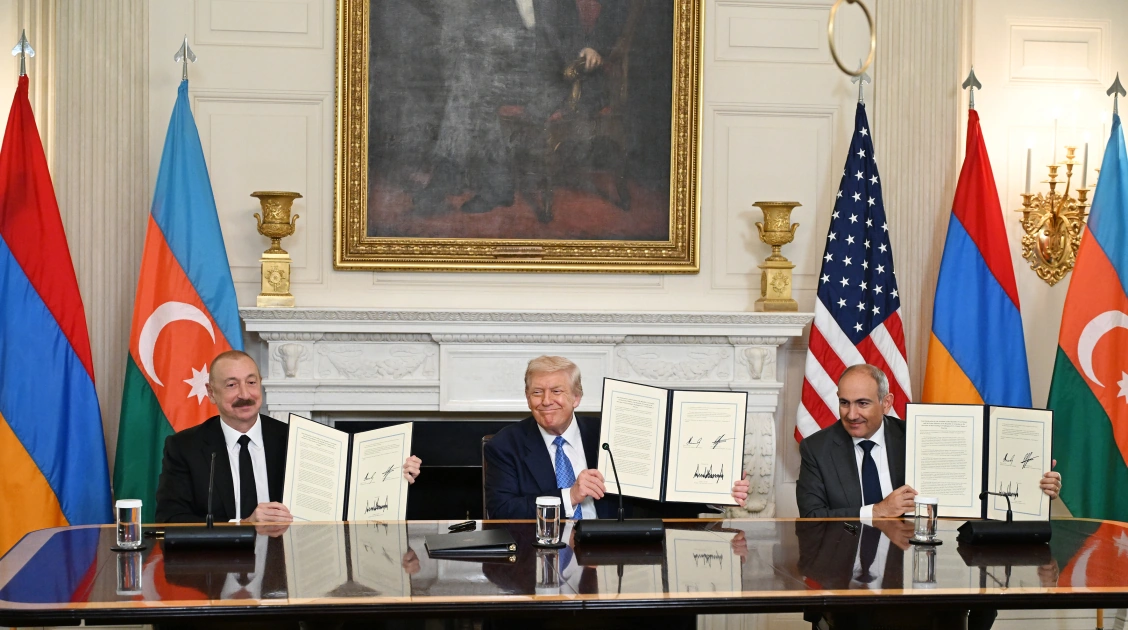
On August 8, 2025, following a trilateral meeting between
President of Azerbaijan Ilham Aliyev, Armenian Prime Minister Nikol
Pashinyan, and U.S. President Donald Trump, a Joint Declaration was
signed on ensuring peace between Azerbaijan and Armenia and
restoring transport links between the mainland of Azerbaijan and
Nakhchivan. The project was named the Trump Route for International
Peace and Prosperity.
At the same time, the Foreign Ministers of Azerbaijan and
Armenia, Jeyhun Bayramov and Ararat Mirzoyan, initialed the draft
"Agreement on the Establishment of Peace and Interstate Relations
between the Republic of Azerbaijan and the Republic of Armenia" and
signed a joint appeal to the OSCE Chairperson-in-Office regarding
the termination of the OSCE Minsk Process, the institution of the
Personal Representative of the OSCE Chairperson-in-Office, and the
High-Level Planning Group.
The Washington summit was more than just a diplomatic event. It
marked the final transition from years of conflict negotiations to
the practical implementation of a peace agenda. For the first time
in many years, the focus was not on finding a settlement formula,
but on issues of cooperation between the two states after reaching
fundamental agreements.
As President of Azerbaijan Ilham Aliyev said in an interview
with local TV channels on Jan. 5, 2026, after decades of living in
war, Azerbaijan has begun to learn "what it is like to live in
peace."
"We are learning what it is like to live in peace since after
gaining independence, and even before that, the people and the
state of Azerbaijan lived in a state of war. There were different
stages of the war. You remember that well. The active stage of the
war, the stage of the ceasefire, the Second Karabakh War, the
anti-terrorist operation, the period that followed it – all these
events ended in August of last year. In other words, Azerbaijan has
put a political seal on the brilliant Victory it achieved on the
battlefield and, as I mentioned, we did it in the world's number
one office. This, of course, will be one of the most memorable
events in the history of our independence, perhaps among the first
of them. From this point of view, the past year can be regarded as
a very successful and historic year for our country, for our
people, and I am sure that from now on the people of Azerbaijan
will live in peace. Although we have been living in these
conditions for only five months, we are already seeing the fruition
of this – both on the political and economic planes. There is an
upbeat mood in society, there is greater confidence in stability
and security. All these factors, of course, have enabled us to
successfully move forward and continue to address all the tasks
facing the country," the head of state said.
It's significant that the practical value of the new reality is
gradually being recognized in Armenia as well. Prime Minister Nikol
Pashinyan, assessing the consequences of the end of the 35-year
conflict, stated that peace with Azerbaijan is precisely what
Armenia lacked to preserve and develop its independence.
According to Pashinyan, peace has been established between
Armenia and Azerbaijan, and, as he noted, "there is no more
reliable guarantee of security than peace."
The changes that have taken place are gradually being perceived
not only as the result of specific diplomatic agreements, but also
as a long-term necessity for both countries.
Elimination of ineffective mechanism
The practical implementation of the agreements reached in
Washington began immediately.
On August 11, 2025, Azerbaijan and Armenia jointly appealed to
the OSCE Secretary General with a request to dissolve the Minsk
Group. The full text of the peace agreement between the two
countries was published that same day.
A few months later, on December 1, 2025, the OSCE officially
terminated the Minsk Group, which had failed to achieve any
practical results in resolving the conflict for 30 years.
This decision effectively marked the end of the format
established in the 1990s. The closure of the Minsk Group was not
simply a procedural step, but a symbol of the end of an entire era
in the history of the conflict and a recognition that further
resolution would be carried out directly by the parties
themselves.
World beginning to work for economy
One of the most notable results of the first year after the
Washington summit was the gradual emergence of elements of economic
cooperation between Azerbaijan and Armenia.
On October 21, 2025, President of Azerbaijan Ilham Aliyev,
delivering a joint press statement with Kazakh President
Kassym-Jomart Tokayev, announced that Azerbaijan had lifted all
restrictions on cargo transit to Armenia that had been in place
since the occupation.
The first cargo to transit the new route was grain from
Kazakhstan. Since then, various products have been regularly
shipped to Armenia from Kazakhstan and Russia through Azerbaijan,
as well as from Azerbaijan.
An even more significant event was the supply of Azerbaijani
petroleum products to Armenia. As Armenian Prime Minister Nikol
Pashinyan previously stated, diesel fuel prices in his country had
fallen by 20% thanks to peace with Azerbaijan. He stated that
imports of petroleum products from Azerbaijan had broken the
decades-old monopoly in Armenia's fuel sector.
To date, more than 36,000 tons of grain, approximately 9,000
tons of fertilizer, 1,136 tons of propane, 133 tons of aluminum,
414 tons of anthracite, and 67,000 tons of timber have been
transited from Russia to Armenia through Azerbaijan. During the
same period, Azerbaijan exported approximately 15,000 tons of
diesel fuel, as well as approximately 5,000 tons of RON-92 and
RON-95 gasoline. Expanding the range of trade between Azerbaijan
and Armenia is also possible in the future.
Just a year ago, such logistics would have seemed practically
impossible. Today, transit traffic is becoming one of the most
visible manifestations of these changes. In essence, the South
Caucasus is gradually returning to its natural role as a transit
bridge between East and West, and transport is beginning to serve
as one of the main instruments for building trust between
neighboring states.
Dialogue becomes ongoing process
While for decades, any contacts between Azerbaijan and Armenia
took place exclusively within the framework of crisis diplomacy and
international mediation, a year after the Washington summit,
bilateral dialogue effectively became a permanent mechanism of
interaction.
A key role in this was played not only by direct contacts
between Baku and Yerevan, but also by the ongoing support of the
peace process by the United States.
As early as November 2025, U.S. Under Secretary of State for
Political Affairs Alison Hooker announced the launch of a special
working group to further support the peace process between
Azerbaijan and Armenia. Its task was not mediation in the
traditional sense, but rather to facilitate the implementation of
existing agreements and maintain sustainable negotiating
momentum.
At the same time, the parties began to gradually expand their
bilateral political dialogue.
One of the first practical humanitarian measures was
Azerbaijan's decision in January 2026 to transfer four convicted
individuals to Armenia: Vagif Khachatryan, Gevorg Sujyan, David
Davtyan, and Vicken Euljekjyan. The transfer was carried out in
accordance with the agreements reached between the parties and the
principles of humanism.
This step was further evidence that the normalization process
was gradually moving beyond purely political statements and
acquiring practical substance.
Leaders consolidate new momentum
Regular contacts between the leaderships of the two countries
were particularly important for maintaining the progress
achieved.
In February 2026, President of Azerbaijan Ilham Aliyev and
Armenian Prime Minister Nikol Pashinyan met in Abu Dhabi. Following
the meeting, the parties confirmed their intention to maintain the
positive momentum in the normalization process and emphasized their
commitment to developing a bilateral negotiating format without
returning to previous mechanisms of international mediation.
Equally significant was the agreement between the leaders to
explore opportunities for expanding trade and economic
cooperation.
Just a few years ago, such a formulation of the issue would have
seemed impossible. While previously meetings between Baku and
Yerevan focused exclusively on security issues and the consequences
of the conflict, now the economy, investment, transport links, and
joint projects are gradually beginning to take center stage.
This is evidence of a qualitative change in the nature of
relations between the two states.
Shortly after their meeting in Abu Dhabi, Ilham Aliyev and Nikol
Pashinyan met again in Washington, on the sidelines of the first
meeting of the Peace Council chaired by US President Donald Trump.
The presidents of Kazakhstan, Kassym-Jomart Tokayev, and
Uzbekistan, Shavkat Mirziyoyev, also joined the conversation,
underscoring the growing attention of the countries of the region
to the formation of a new cooperation architecture in the South
Caucasus.
On delimitation process
Over the past year, a number of delimitation commission meetings
have been held to discuss practical issues of delineating the state
border, conducting geodetic surveys, and preparing the relevant
documentation.
It's significant that the meetings were held in a constructive
atmosphere and concluded with joint statements from the parties,
something that would have been virtually unimaginable just a few
years ago.
In particular, following the thirteenth meeting of the
commissions in Aghveran, Armenia, the parties reaffirmed their
commitment to continuing the delimitation process and noted the
positive dynamics in the implementation of previously reached
agreements.
In July, it was announced that approximately 13 kilometers of
the state border between Azerbaijan and Armenia had already been
delimited, and demarcation work had also been completed in these
areas. Certain agreements were reached that the delimitation
process would continue from north to south.
TRIPP: from peace agreement to a new transport
reality
One of the most illustrative examples of how the achieved peace
is gradually being translated into concrete infrastructure projects
is the implementation of the Trump Route for International Peace
and Prosperity (TRIPP). If the Washington summit created the
political basis for restoring transport links, TRIPP is intended to
transform this agreement into physical infrastructure capable of
changing the region's transport map.
Speaking at the opening of the 4th Shusha Global Media Forum on
July 13, President Ilham Aliyev clearly outlined the broader
significance of the launch of TRIPP.
"Practical work on the ground will start, hopefully, this year.
So, this will completely change the connectivity map of the region.
This will lead to security in the South Caucasus. We need that
badly, and this will lead to cooperation in the South Caucasus in a
good spirit," the head of state said.
Although the project is being implemented directly between the
U.S. and Armenia, its significance cannot be viewed solely in a
bilateral context. The entry and exit points of the route are
located in Azerbaijani territory, so the American side regularly
informs Baku of the project's progress.
Physical construction work on the 42-kilometer section of the
Zangezur Corridor running through Armenia is expected to begin in
2026.
For its part, Azerbaijan is already fulfilling its obligations
at an accelerated pace. Construction of new railways and roads on
Azerbaijani territory is at a high level, and Baku expects both
routes to reach the Armenian border by early 2027.
It's significant that the potential of TRIPP is gradually
gaining recognition in Armenia itself. On June 7, the day of
parliamentary election, Prime Minister Nikol Pashinyan called the
project a game-changer and beneficial to all countries in the
region. According to him, TRIPP is beneficial not only to Armenia
and Azerbaijan, but also to Türkiye, Georgia, and Iran.
Practical preparations for the project's implementation have
already begun. In May, representatives of the American engineering
and consulting firm AECOM began surveying the TRIPP site in
Armenia. The AECOM team arrived in Yerevan on behalf of the US
State Department's Global Infrastructure and Investment Partnership
Fund.
Work on the project continued at the diplomatic level. On August
5 in Yerevan, Armenian Foreign Minister Ararat Mirzoyan discussed
the implementation of TRIPP with Ari Lightstone, Senior Advisor to
the US Special Envoy for Peace Missions. The parties emphasized
their interest in moving to the practical implementation of the
program on the ground in a short time.
It's worth noting that the American side highly appreciates the
importance of this route.
In an exclusive interview with Trend on the sidelines of Baku
Energy Week, U.S. Special Envoy for Peace Missions Aryeh Lightstone
said that the Trump Route for International Peace and Prosperity
has much greater potential than initially thought.
According to him, TRIPP was initially seen primarily as a way to
connect the bulk of Azerbaijan with Nakhchivan and ensure
sustainable peace between Azerbaijan and Armenia. However, it later
became obvious that the significance of the project was much
broader.
"Azerbaijan becomes a central focus going to the C5 (five
Central Asian countries), which is now the C6 (five Central Asian
countries plus Azerbaijan), and extending all the way to the west,"
the American special envoy noted.
In this sense, TRIPP is becoming a key element of the new model.
The road, which is intended to pass through Armenia and connect
Azerbaijan with Nakhchivan, is potentially becoming much more – a
link between the Caspian Sea, Central Asia, the South Caucasus, and
Western markets.
Trump's role in peace process and new era of
Azerbaijani-American partnership
The role of U.S. President Donald Trump deserves special
attention in the context of the results of the first year since the
Washington summit. In a broader sense, what has happened during
this period can be seen not only as a new stage in the
Armenian-Azerbaijani peace process, but also as the beginning of a
fundamentally new era in relations between Azerbaijan and the
United States.
For Baku, American participation became particularly significant
precisely because, at a crucial moment, Washington focused not on
maintaining the existing status quo, but on achieving a concrete
political outcome – peace between Azerbaijan and Armenia and
creating the conditions for its long-term consolidation.
In May 2026, Donald Trump himself, congratulating President
Ilham Aliyev on Azerbaijan's Independence Day, emphasized that the
United States continues to support lasting peace between Azerbaijan
and Armenia.
"We are encouraged by Azerbaijan's efforts to advance the peace
agreement you initialed last August, including the ongoing border
delimitation process, the release of four Armenian prisoners in
January 2026, fuel shipments to Armenia, and the Peace Bridge
initiative bringing together the two countries' civil societies,"
the U.S. President emphasized.
At the same time, Trump linked support for the peace process
directly with the prospect of further development of relations with
Baku, stating that he looks forward to "continuing to strengthen
our strategic partnership in the years and decades to come.
This is a fundamentally important formulation. The Washington
process in this case is not limited to resolving the conflict
between the two countries. It is becoming the basis for expanding
bilateral relations between Azerbaijan and the U.S.—from political
cooperation and energy to infrastructure, regional security, and
new economic projects.
President Ilham Aliyev, in turn, has repeatedly emphasized the
fundamental difference between the Trump administration's approach
and the policies of previous American administrations.
"Yes, there is a big difference between what President Trump has
done and is doing and what his predecessors did. Because
unfortunately, during the period of occupation, which lasted for
almost 30 years, American administrations, along with the other
co-chairs of the OSCE Minsk Group, were mainly pursuing the policy
of freezing the conflict, not liberating Azerbaijani territory
based on the resolutions of the Security Council of the United
Nations, which they themselves adopted. But their goal was to
freeze the situation and to use it as leverage over Azerbaijan and
also, to a certain degree, over Armenia. All of them were working
in a very synchronized way, and all the activity of the OSCE Minsk
Group was aimed not at the resolution of the conflict but at making
the occupation endless.
President Trump's approach was quite different. He is a person
who loves peace, a person who brings peace to many destinations, as
he himself tells he brought peace to eight conflicts, and this is
his character. This is his vision and his policy.
So, in our case, his role was very important when Azerbaijan and
Armenia were in the final stage of negotiations on a peace
agreement. President Trump and his team stepped in, and they
created such a framework that peace became possible," President
Ilham Aliyev said, speaking at the opening of the Shusha Media
Forum.
Subsequent developments confirmed that this was not an episodic
diplomatic success.
In February 2026, U.S. Vice President J.D. Vance visited
Azerbaijan and Armenia. During his visit to Azerbaijan, the Charter
on Strategic Partnership between the governments of Azerbaijan and
the United States was signed. The publication of such a document
within months of the Washington summit demonstrates how quickly the
political momentum generated by Trump began to transform into an
institutional foundation for bilateral relations.
Another historic decision was Trump's signing of a directive in
the Oval Office in August 2025, in the presence of President Ilham
Aliyev, suspending Section 907 of the Freedom Support Act. For
Azerbaijan, this move was of particular political significance, as
it addressed a restriction that had remained one of the most
sensitive issues in relations between Baku and Washington for
decades.
Thus, in a relatively short period of time, a number of new
elements of Azerbaijani-American cooperation were established:
Washington's active participation in achieving peace between
Azerbaijan and Armenia, support for regional transport
connectivity, the suspension of Section 907, the U.S. Vice
President's visit to the region, and the signing of the Charter on
Strategic Partnership.
A personal factor is also important. At the signing ceremony of
the Charter of the Board of Peace at the World Economic Forum in
Davos in January 2026, Donald Trump, speaking about relations with
the leaders of Azerbaijan and Armenia, stated: "Leaders of
Azerbaijan and Armenia - President Ilham Aliyev and Prime Minister
Nikol Pashinyan have become my friends."
A new era in Azerbaijan-U.S. relations is emerging
simultaneously on two levels. The first is political: Washington
became a direct participant in the process that led to the historic
agreement between Azerbaijan and Armenia. The second is strategic:
the achieved peace has created space for a qualitative expansion of
the Azerbaijani-American partnership itself.
In this context, the Washington summit was not an end point, but
the beginning of a much larger process.
Rating agencies note effect of normalization in Baku and
Yerevan
Another indicator of how much the perception of the situation in
the South Caucasus has changed in the year since the Washington
summit is the assessments of international rating agencies. While
political statements document the achievement of peace and a change
in relations between Azerbaijan and Armenia, Moody's, Fitch
Ratings, and S&P Global Ratings assess this process in terms of
its impact on political risks, the investment climate, trade,
economic growth, and the creditworthiness of these countries.
One of the most notable signals was Moody's decision to improve
the outlook on Armenia's long-term ratings from "stable" to
"positive," while maintaining the long-term issuer ratings in both
local and foreign currencies at Ba3.
The agency itself directly linked the outlook change to the
progress of the peace agenda with Azerbaijan.
"The positive outlook reflects a significant reduction in
political risks, driven by the lower likelihood of a resumption of
large-scale hostilities with Azerbaijan, a reorientation of
external relations toward a more diversified set of partners, and
muted domestic political risks," Moody's reported.
In another report, Moody's already considers the implications of
normalization in a broader regional context. The agency notes that
geopolitical dynamics in the South Caucasus have become more
favorable.
"Growing economic interaction between Azerbaijan and Armenia,
progress on regional transport corridors, and continued
international support for the peace process are gradually improving
regional connectivity and mitigating geopolitical risks, despite
the absence of a formally ratified peace treaty," the report
states.
Another Moody's report emphasizes that the U.S.-brokered peace
plan reached in August 2025 creates a solid foundation for
normalizing relations between Azerbaijan and Armenia.
"Risks associated with the conflict between Azerbaijan and
Armenia remain, but we believe it is unlikely that the conflict
will escalate to a point that would significantly delay
policymaking or negatively impact the countries' economic and
fiscal prospects in 2026. The U.S.-brokered peace plan between
Armenia and Azerbaijan reached in August 2025 creates a solid
foundation for normalizing bilateral relations," the agency
notes.
It's significant that even before the Washington meeting, Fitch
Ratings had already assessed the likelihood of a resumption of
large-scale military conflict as low. In July 2025, even before the
August meeting in Washington, the agency noted that a return to
military conflict between Azerbaijan and Armenia was unlikely.
Following the August meeting, Fitch became more specific in its
assessment. Fitch stated that the framework peace agreement between
Armenia and Azerbaijan is a positive step towards a comprehensive
agreement and reduces the risk of renewed hostilities.
"Achieving a peace agreement is unlikely to have an immediate
impact on any country's ratings, but could support positive
medium-term credit trends, particularly through expanded trade,
which could boost economic growth, although this is difficult to
quantify," Fitch noted.
For Azerbaijan, Fitch highlights another potential benefit of
easing tensions with Armenia: the opportunity to focus on domestic
economic reforms, primarily economic diversification and
strengthening public administration.
TRIPP takes a special place in the agency's assessment.
According to Fitch, the implementation of the Trump Road for
International Peace and Prosperity could contribute to export
growth and long-term economic development for Azerbaijan.
Fitch considers Azerbaijan's decision in October 2025 to allow
overland cargo transit to Armenia as another sign of easing
tensions. "Several large-scale infrastructure investment projects
could provide additional long-term growth prospects, including the
Trump Road for International Peace and Prosperity," the agency
notes.
At the same time, Fitch directly links the potential for
improving Armenia's medium-term economic prospects to the
consistent implementation of the peace agreement with Azerbaijan
and the opening of the border with Türkiye.
S&P Global Ratings offers a similar assessment. The rating
agency notes that normalization efforts could reduce the likelihood
of future military escalation and thereby mitigate risks to
regional security. S&P is already recording the first practical
changes. "The first steps toward normalization have already led to
a moderate improvement in regional connectivity and trade," the
report notes. S&P analysts also call the U.S.-brokered
agreement reached in August 2025 an important political milestone,
demonstrating the commitment of the two countries' leaderships to
the peace process and contributing to the stabilization of the
security situation.
Peace architecture created: what remains to
do
Today, a year after the historic Washington meeting between
Azerbaijan and Armenia, the region is effectively enjoying peace.
From the very beginning, Baku's approach was not to temporarily end
the confrontation, but to create a new architecture of relations
based on mutual recognition and respect for the sovereignty and
territorial integrity of the two states.
Over the past period, Azerbaijan has consistently fulfilled its
obligations. Baku has repeatedly emphasized that, to finalize
peace, Armenia must remove from its Constitution provisions
containing territorial claims against Azerbaijan.
Namely this issue remains one of the final elements necessary
for the final legal consolidation of peace.
In this sense, the experience of Azerbaijan and Armenia already
extends far beyond the scope of a bilateral settlement. As
President Ilham Aliyev noted at the Zayed Award for Human
Fraternity ceremony in Abu Dhabi in February 2026, the example of
Azerbaijan and Armenia should be studied and used as a roadmap by
countries still at war.
This is perhaps one of the most important outcomes of the past
year. Azerbaijan not only ended a long-standing conflict, restored
its territorial integrity, and achieved political consolidation of
the war's results, but also proposed a model for transition from
conflict to peace, from closed borders to a connected region, and
from confrontation to economic cooperation.
Therefore, the question today is no longer whether peace between
Azerbaijan and Armenia is possible. Over the past year, it has
become clear that peace has become the new reality in the South
Caucasus. The main question is how quickly this reality will be
finally legally enshrined.
And here, Azerbaijan's initiative continues to play a key role.
The next stage is to transform the achieved peace into a
sustainable system of cooperation that will benefit not only Baku
and Yerevan, but also the entire South Caucasus, Türkiye, Central
Asia, and Europe.