BISHKEK, Kyrgyzstan, August 31. Tajikistan
andtheUN discussed the country’s international initiatives on
water, glaciers, climate change and sustainable development.
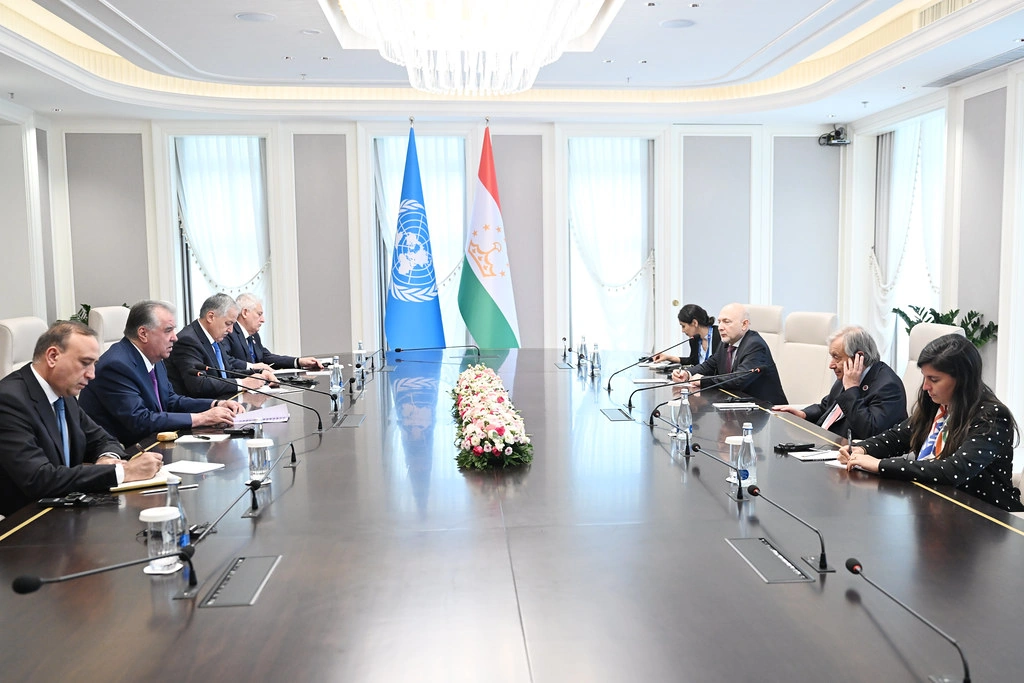
This was announced by the press service of the Tajik President,
following the meeting between President Emomali Rahmon and UN
Secretary-General Antonio Guterres on the sidelines of the meeting
of the Council of Heads of State of the Shanghai Cooperation
Organization (SCO).
According to the information, during the meeting, Emomali Rahmon
expressed appreciation to the UN Secretary-General for his
congratulatory message on the adoption of the resolution
proclaiming the “Decade of Strengthening Peace for Future
Generations” and for the UN’s continued support for Tajikistan’s
international initiatives.
The Tajik president emphasized that achieving the goals of the
decade would contribute to further strengthening peace and
stability internationally.
For his part, Antonio Guterres highlighted Tajikistan’s role in
addressing global water-related challenges and promoting the
international agenda on glaciers.
"Thanks to Tajikistan, the issue of water resources has become
one of the central topics of international discussions. In
addition, Tajikistan plays a leading role in promoting the
international agenda on glaciers," Antonio Guterres said.
The UN secretary-general also reaffirmed the organization’s
support for Tajikistan’s initiatives and its readiness to assist
the country in its development efforts.
Emomali Rahmon, in turn, said Tajikistan fully supports the UN
leadership’s efforts to achieve the Sustainable Development Goals
through 2030, restore trust, resolve conflicts and disputes,
address the consequences of climate change, prevent biodiversity
loss and improve the socio-economic situation of countries.
The sides also discussed the role of digital technologies,
including artificial intelligence, in achieving the Sustainable
Development Goals. Emomali Rahmon noted that Tajikistan had taken
these objectives into account when presenting a draft resolution on
the role of artificial intelligence in creating new opportunities
for sustainable development in Central Asia.
Climate change, the rapid melting of glaciers, depletion of
water resources and the growing risk of natural disasters were
identified as major challenges facing the international
community.
In this context, Emomali Rahmon highlighted Tajikistan’s efforts
to strengthen international cooperation in the water and climate
sectors within the framework of the Dushanbe Water Process.
The Tajik president also referred to the planned UN Water
Conference in Dushanbe in 2028 and proposed establishing a
“Dushanbe Water Framework Program” as a strategic mechanism for
guiding international cooperation in the water sector.
The sides also exchanged views on other regional and
international issues of mutual interest.