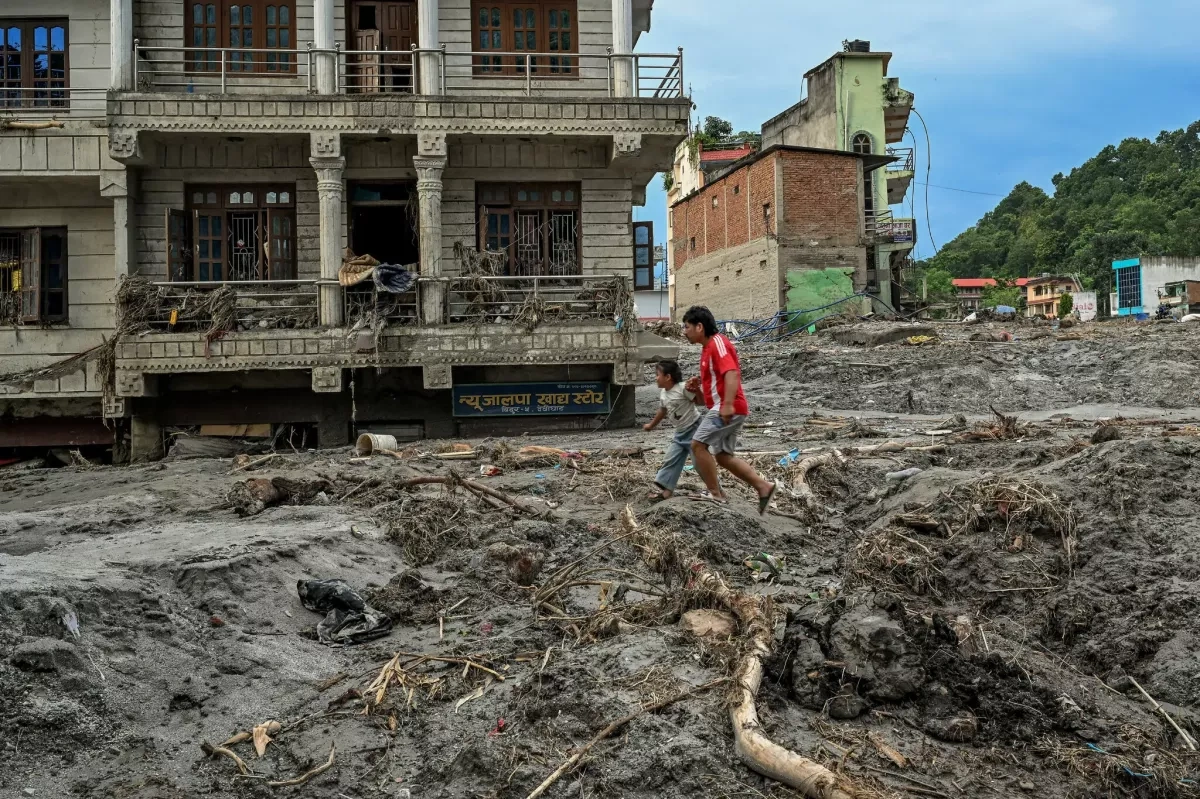
Five days after devastating floods struck Nepal’s Rasuwa and Nuwakot regions, the scale of the disaster is still emerging, with more than 4,700 people reported missing and authorities struggling to cope with the number of recovered bodies.
For climate advocate Dikshya Subedi, the disaster is also deeply personal. Her husband’s village was destroyed, while his relatives narrowly escaped the flood.
Subedi argues that Nepal urgently needs stronger investment in disaster preparedness as the country faces growing risks from a warming climate. Preliminary scientific evidence indicates that a massive ice-and-rock collapse in the high Himalayas triggered a cascading event in the Lhende Khola, sending a sudden surge of water, rock and sediment into the Bhote Koshi-Trishuli river system.
A lake has also formed near the Nepal-Tibet border, raising fears of a possible second flood.
While the initial collapse could not realistically have been prevented, Subedi says the disaster has exposed major weaknesses in Nepal’s disaster risk reduction and preparedness systems.
She calls for properly funded early-warning systems for glacial and flood hazards, particularly in high-risk mountain corridors. Authorities, she says, need to map and monitor unstable glaciers, landslide-dammed lakes and river corridors, restore damaged sensors and establish round-the-clock communication between mountain monitoring stations and downstream communities.
Stronger upstream monitoring, river-corridor planning and transboundary data-sharing with China are also needed, alongside risk-sensitive infrastructure planning and continuous monitoring of unstable glaciers, slopes and temporary debris dams, Al Jazeera reports.
Subedi argues that evacuation triggers and emergency shelters should be put in place, supported by multiple warning channels such as SMS alerts, sirens and local radio. Such measures could give communities more time to reach safety if secondary flooding occurs.
The wider challenge, she says, is climate resilience. Rising temperatures in the Himalayas are destabilising glaciers, glacial lakes and mountain slopes, increasing the risk of cascading disasters.
Nepal therefore needs infrastructure capable of withstanding floods, landslides and other mountain hazards. Roads, bridges, hydropower facilities and public services should be built with greater resilience, while locally led adaptation should protect communications, livelihoods and essential services in vulnerable downstream communities.
But Subedi argues that Nepal cannot meet these challenges alone. Wealthier countries, which have contributed most to global greenhouse gas emissions, should provide financial support for recovery and reconstruction rather than relying on symbolic gestures.
She calls for climate finance to be delivered immediately and for Nepal to have access to the Loss and Damage Fund. Such funding, she argues, should be new money, provided as grants rather than loans, and made accessible without lengthy bureaucratic procedures.
Nepal contributes less than 0.1 percent of global greenhouse gas emissions but is among the world's most climate-vulnerable countries. For Subedi, this makes the demand for financial support a matter of climate justice rather than charity.
At the same time, she highlights the role of Nepalese communities themselves, particularly young people, in responding to the disaster. Young volunteers have organised the Rasuwa Relief Group to mobilise resources, coordinate support and share verified information, while others have signed up for relief and rescue operations.
For Subedi, their response demonstrates that young people are not simply among those most vulnerable to climate change but can also become first responders and leaders during crises.
The lesson from the disaster in Rasuwa, Nuwakot and Dhading, she argues, is that climate action must extend beyond mitigation targets and international policy meetings. The communities most exposed to climate risks, together with young people, should have a meaningful role in deciding how Nepal prepares for future disasters.
In a country where climate risks can turn into devastating floods and landslides within minutes, stronger early-warning systems, resilient infrastructure, local preparedness and timely climate finance are presented as urgent necessities rather than long-term ambitions.
By Aghakazim Guliyev