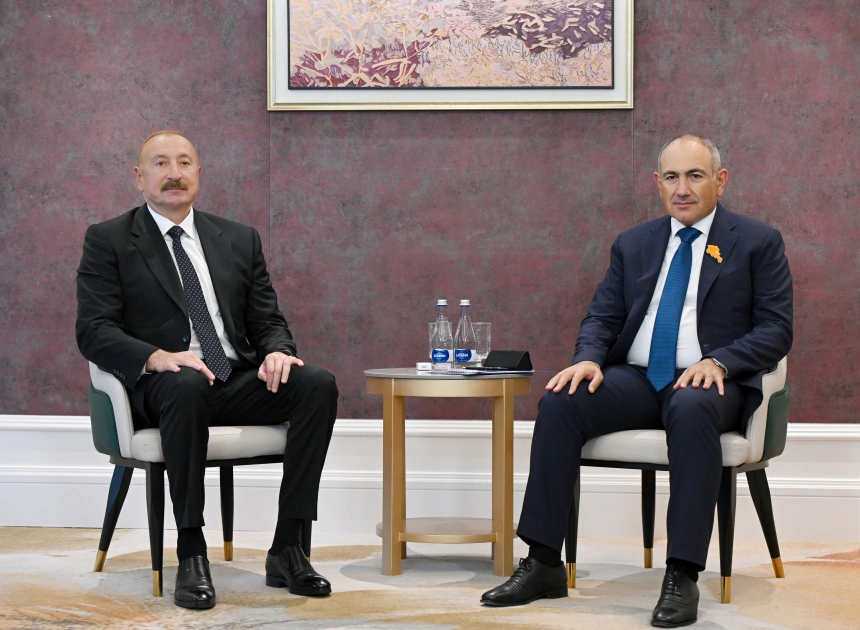
BAKU, Azerbaijan, September 1. The meeting
between the President of Azerbaijan Ilham Aliyev and Armenian Prime
Minister Nikol Pashinyan in Bishkek on August 31 marked another
important step in advancing the peace process between Baku and
Yerevan following the historic Washington summit on August 8,
2025.
A year after the political breakthrough achieved with U.S.
participation, the two sides are demonstrating that the course they
had set is not only being maintained, but is gradually being
fleshed out—from trade and transit to energy cooperation, border
delimitation, and the development of transport links.
The key outcome of the meeting in Bishkek was the reaffirmation
of the two countries' commitment to further strengthening
sustainable peace, normalizing interstate relations, and developing
direct bilateral contacts. This continuity is particularly
significant today: the parties are not returning to discussions of
past stages, but are continuing to work on implementing the
agreements reached within the framework of the new peace phase.
It's significant that the leaders once again noted the historic
significance of the Washington Peace Summit, the Joint Declaration
signed following it, and the initialed text of the Agreement on the
Establishment of Peace and Interstate Relations. Thus, Baku and
Yerevan effectively confirmed that this treaty remains the
foundation for further progress toward sustainable peace.
At the same time, the meeting's agenda itself demonstrates how
significantly the content of the Armenian-Azerbaijani dialogue has
changed. Along with political issues, the leaders discussed
concrete mechanisms for peaceful coexistence. Trade, transit,
energy cooperation, border delimitation, and transport connectivity
were at the center of attention.
The fact that economic relations are gradually becoming one of
the practical dimensions of peace has particular significance. The
export of Azerbaijani petroleum products to Armenia, the transit of
grain and other goods through Azerbaijan, the development of
bilateral trade, and contacts between business communities testify
to the emergence of real economic ties between the two
countries.
These are no longer the potential benefits of a peace agreement,
but processes that have actually begun to take place. A joint
statement by the U.S., Azerbaijan, and Armenia, published on the
first anniversary of the Washington summit, noted that over the
past year, approximately 60,000 tons of cargo had been transported
through Azerbaijan to and from Armenia, while Azerbaijan supplied
Armenia with 20,000 tons of petroleum products. The same document
emphasized that the parties continue to work to expand bilateral
trade.
Thus, the economic component is gradually becoming an important
element of peacekeeping. The more trade, transport, and energy ties
emerge between the two countries, the more meaningful the
relationship itself becomes and the greater the practical
incentives for maintaining stability.
The Trump Route for International Peace and Prosperity (TRIPP)
remains an important area of this work. In Bishkek, President
Ilham Aliyev and Pashinyan discussed further practical steps for
its implementation and emphasized the importance of developing
transport projects along the route. This demonstrates that
transport connectivity remains a central element of the
post-Washington agenda.
TRIPP has also received practical development over the past
year. The joint statement by the U.S., Azerbaijan, and Armenia
noted that an agreement had been reached between the U.S. and
Armenia to establish the TRIPP Development Company, engineering
survey work had begun in Armenia, and Azerbaijan had nearly
completed construction of a road and railway on its territory,
which would connect with the route infrastructure in Armenia.
In this context, the transport component takes on broader
regional significance. Implementing TRIPP has the potential to
strengthen the transport connectivity of the South Caucasus with
the Caspian region, Central Asia, and European markets. Therefore,
promoting the route is both an economic project and a practical
tool for strengthening peace.
Another evidence of the deepening process was the emergence of
energy on the bilateral agenda. On August 25, in Lachin,
representatives of energy agencies from Azerbaijan and Armenia
discussed the possibility of importing and exporting electricity
between the two countries, as well as options for connecting energy
infrastructures on the state border.
The energy dialogue is particularly significant, as it addresses
the potential interaction of critical infrastructure between the
two countries. If these contacts develop further, energy
cooperation could become another practical mechanism for
strengthening interdependence and regional stability.
At the same time, the peace process continues to include issues
that require consistent work. In Bishkek, the leaders specifically
emphasized the importance of the work of the relevant state border
delimitation commissions and the need to continue this work in
accordance with the agreements reached between the parties.
This doesn't indicate that the peace process has moved to a more
detailed stage. After reaching fundamental political agreements,
the focus gradually shifts to their practical implementation and
the creation of mechanisms capable of ensuring the long-term
sustainability of relations.
Contacts beyond the immediate political leadership are also
becoming an important element of this work. President Ilham Aliyev
and Nikol Pashinyan praised the interaction between
parliamentarians and civil society representatives, noting their
contribution to strengthening mutual trust. This is also part of a
broader transformation of relations, as sustainable peace requires
not only agreements between leaders but also the gradual formation
of new ties between societies.
Looking at the events of the past year as a whole, it becomes
clear that the Washington breakthrough continues developing in
several directions simultaneously. Over the course of the year,
stability was maintained on the Armenian-Azerbaijani border,
delimitation work continued, transit restrictions were lifted, real
freight traffic and petroleum product deliveries began, contacts
between business communities developed, TRIPP was promoted, and now
energy cooperation is being added to this list.
It's also significant that on the first anniversary of the
Washington summit, August 8, 2026, President Ilham Aliyev and
Pashinyan held a phone conversation. The very fact of regular
direct communication between the leaders and the subsequent
in-person meeting in Bishkek several weeks later confirm the
continued political dialogue and commitment to further advancing
the peace process.
Thus, the current stage of relations between Baku and Yerevan is
no longer characterized by isolated diplomatic contacts, but by the
consistent development of an entire system of interaction.
Political dialogue is complemented by economic ties, transport
projects, energy contacts, border work, and confidence-building
measures.
This is precisely the primary significance of the meeting in
Bishkek. It demonstrates that the momentum achieved since the
Washington summit is continuing, and both sides continue to move
toward strengthening peace and normalizing relations.
However, the final formation of a new system of relations still
requires time. It is necessary to continue delimitation work,
implement the agreements reached, develop the TRIP, expand trade
ties, and create new mechanisms for economic and energy
cooperation.
The main trend today is precisely this: the Washington
breakthrough continues, and peace between Azerbaijan and Armenia is
gradually transforming from a political agreement into a
sustainable reality, underpinned by trade, transit, energy, and
transport connectivity.