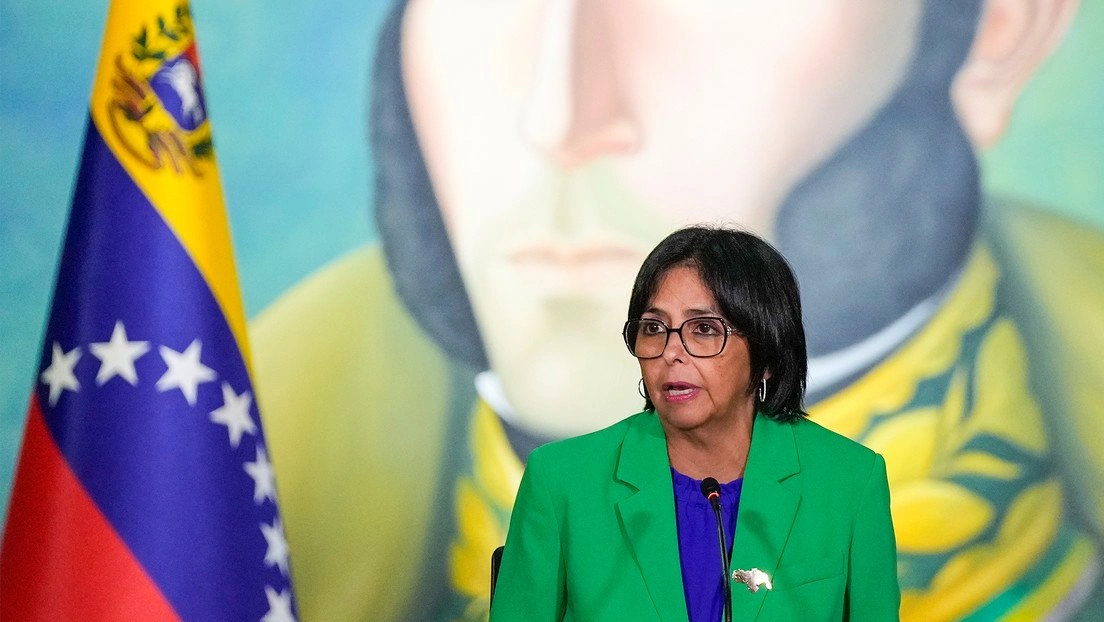
BAKU, Azerbaijan, September 1. Venezuela’s
Acting President Delcy Rodríguez stated that the oil deal with the
U.S. will have a significant impact on Venezuela’s future.
This was stated in her remarks on the oil agreement with the
U.S.:
“Yesterday we announced a historic agreement with the U.S.
government that will have a significant impact on the lives of all
Venezuelans in the medium and long term.
We are committed to a prosperous Venezuela so that we, the
Venezuelan people, can look to the future in one year, five years,
ten years, fifty years; we are thinking about the Venezuela of the
future.”
As everyone knows, our country possesses the world’s largest oil
reserves, but having underground reserves is not enough. We need
investment, technology, infrastructure, and production capacity to
turn this wealth into prosperity for our people. There is no point
in keeping our oil reserves underground so that they appear only in
statistics or accounting records; even if we cannot transform them
into Venezuela’s development, we will still be able to say, “We are
the country with the world’s largest reserves.” Our reserves must
be transformed into well-being, prosperity, and happiness for this
country, which will allow us to restore our production capacity and
strengthen our position as an energy and manufacturing
powerhouse.
Rodríguez emphasized that the use of Venezuela’s oil reserves
must serve the country’s development and the strengthening of its
energy potential:
“It makes no sense for our underground oil reserves to appear
only in statistics or accounting records, just so we can say that
we are the country with the world’s largest oil reserves, when we
cannot transform and use them for Venezuela’s development. Our
resources must bring prosperity, well-being, and happiness to this
country, as well as enable us to restore our productive capacity in
order to strengthen our position as an energy and industrial
power.”
“In this way, we are not only providing our people with better
incomes, public services, healthcare, education, and transportation
infrastructure, but we are also contributing to the hemisphere’s
energy security and helping to create a more balanced and stable
international energy market.”
Delcy Rodríguez noted that the agreement reached by her country
with the United States is based on combining the parties’
strengths:
“This agreement is based on a very simple principle: each party
contributes what it does best. Venezuela offers its oil, its
industry, and the more than a century of experience of its workers.
The United States provides the capital and technology needed to
restore and develop these assets. In return, Venezuela gains
production, jobs, infrastructure investments, higher government
revenues, and supply chains for local businesses.”
The benefits go beyond mere numbers. This bilateral project,
signed for a term of 25 years, calls for the development of 17
strategic oil fields with a target daily production of more than
1.5 million barrels. This was made possible solely by the bilateral
agreement between Venezuela and the US. But our goal is even
higher: we want to become an energy powerhouse, a major oil
producer, a key gas exporter, and develop a world-class domestic
petrochemical industry by entering into major agreements with other
large companies, including Chevron, Repsol, Eni, Shell, bp, and
others.”
Rodríguez also addressed the issue of the revenue the agreement
will generate for Venezuela and disclosed specific figures:
“And here a legitimate question arises, one that every
Venezuelan citizen has every right to ask: How much does Venezuela
earn? If we take a price of $65 per barrel (this price may go up or
down), our country’s revenues will total $209 billion 335 million
for the Venezuelan state.” Specifically, this means that
approximately $19 from every barrel of oil produced and sold goes
directly to our country.
In conclusion, I would like to remind you that thirty years ago,
as part of the privatization of the oil industry, a major project
was implemented to develop four new fields in the Orinoco Oil Belt
based on a strategic partnership with a 1% royalty (mineral
extraction tax) and a 34% income tax. This bilateral project
provides for the development of eight new fields in the Faja area
with a minimum royalty of 16% and a 34% income tax.