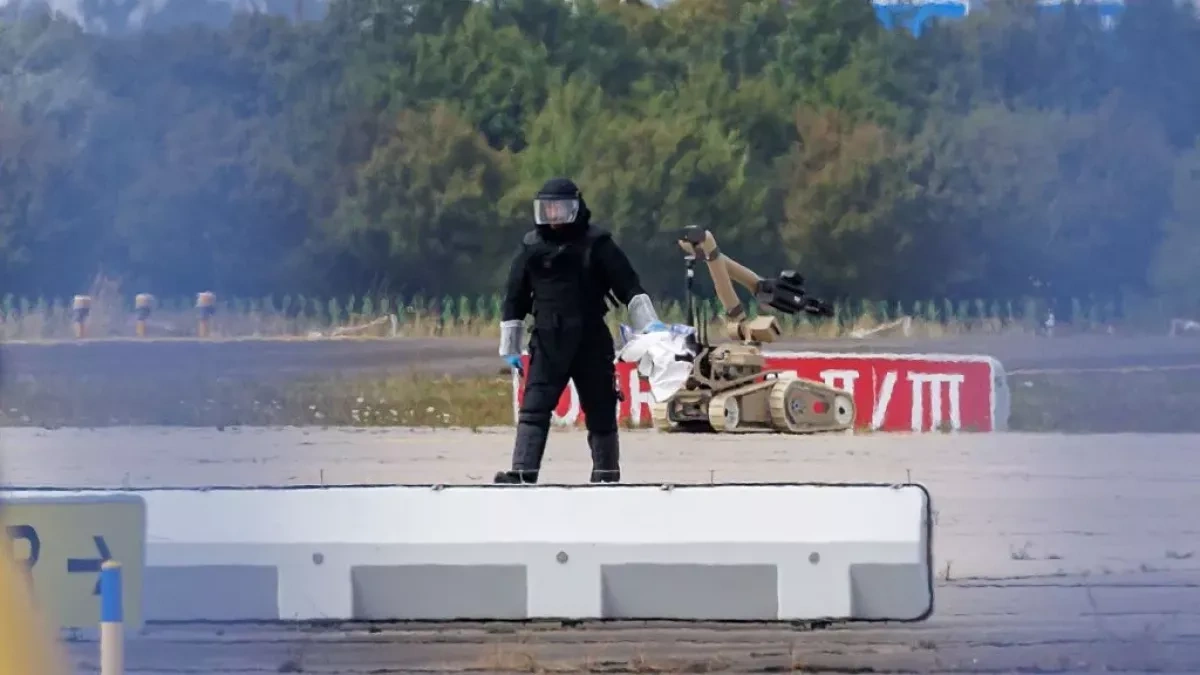
Germany has accused Russia of being behind a drone attack at Leipzig/Halle Airport last month, saying the incident matched a broader pattern of Russian hybrid operations across Europe.
A drone carrying an explosive device was found at the eastern German airport on August 4, near Ukrainian cargo aircraft. The device failed to detonate, apparently because of a faulty detonator, Caliber.Az reports, citing the BBC.
Investigators also suspect a second drone collided with a nearby cargo plane, while a third drone was reportedly discovered near the airport 10 days later.
Interior Minister Alexander Dobrindt confirmed that the attack followed the “well-established pattern of Russian hybrid operations in Europe” and warned that Germany could be targeted again.
In his words, an examination of the equipment involved, together with intelligence findings, had established Russian involvement.
Foreign Minister Johann Wadephul, who appeared alongside Dobrindt at a press conference in Berlin, announced that Germany would close the Russian consulate in Bonn and terminate the contract for the Russian House in Berlin, which critics have accused of being used for espionage and spreading Russian propaganda.
Wadephul also announced tighter entry controls for Russian nationals and said Germany would step up pressure on Russia’s shadow fleet of ageing tankers used to circumvent Western sanctions imposed after Moscow’s 2022 invasion of Ukraine.
He made clear that he had summoned Russia’s ambassador to Germany, Sergei Nechayev, who was seen arriving at the Foreign Ministry shortly after the announcement.
Russia stated that it would respond to the “anti-Russian decisions.” Moscow has consistently denied involvement in the Leipzig incident, although security experts had previously suggested Russia could be responsible.
Leipzig/Halle Airport is used by the German military and NATO allies to transport military equipment. It is also a base for Ukraine’s Antonov Airlines, which handles much of the country’s air cargo.
According to NATO Secretary General Mark Rutte, the alliance “stands in full solidarity with Germany”.
“The evidence is clear. And I welcome the measures announced by Germany in response,” he wrote on X.
The incident was due to be discussed at a meeting of EU foreign ministers in Ireland later Tuesday.
European Commission President Ursula von der Leyen wrote on X: “We are united in our resolve to stand against Russian aggression. We will deter anyone who seeks to undermine our freedom and security.”
She added that the EU was preparing additional sanctions against Russia.
Germany is among several NATO members that have reported drone sightings near airports, military facilities and industrial sites over the past year.
Berlin had previously declined to identify a potential perpetrator of the Leipzig incident, saying only that “foreign powers” could have been involved. US media had earlier reported that American officials had linked the incident to Russia.
German authorities have warned that the country is a “daily target” of hybrid warfare, while Chancellor Friedrich Merz said last week that those responsible for hostile actions against Germany would “pay a price”.
The government is also seeking to expand the powers of German intelligence agencies, which have long faced criticism for being too limited in countering such threats.
Germany remains one of Ukraine’s key supporters, with Merz taking a strong stance in favour of Kyiv. Ukrainian cargo aircraft operating from an important German logistics hub could therefore be seen as a potential target for Moscow.
The announcement comes at a politically sensitive time for Merz’s government, with a state election in eastern Saxony-Anhalt potentially giving the far-right Alternative für Deutschland (AfD) its first opportunity to take power at the state level.
The AfD, Germany’s largest opposition party, opposes continued support for Ukraine and has called for renewed relations with Russia.
Separately, German police said Tuesday they were investigating the discovery of improvised explosive and incendiary devices at a power substation in Brandenburg. A damaged power line caused a temporary outage, but it remains unclear who planted the devices.
By Bakhtiyar Abbasov