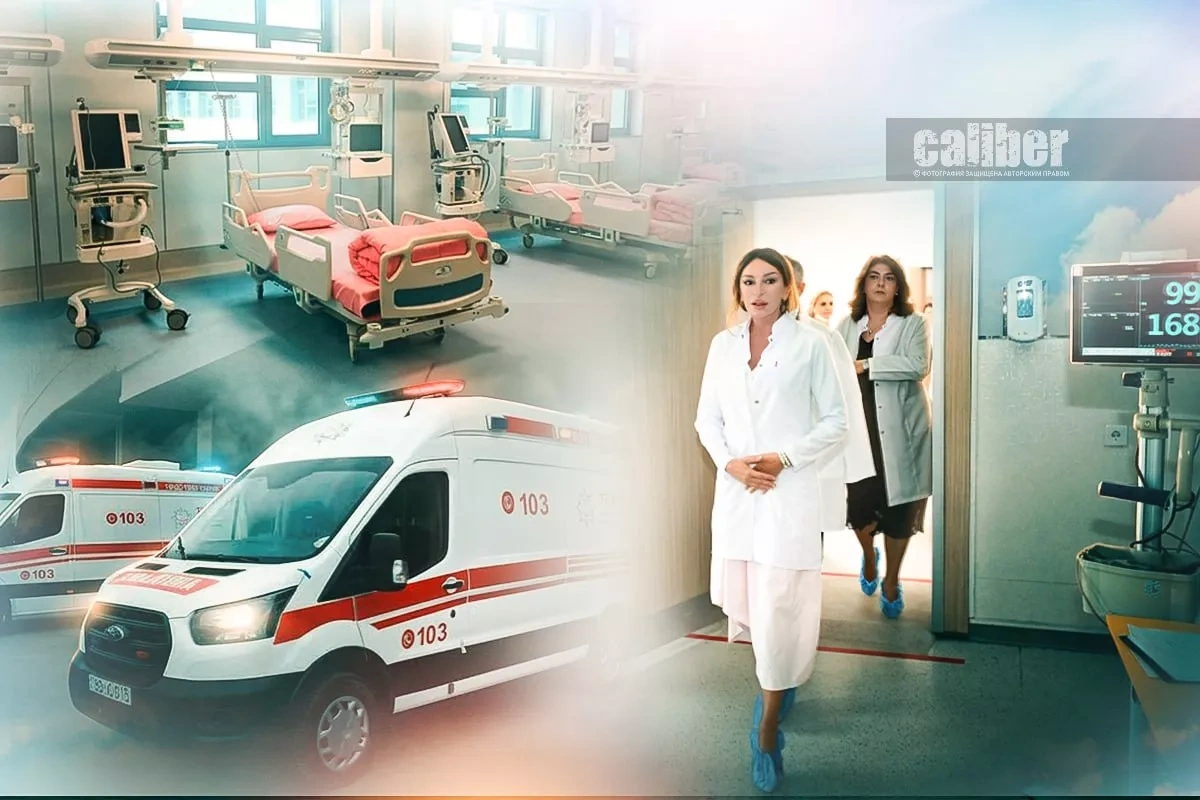
New remuneration rules came into effect across Azerbaijan’s healthcare system on September 1. The figures announced that day by Anar Bayramov, Executive Director of the Management Union of Medical Territorial Units (TƏBİB), are striking on their own: the reform covers 72,212 healthcare workers employed at medical institutions under TƏBİB, while the annual payroll is set to increase by 189 million manats ($111 million), or 13.66%. For some categories of employees, the increase will be as high as 135%.
The initiative was put forward by First Vice President Mehriban Aliyeva, who proposed raising the salaries of healthcare workers within the TƏBİB system to improve their financial standing, better recognise the importance of their work, and strengthen human capital in Azerbaijan’s healthcare sector. President Ilham Aliyev endorsed the initiative and instructed the relevant authorities to implement it.
Yet the most interesting aspect of the decision is not the size of the increase, but how the additional funding is being allocated.
Not indexation, but a redesign
Salary increases in the public sector are usually straightforward: everyone receives the same percentage increase based on their existing salary, typically linked to inflation or an increase in the minimum wage. While such an approach may be mathematically fair, it does little from a management perspective — it simply reproduces existing disparities on a larger scale.
The current reform takes a different approach. Salary increases are differentiated according to position, specialty, workload, performance indicators, and the availability of personnel in different regions. In other words, the state is using the payroll not merely as a form of social support, but as a tool for managing the geographical distribution of healthcare professionals.
This is particularly evident in the figures for specific positions. The salaries of family and district physicians will increase by 74%, or 850 manats (about $500), from 1,150 manats (about $676) to 2,000 manats (about $1,176). For physicians working in emergency medical departments at Category 3A and 3B facilities, salaries will rise by 43%, or 900 manats (about $529), from 2,100 manats (about $1,235) to 3,000 manats (about $1,765).
The salaries of anesthesiologists and intensive care physicians at Category 3A and 3B facilities will increase by 107%, or 1,550 manats (about $912). In regions facing shortages of doctors, specialists in obstetrics and gynaecology, neurosurgery, pediatric surgery, cardiovascular and maxillofacial surgery, and traumatology will see their salaries rise from 1,450 manats (about $853) to 2,150 manats (about $1,265) — an increase of 700 manats, or about $412, equivalent to 48%.
The list reads almost like a diagnosis of the system. Primary care, emergency medicine, intensive care, and shortage specialties in the regions are precisely the areas where workloads are heaviest, burnout comes quickly, and there is no shortage of vacancies or a long line of willing applicants. The state has identified its pressure points openly — and put a price tag on them.
The arithmetic of scarcity
The composition of the workforce covered by the reform illustrates the scale of the challenge. Of the 72,212 employees, 15,804 (21.9%) are physicians, 36,041 (49.9%) are mid-level medical staff, and 20,367 (28.2%) are junior medical personnel. Within the physician workforce, 8,675 provide outpatient care, while 7,129 work in primary care, emergency medicine, anesthesiology and intensive care, or specialised fields facing regional staff shortages.
Nearly half of all physicians in the system fall into this priority group. This is not a targeted bonus for a few hundred people, but a recalibration of an entire segment of the healthcare workforce.
There is another important mechanism: a regional coefficient. A coefficient of 1.3 applies to special incentive allowances for shortage specialties as well as to additional performance-based payments. The logic is straightforward: the same qualification should command a higher income in a district hospital than in a clinic in the capital. Until now, market forces have worked in the opposite direction, drawing specialists toward Baku and, from there, often beyond the country’s borders.
There is a third element that deserves separate attention: patient satisfaction will directly affect the size of physicians’ monthly additional payments. This marks a shift from rewarding presence to rewarding results — a principle that has proved particularly difficult to establish in post-Soviet healthcare systems because it requires reliable mechanisms for measuring performance. It is an ambitious move, and the way it is implemented will be an important test of the reform’s overall effectiveness.
A continuum, not an isolated step
The decision did not come out of nowhere. Salaries at TƏBİB institutions have been increased since 2023, followed by another adjustment in 2025 in connection with the increase in the minimum wage. Meanwhile, coefficients ranging from 1.5 to 3 were applied to the tariff salaries of employees at children’s homes under the Ministry of Health. The current reform continues this trajectory, but changes its character: the focus is shifting from simply raising payments to restructuring the very architecture of remuneration.
This is where the political substance of the issue lies. The development of healthcare, improvement of medical services, and social well-being of healthcare workers have been declared state policy priorities for years. What is different now is that these priorities are backed by a feedback mechanism: funding is tied to staffing shortages, coefficients to geography, and additional payments to patient assessments.
Care with a history
It is too early to assess the reform based on its first few days, but its place within the broader logic of state policy is already clear. This is neither a one-off measure nor a response to short-term circumstances — it is another step in a policy trajectory that has been developing steadily and consistently.
Salary increases at TƏBİB institutions began in 2023. In 2025, another increase followed in connection with the rise in the minimum wage. Coefficients ranging from 1.5 to 3 were also applied to the tariff salaries of employees at children’s residential care homes under the Ministry of Health. At the same time, healthcare facilities were being built and renovated, medical equipment was being upgraded, and the primary care network was being expanded. The current 189 million manats therefore builds on an existing foundation rather than starting from scratch.
The nature of state support is also changing. Previously, the focus was on increasing pay; now it is on redesigning the remuneration system to reflect specialty, workload, regional staffing needs, and patient assessments. Support for healthcare workers is no longer simply a line item in the budget. It is becoming a feedback-driven system in which a doctor working in a district hospital, on duty in intensive care, or responding to emergency calls receives not merely a general pay increase, but targeted recognition of the specific demands of the job.
What is also telling is who stands behind the decision. The initiative of First Vice President Mehriban Aliyeva, followed by instructions from President Ilham Aliyev, elevated the issue from an institutional matter to one of nationwide importance. In this approach, healthcare workers are not viewed simply as a budget expense, but as part of the country’s human capital — the people helping rebuild the liberated territories, construct new hospitals, and host international healthcare forums. A system of this scale cannot rely on staff commitment alone, and the state has acknowledged this directly — through a specific allocation, a clear timeline, and a concrete mechanism.
The reform will almost certainly be followed by further steps. The experience of recent years shows that each decision in this area has laid the groundwork for the next. The 189 million manats in additional funding is not a final destination, but another milestone along a