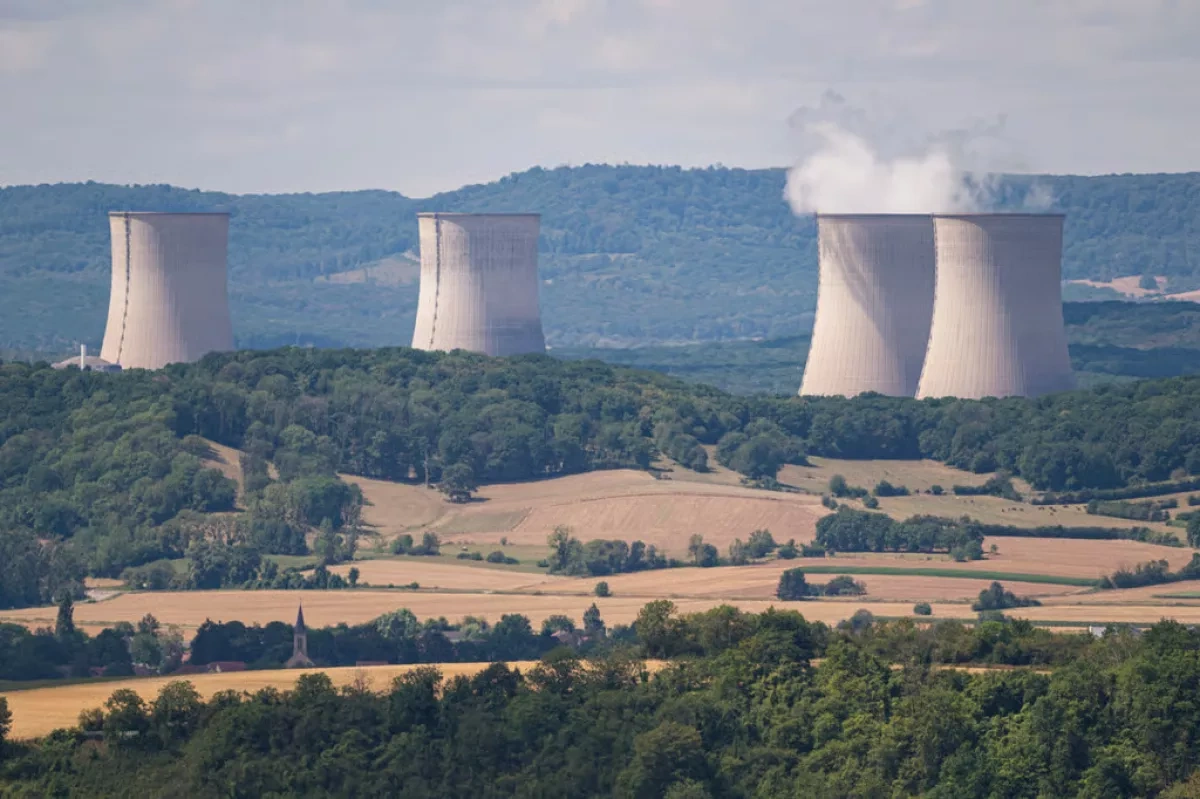
Europe is betting heavily on nuclear power to meet rising electricity demand and achieve its net-zero ambitions. But this summer’s heat waves and drought have exposed a growing vulnerability at the heart of that strategy: the continent’s ageing nuclear fleet depends heavily on water supplies that climate change is making increasingly unreliable.
According to an article by Politico, record-low river levels and unusually high water temperatures across Europe forced nuclear operators to reduce or suspend generation this summer. The disruptions have raised questions about whether governments need to reconsider how and where billions of euros in planned nuclear investments are deployed.
“Climate change is making nuclear power more and more unpredictable,” said Per Högselius, a professor of technology history at Sweden’s KTH Royal Institute of Technology.
The impact has been particularly visible across southeastern and western Europe. Bulgaria’s only nuclear power plant reduced output, while Romania was eventually forced to shut down both of its reactors after water levels in the Danube fell sharply. Hungary narrowly avoided a shutdown at the Paks nuclear plant, which supplies about half of the country’s electricity, but production was cut by roughly three-quarters.
France also experienced an unusually high number of reactor shutdowns and production reductions. In some cases, the problem was not a lack of water but excessive heat. Regulations designed to protect aquatic ecosystems can prevent plants from discharging cooling water when river temperatures become too high. Switzerland shut down one reactor in June for this reason.
“We are clearly going to see this more and more frequently,” Högselius said.
The challenges come as nuclear power is enjoying a major revival. A group of EU countries aims to increase the bloc’s nuclear generation capacity by 50 per cent by 2050, while the United Kingdom plans to quadruple its nuclear capacity. Globally, nuclear generation could triple by midcentury as governments seek reliable domestic electricity and lower-carbon power.
Yet Europe is particularly exposed. Many of its reactors were built in the 1970s and 1980s, when climate conditions were significantly different. A large share relies on rivers or other freshwater sources for cooling, leaving plants vulnerable to prolonged drought and extreme heat.
“The temperature increases within Europe have been among the highest in the world,” said Brent Wanner, head of the power sector unit at the International Energy Agency. “So Europe would see some of these impacts first.”
The risks extend beyond drought. Wildfires, storms and flooding can threaten nuclear infrastructure, while warmer coastal waters can encourage jellyfish swarms that clog cooling systems — a problem French nuclear plants experienced this summer.
International Atomic Energy Agency data show that nuclear outages occur more frequently during summer than winter and have increased with each decade since 1990. Around 15 per cent of reactors worldwide depended on freshwater sources facing significant warming-related stress in 2022, a figure the agency expects to reach 25 per cent within two decades.
Still, Europe’s nuclear ambitions remain intact. Instead, governments and operators are increasingly focusing on adaptation. France’s EDF plans to spend €4.3 billion by 2040 to make its plants more resilient to climate change.
Romania has likewise said drought has not altered its nuclear expansion plans, while acknowledging that future projects must account for climate, hydrological and environmental risks.
The changing climate could, however, reshape where Europe builds its next reactors. Coastal sites, which have more reliable access to seawater, are becoming increasingly attractive.
“The vast majority of new constructions are on coastal sites,” Wanner said. “It’s actually already kind of being structurally addressed.”
By Sabina Mammadli