BAKU, Azerbaijan, September
25. Azerbaijan is becoming a production hub
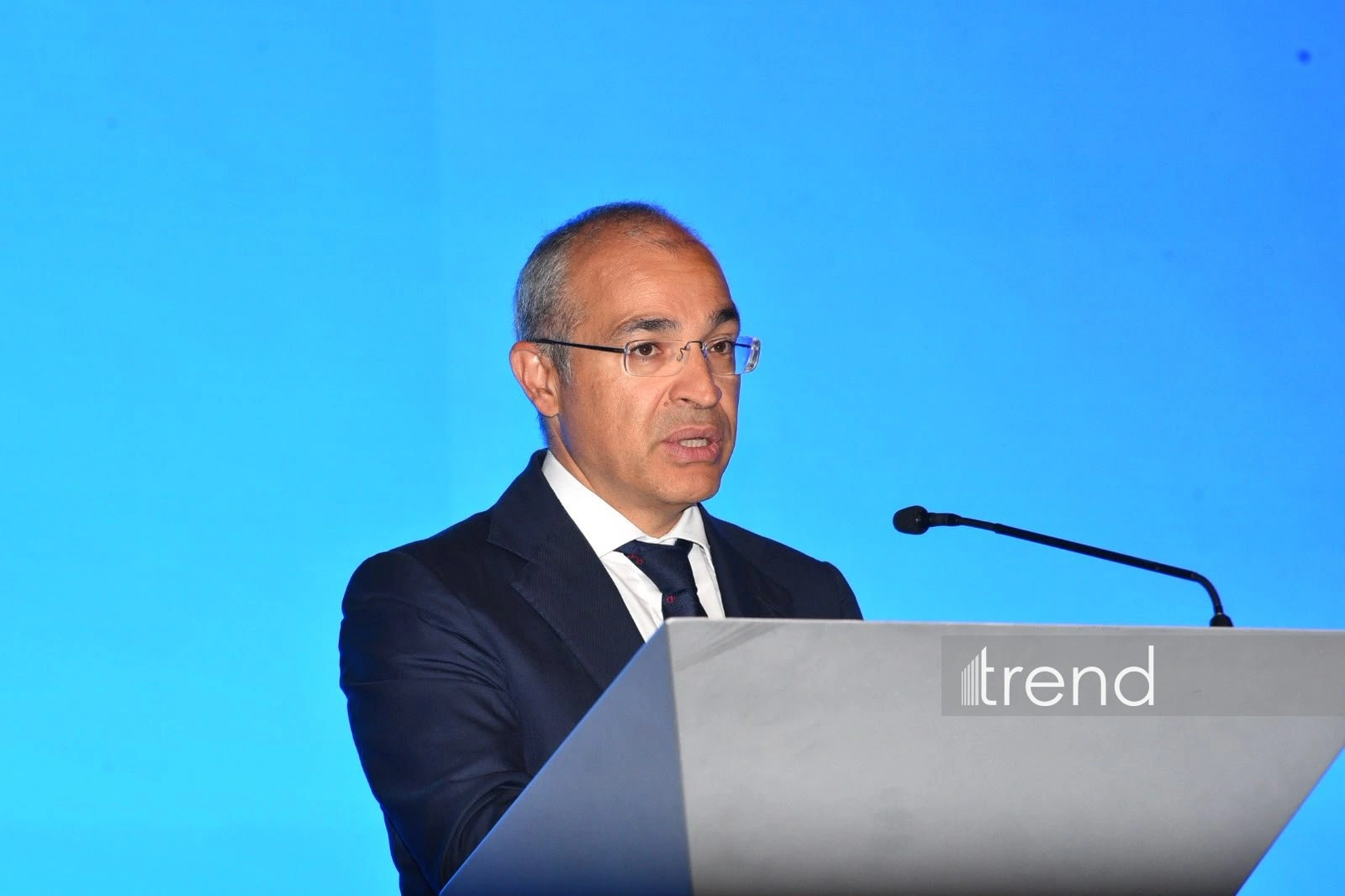
between Central Asia and Europe, Minister of Economy Mikayil
Jabbarov said at the 2nd Azerbaijan International Investment Forum
held in Baku today, Trend's correspondent reports from the event.
According to him, Azerbaijan's geographical location, developing
transport infrastructure, and long-term investments have
transformed the country into a key economic and logistics hub
connecting Central Asia, the South Caucasus, Türkiye, and
Europe.
The minister noted that investors want assurance that the
commitments they undertake and the conditions underpinning their
investment decisions will remain stable and sustainable in the long
term.
"Azerbaijan’s domestic political stability, policy consistency,
relatively low public debt, substantial financial reserves, and
predictable policymaking provide a solid foundation for investors.
This foundation is further strengthened by geopolitical
developments in the region at a time when connectivity between
Central Asia and the South Caucasus is becoming a reality,"
Jabbarov pointed out.
According to him, a key aspect of Azerbaijan's investment policy
is the establishment of predictable regulations and their effective
implementation.
"Transparent rules, investment protection, and reliable dispute
resolution form the basis of our economic policy. We are also
shortening the time gap between the signing of an agreement and its
implementation. To this end, a special commission led by the Deputy
Prime Minister is currently accelerating strategic investment
projects and coordinating efforts among various government
agencies," the minister explained.
Jabbarov emphasized that, despite being a landlocked country,
Azerbaijan has transformed into an international transport hub
through long-term policies and sustained investments.
"Today, the East-West and North-South corridors passing through
our territory are operational in both directions. The Baku
International Sea Trade Port, the Baku-Tbilisi-Kars railway, our
merchant fleet, and the Caspian cargo fleet are just a few elements
of the Middle Corridor, which connects Central Asia with the South
Caucasus, Türkiye, and Europe via the Caspian Sea," he
mentioned.
The minister announced that, by working together with partner
nations, Azerbaijan has established safe and reliable routes along
these corridors.
"The volume of cargo transportation is increasing annually, and
the potential is even greater. In its 2023 assessment, the World
Bank estimated that appropriate investments and efficiency measures
could triple trade flows along the Middle Corridor and halve
transit times by 2030," Jabbarov said.
According to him, the development of the Middle Corridor is also
reflected in the European Union's approach to this route.
Jabbarov highlighted that the construction of the sections of
transport corridors within Azerbaijan has largely been completed,
and the primary focus of the next stage will be on enhancing the
quality of services.
"The construction of the sections of these corridors within our
territory is complete, but the next phase is about
quality—specifically, the quality of service. The goal is to ensure
that the routes through Azerbaijan are not only secure in the
current geopolitical climate but also competitive in terms of cost
and time," the minister underscored.
He also noted that increasing investments in digitalization and
artificial intelligence-based solutions, in cooperation with
partner states, serves precisely this objective.
"Logistics terminals, digital services, and the industrial
sectors emerging around them create additional opportunities for
targeted investments," Jabbarov said.
The minister further noted that the peace process in the South
Caucasus is opening up new opportunities for the region's economic
and investment potential. "In August 2025, the leaders of
Azerbaijan and Armenia signed a joint declaration and initialed a
peace agreement with the participation of the US President. This
transformed the situation in the South Caucasus and boosted the
investment and economic capitalization of the broader Central
Asia-South Caucasus region," he clarified.
According to Jabbarov, peace opens up access to previously
unreachable markets, supply chains, and investment
opportunities.
"We are striving to transition from transport corridors to
economic corridors; therefore, our priority is to transform this
into a diversified, export-oriented economy led by the private
sector," the minister stressed.
He noted that from 2021 through 2025, the non-oil and gas sector
in Azerbaijan saw an average annual real growth of 6%, the non-oil
industry expanded by 50%, and non-oil and gas exports nearly
doubled.
"In 2025, the non-oil and gas economy accounted for 71% of GDP,
and this figure is expected to reach 82% by 2030," said
Jabbarov.
Furthermore, the minister highlighted the expansion of
Azerbaijan's economic ties with Central Asia.
"In November 2025, Azerbaijan became a full participant in the
Consultative Meeting of the Heads of State of Central Asia format.
In practical terms, Azerbaijan and Central Asia are increasingly
coordinating their approaches to transit, logistics, energy, and
investment," he noted.
Jabbarov emphasized that these processes are creating new
opportunities for companies operating in Azerbaijan.
"For a company based in Azerbaijan, this signifies a production
base connected to Central Asian markets on the one hand, and to
Türkiye and Europe on the other," the minister added.