BAKU, Azerbaijan, September
25. Azerbaijan seeks to generate economic value
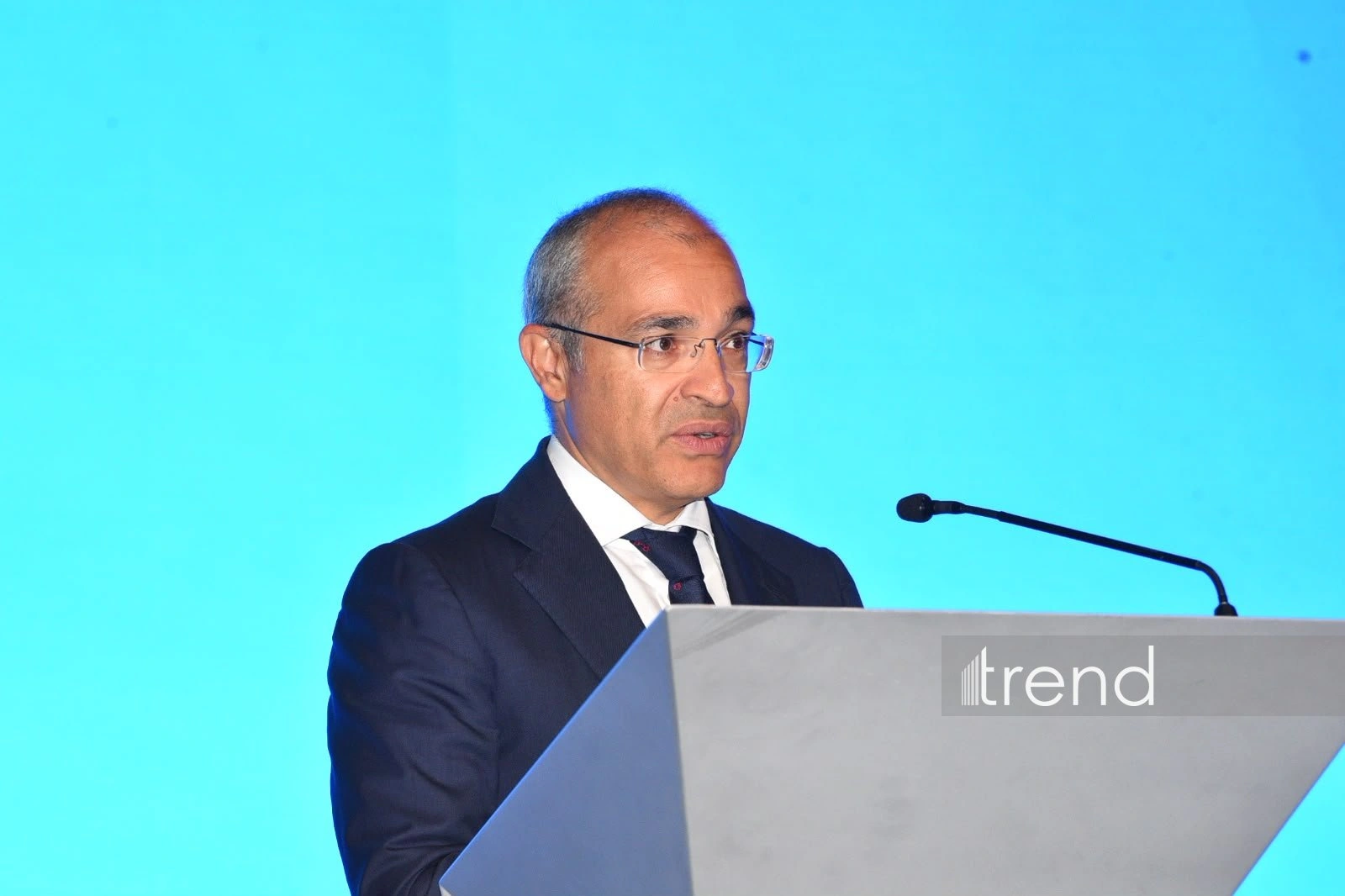
from corridors, Minister of Economy Mikayil Jabbarov said at the
2nd Azerbaijan International Investment Forum held in Baku today,
Trend's
correspondent reports from the event.
According to him, Azerbaijan views transport corridors not
merely as channels for freight transport, but as broad economic
platforms facilitating the movement of goods and services, energy,
information, capital, and human capital.
The minister noted that the development of corridors should not
be limited merely to expanding transit capabilities; rather,
economic activities that generate added value should be established
around them.
"We believe that a corridor signifies more than just the
transportation of cargo. In fact, we would like to highlight five
key flows: goods and services, energy, data, capital, and—most
importantly—people, or human capital," Jabbarov emphasized.
According to him, the primary objective regarding goods and
services is not simply to transport cargo from one point to
another, but to create added value.
"Raw materials from the region can be processed here and
delivered to consumers in Türkiye and Europe. This process is
carried out by leveraging the capabilities of the Alat Free
Economic Zone and our industrial parks, which serve as platforms,"
the minister said.
Jabbarov pointed out that energy sustainability is also a key
aspect of Azerbaijan's contribution to regional corridors.
He also noted that new support mechanisms provide for the
reimbursement of up to 70% of transportation costs for non-oil
exports, within established limits.
"For a manufacturer operating in Azerbaijan, this means
preferential access to markets along the corridor and beyond," the
minister explained.
According to the minister, one of Azerbaijan's key objectives in
the energy sector is to transform its abundant renewable energy
potential into export opportunities.
"Large-scale green energy projects are already being implemented
in Azerbaijan in partnership with leading global companies. An
agreement signed by the leaders of Azerbaijan, Kazakhstan, and
Uzbekistan during COP29 laid the foundation for a green energy
corridor from Central Asia. At the same time, the Caspian-Black
Sea-Europe green energy corridor is being designed to transport
renewable electricity to European markets," Jabbarov said.
He added that these projects create extensive opportunities for
investors in electricity generation and transmission, as well as in
energy-intensive industrial sectors.
Noting the close interconnection between energy and digital
connectivity, Jabbarov said that Azerbaijan aims to become a
digital hub.
"The Trans-Caspian fiber-optic cable line being laid across the
bed of the Caspian Sea between Azerbaijan and Kazakhstan will
establish a new, high-capacity digital link between Europe and
Asia. Coupled with other connectivity investments already made in
Azerbaijan, this creates a competitive environment that enables the
attraction of investment into data centers and artificial
intelligence infrastructure," the minister underscored.
He announced that Azerbaijan seeks to share risks with its
partners regarding capital flows.
"Azerbaijan has established joint investment funds with a number
of partner countries and participates in diversified investment
platforms. We don't shy away from investing in our own economy. We
believe that when states invest alongside private companies, it
sends a signal of confidence and mitigates the risks associated
with regional projects," Jabbarov noted.
The minister also highlighted the development of human capital
as a key factor in the formation of economic corridors. "At the end
of the day, everything comes down to people—to human productivity,
human capital, and talent. Azerbaijan embarked on this path
approximately 20 years ago with the State Program for the Education
of Youth Abroad, initiated by President of Azerbaijan Ilham Aliyev
and funded by the Oil Fund. This program has created a cluster of
thousands of competitive Azerbaijani professionals who have
received world-class education," he recalled.
Jabbarov noted that a special legislative package aimed at
attracting highly skilled migrants—particularly IT and data
specialists—to enrich the domestic talent pool is currently under
consideration in parliament.
The minister also stressed that Azerbaijan's tradition of
bringing together diverse cultures shapes the country's regional
economic role.
"From COP29 to this forum, we have been striving to bring
together diverse regions and interests at the same table. We are
extending our experience in energy and transport partnerships to
new industrial sectors—such as mining and metallurgy (including in
the liberated territories), chemicals and petrochemicals,
agriculture and food processing, as well as industries powered by
competitive energy," said Jabbarov.
He invited investors to implement new projects in
Azerbaijan.
"These are the sectors where we invite you to operate in
Azerbaijan—not only because it offers access to markets across
several regions, but also because many of you can feel right at
home here. We are seeking partners who will bring the capital,
technology, and expertise needed to transform these opportunities
into competitive products," the minister concluded.