BAKU, Azerbaijan, September 29. A.P. Moller -
Maersk has completed the first commercial ship-to-ship ethanol
bunkering of a deep-sea container vessel in the United States,
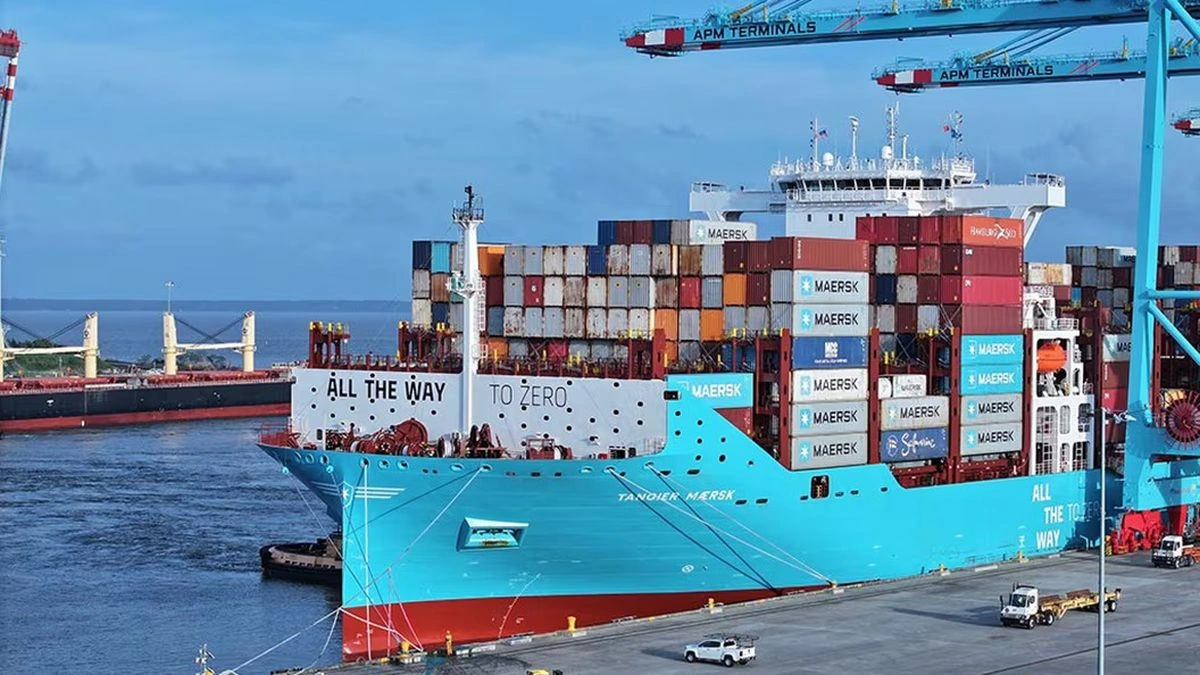
supplying its dual-fuel alcohol-enabled Tangier Maersk with 100%
U.S.-produced corn ethanol, the company said.
The operation is part of Maersk’s efforts to assess multiple
potential fuel pathways as the shipping industry moves toward
lower-emission operations. The bunkering provided Maersk with
operational experience related to the use of ethanol as a marine
fuel, including considerations around infrastructure, sourcing and
supply chains.
“Achieving lower-emission logistics requires turning new
technologies into practical, scalable solutions,” said Ditlev
Blicher, Maersk Regional President for North America.
“This bunkering operation aboard Tangier Maersk provides
valuable real-world experience with alternative fuels in commercial
shipping. The insights gained will help drive the development of
more sustainable supply chains,” he added.
The operation follows earlier ethanol trials conducted aboard
Laura Maersk and Antonia Maersk, as Maersk continues to examine
ethanol alongside other alternative fuels.
Ethanol added to Maersk’s multi-fuel
strategy
Maersk has been expanding its fleet of vessels capable of
operating on alternative fuels as part of its broader
energy-transition strategy.
The company says its approach is based on a diversified,
fuel-agnostic portfolio, reflecting uncertainty over which
lower-emission fuels will ultimately scale across global shipping.
Its options include bio- and e-methanol, ethanol and bio-LNG, while
Maersk has also said it expects to explore other technologies and
fuels, including ammonia, over the longer term.
Ethanol has attracted Maersk’s attention partly because it
already has an established production and distribution
infrastructure. In an earlier trial aboard Laura Mærsk, the company
tested blends containing 10% and 50% ethanol with methanol and said
the initial 10% ethanol test confirmed that the fuel could be
safely integrated into the engine while maintaining performance.
Maersk said it subsequently planned to test 100% ethanol.
The company has also highlighted the United States as the
world’s largest ethanol producer, with the U.S. and Brazil together
accounting for about 80% of global ethanol production, according to
Maersk. At the same time, it says the sustainability of crop-based
ethanol depends on factors including lifecycle greenhouse-gas
emissions, traceability, certification and responsible
sourcing.
Maersk expands dual-fuel fleet
Maersk’s ethanol work builds on its earlier deployment of
methanol-enabled container ships.
Laura Mærsk, which entered service in September 2023, was the
world’s first methanol-enabled container vessel, according to
Maersk.
The company subsequently expanded its dual-fuel fleet. Maersk
reported that it took delivery of 10 new dual-fuel methanol vessels
in 2025, bringing its total fleet of dual-fuel vessels to 19, with
six additional vessels scheduled for delivery in 2026.
The company has also committed to ordering only new owned
vessels with dual-fuel engines, according to its published
energy-transition materials.
Maersk has set a target of net-zero greenhouse-gas emissions
across its business by 2040, while its fleet renewal strategy is
intended to increase the share of vessels capable of operating on
lower-emission fuels.
The company said the Tangier Maersk bunkering operation will
provide additional practical experience as it evaluates the
availability of fuels, regulatory requirements and operational
readiness needed to develop scalable alternative-fuel supply
chains. For Maersk, the latest operation does not represent a
single-fuel commitment but rather another step in testing different
technologies and fuel pathways that could support the shipping
industry's energy transition.