BAKU, Azerbaijan, September 30. Uzbekistan and
Egypt prepared pilot projects covering 20,000 hectares to improve
water management, restore pastures and unused land, and introduce
modern agricultural technologies, following a meeting on Sept. 29
in Tashkent.
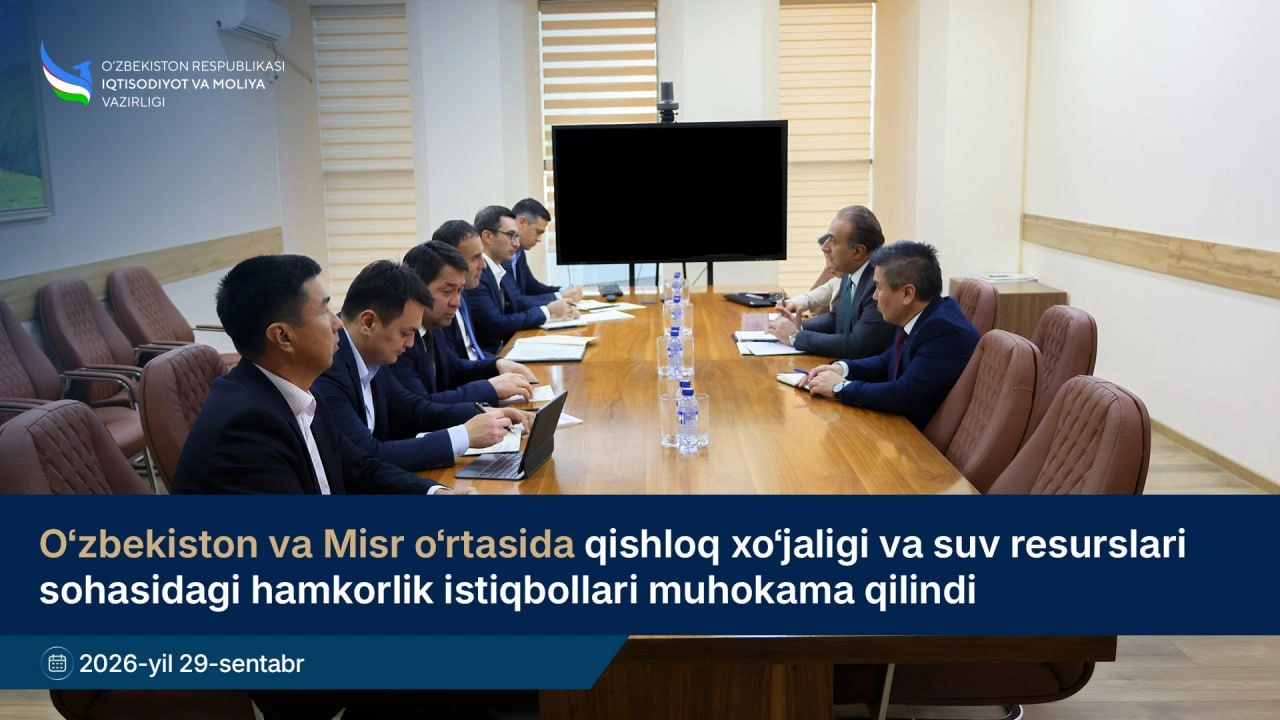
This was reflected in the statement by the Ministry of Economy
and Finance of Uzbekistan, following a meeting between First Deputy
Minister of Economy and Finance Ilhom Norqulov and Egypt’s
Ambassador to Uzbekistan Tamer Fathi Abdelsalam Hammad to discuss
expanding bilateral economic cooperation, with a focus on
agriculture, water resources management, irrigation, desert and
pasture development, and scientific research.
“The implementation of previously reached agreements and the
launch of pilot projects will help translate the accumulated
experience of Uzbekistan and Egypt into practical results,
particularly in efficient water use and agricultural development,”
the Uzbek side said.
Particular attention was given to the Uzbek delegation’s
visit to Egypt on Sept. 15–20, during which
officials studied Egypt’s experience in water management, land
development, modern irrigation technologies, seed production,
livestock breeding and the productive use of desert areas.
Additionally, the two sides discussed expanding cooperation
between Uzbek and Egyptian research institutions. Proposed areas
include water-saving technologies, hydrology and modeling,
geographic information systems (GIS), remote sensing, climate
change and water reuse.
Uzbekistan and Egypt are also considering reciprocal visits by
specialists and researchers and the involvement of experts from
leading Egyptian research institutions in projects in
Uzbekistan.
The planned pilot projects are expected to focus on pasture
restoration, the development of unused land, modern irrigation
solutions, seed production and livestock breeding, drawing on
Egypt’s practical experience.
The parties agreed to develop concrete joint projects,
strengthen contacts between experts and advance scientific and
practical cooperation in the identified areas.