BAKU, Azerbaijan, September 30. Additional oil
recovery by KazMunayGas (KMG) may reach up to 155 million tons,
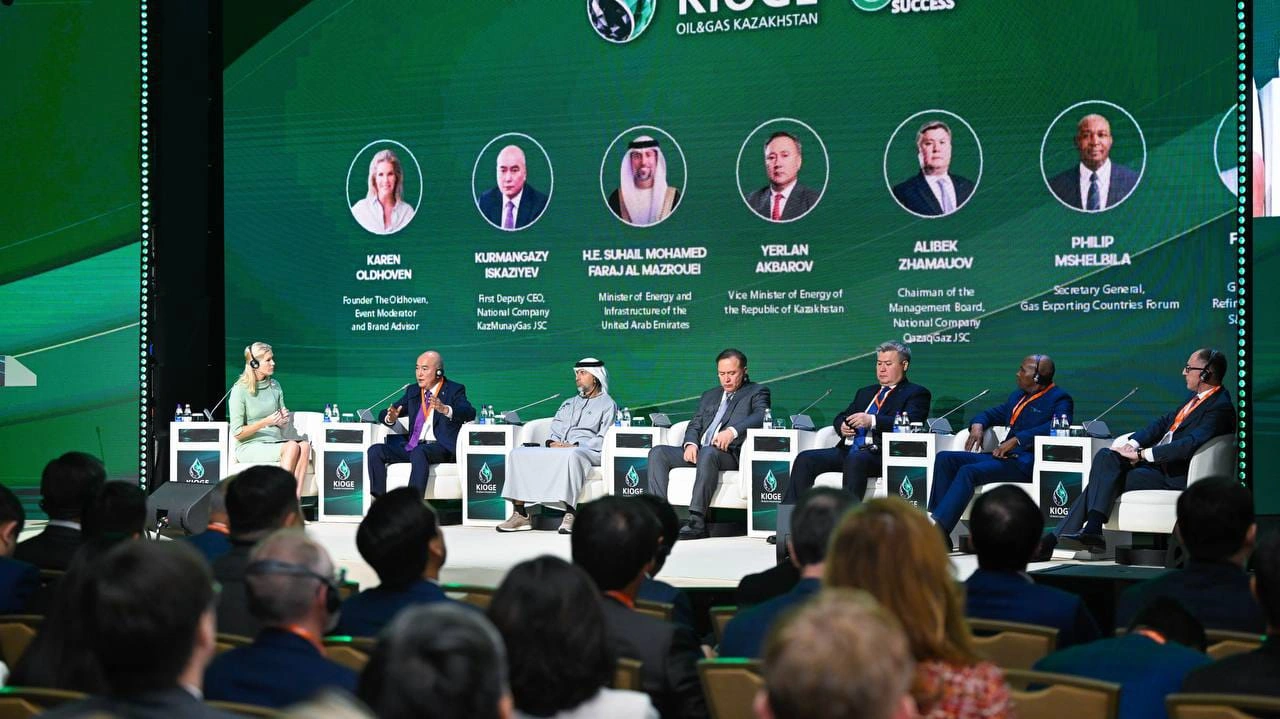
First Deputy Chairman of the Management Board of KazMunayGas
Kurmangazy Iskaziyev said during the KIOGE-2026 conference in
Almaty.
This was announced in a statement by the press service of
KazMunayGas.
During the plenary session of the forum, he emphasized that
under current conditions, KMG is focused on maintaining a
sustainable level of production at existing fields and continuously
replenishing the country’s resource base.
“The company has adopted a strategy to increase the oil recovery
factor at 12 priority fields, which currently account for 90
percent of total production. According to calculations, additional
oil recovery may amount to up to 155 million tons compared with the
current design indicators by the end of the fields’ life cycle,”
KMG said in a statement.
Moreover, it is noted that one of the key tools is the
introduction of digital twins, which make it possible to improve
the accuracy of modeling and the efficiency of production
management.
In particular, a digital twin is being implemented at the
Vostochny Moldabek field operated by Embamunaigas in the Atyrau
region. Following the project, additional production of
approximately 168,000 tons over three years is expected, along with
an increase in the oil recovery factor and the inter-repair period
to 750 days.
At the same time, to ensure sustainable production over the long
term, KMG is implementing a Large-Scale Geological Exploration
Program, which includes 23 projects with a combined geological
resource base of approximately 4.7 billion tons of oil equivalent
(toe).
The main focus of geological exploration is on deep-lying
horizons and poorly studied areas, the development of which
requires significant resources. Given the high capital costs and
geological and technological risks, KazMunayGas, as the national
company, is taking on a key role.
According to the company, in implementing such complex projects,
KMG combines its own expertise with the technologies, experience
and investment capabilities of leading global companies.
Contracts have currently been signed with China’s Sinopec for
the Berezovsky block in the West Kazakhstan region and CNOOC for
the Zhylyoi block in the transit zone in the northeastern part of
the Caspian Sea, as well as Croatia’s INA for the Shygys block in
the Aktobe region. The latter two companies are entering Kazakhstan
with investments for the first time.
In addition, one of the global energy players, BP, is returning
to Kazakhstan as part of the implementation of the Ustyurt-1/2
project.
Particular importance is attached to the planned regional study
of the pre-salt complex of the Caspian Basin, which has a potential
of up to 60 billion tons of oil equivalent. The project envisages
conducting approximately 60,000 linear kilometers of seismic
surveys.
Companies including Shell, Chevron, CNOOC and Sinopec have
already expressed interest in participating in the studies. KMG is
currently holding negotiations on the establishment of a
consortium.
“Thus, we are addressing two interconnected tasks – maintaining
a stable level of production at existing fields and expanding the
resource base,” Iskaziyev concluded.