
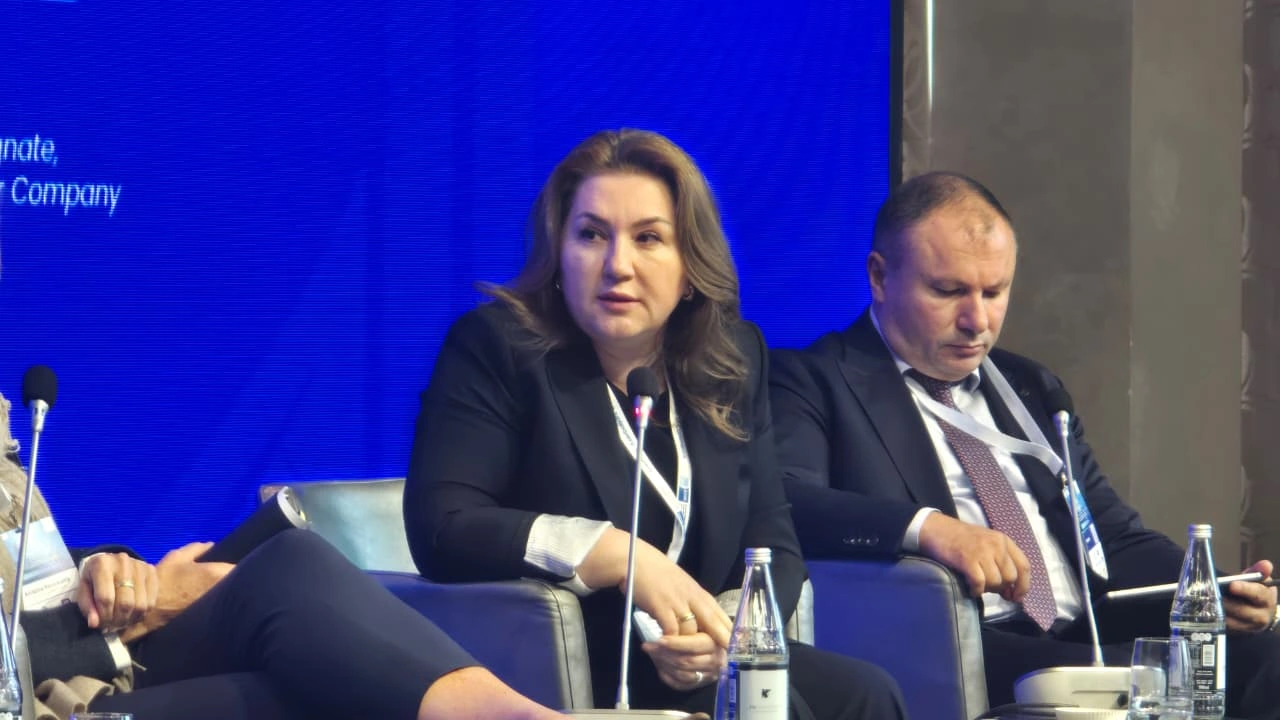
BAKU, Azerbaijan, October 6. The development of
both local and cross-border grids is crucial for expanding
investment in renewable energy projects in Azerbaijan and the
region, the Deputy Chair of the Board of the Azerbaijan Green
Energy Company (AGEC), Khayala Naghiyeva, said at the
Azerbaijan-Germany Conference on Strategic Partnership and
Connectivity in Baku today, Trend's correspondent reports.
She noted that AGEC is an investment company specializing in
renewable energy investments in Azerbaijan and the region, and
began operations in 2023.
“Until last year, we were essentially a startup. However, since
last year, we have entered a phase of active growth much earlier
than our strategic plan had envisaged. This rapid development is
driven by market demand and regional dynamics. The program for the
development of renewable and green energy, implemented by both the
government and international organizations, played an important
role in this process,” Naghiyeva noted.
According to her, the company’s portfolio currently
includes two commercial projects for the construction of solar
power plants and two projects for the development of wind power
facilities.
“In the solar energy sector, we have made faster
progress than we expected. One of the projects has already been
commissioned in Nakhchivan and has a capacity of 25 MW. We are
currently approximately halfway through the construction of the
solar power plant in Jabrayil,” she said.
Naghiyeva added that the company is at an early stage
of developing both onshore and offshore wind power projects.
“We are working closely with various consultants and
technical experts to implement these projects. We clearly see our
next steps and have a roadmap in place,” the AGEC representative
emphasized.
She noted that the role of government institutions and
the government should be viewed not only within the framework of
partnerships but also as a mechanism that enables and supports
projects.
“From the perspective of a private investor, reliable
governance, a transparent regulatory framework, stable tariffs,
government guarantees, banking support, as well as reliable
contractors and suppliers play a decisive role in such projects.
Coordination between the public and private sectors is essential
for the success of projects and for reducing investment risks,”
Naghiyeva said.
According to the AGEC representative, investment
decisions and financing should remain the responsibility of the
private sector. However, since land allocation, permitting and
regulatory matters fall within the competence of the state,
public-private partnership is inevitable.
“Over the past three years, we’ve had a fairly successful track
record of negotiating and finalizing the terms of our solar
projects. Although some regulatory frameworks are in place, there
are still certain gaps in the procedures. For example, it’s not
entirely clear where the roadmap begins and ends, or what steps
should be taken at each stage. This creates certain difficulties
for investors. I believe the public sector should work to make
these mechanisms more practical,” she added.
In addition, Naghieva noted that during the implementation of
the first projects, the parties operated on a “learn-as-you-go”
basis, since the processes were new to both the government and
local investors.
“Today, we have a clearer understanding of how management should
be carried out, who bears the risks, and how to mitigate them. Now
we need to formalize, document, and transparently present this
experience to all parties,” noted the AGEC representative.
According to her, grid connection is of particular importance
for the company’s growth.
“ For our company, which is in a growth phase, grid connection
is not just a way to enter the market or reach the end consumer; it
is a matter of scalability. Without the ability to connect to the
grid at the local, regional, and cross-border levels, it will be
very difficult for investors to expand their businesses in the
green energy sector,” emphasized Naghieva.
She noted that the presence of reliable buyers, proper power
purchase agreements (PPAs), and real demand are among the key
conditions for investment attractiveness.
“Even if we are willing to invest, without reliable buyers,
proper PPAs, and real demand, these investments will not be
attractive. This is because the market and the region are limited.
In this regard, cross-border grid connections are vital for
business expansion,” she said.
Naghiyeva added that European countries and the European Union
can play an important role in creating market opportunities and
making commitments. In her view, this could provide momentum to
accelerate investment in renewable energy in Azerbaijan and the
region.
The Deputy Chair of AGEC emphasized the importance of creating
broad opportunities for small and medium-sized enterprises and
small-scale investments in the renewable energy sector.
“To achieve this, regulations and procedures must be simplified.
This could take the form of a ready-made package or a ‘one-stop
shop’ model. Interested small businesses or individuals can obtain
this ready-made package and implement it,” Naghiyeva said.
She noted that tariff uncertainty, difficulties with grid
connection, and complex technical requirements hinder the
integration of small and medium-sized enterprises into the
renewable energy sector.
“Until these issues are resolved, it will continue to be very
difficult for small and medium-sized enterprises to integrate into
the network infrastructure and take an interest in this field,” she
added.


