
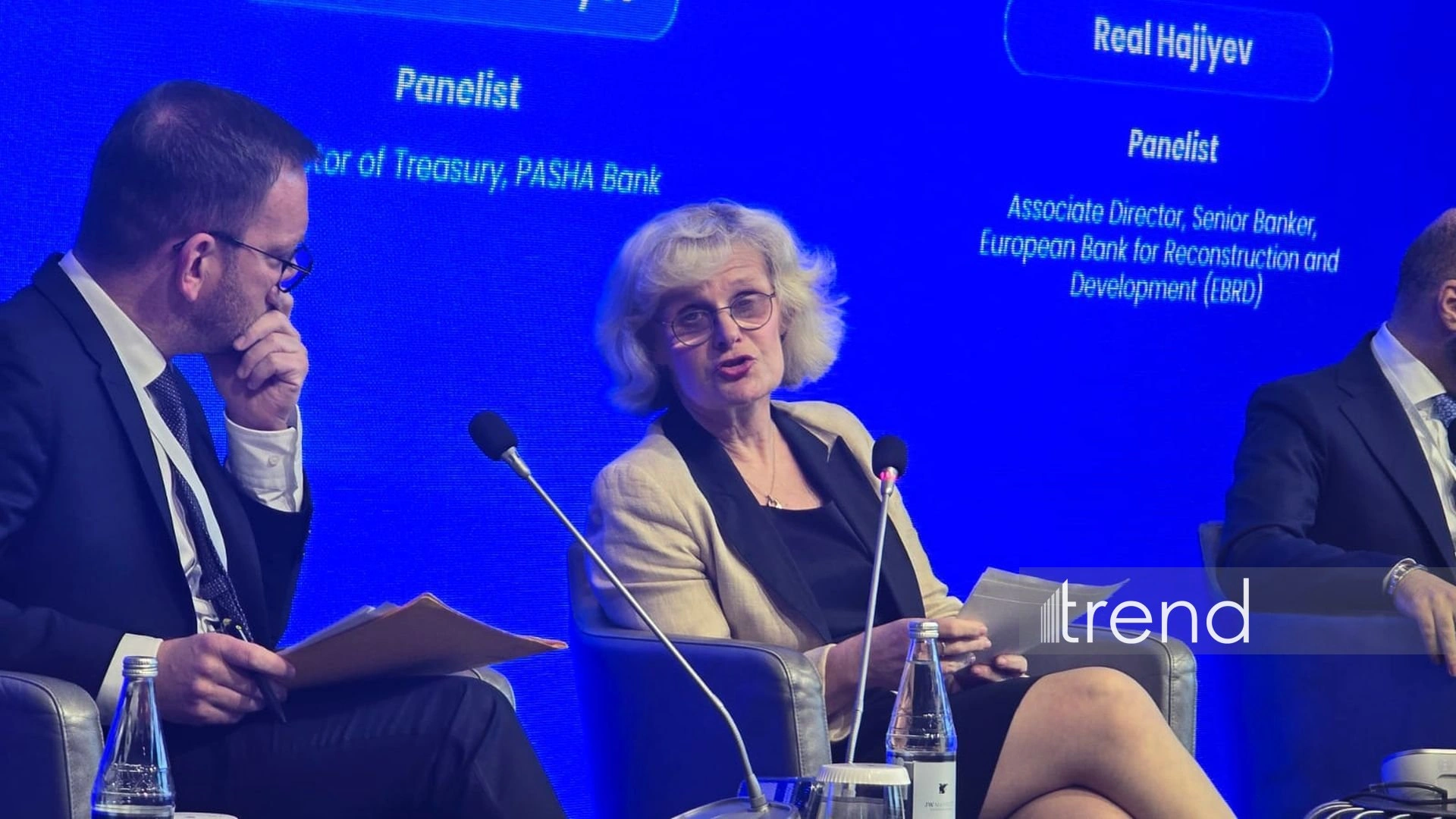
BAKU, Azerbaijan, October 6. Germany may
provide support in securing financing through export credits for
long-term investment projects that Azerbaijan plans to implement in
the areas of infrastructure, energy, and economic diversification,
the Deputy Director General of the German Federal Ministry for
Economic Affairs and Energy (BMWE), Gerlind Heckmann, said,
Trend's correspondent
reports.
She made the statement at the German-Azerbaijani Connectivity
Conference in Baku on Tuesday
According to her, Germany has implemented reforms aimed at
adapting its export credit support system to the realities of
modern global value chains, strengthening the competitiveness of
German companies and exporters, and increasing the attractiveness
of German export credit guarantees for international buyers and
financing partners.
“International supply chains are becoming increasingly complex
and integrated. At the same time, competition among exporting
countries has intensified significantly. Therefore, the
modernization package is designed to ensure that German export
financing remains a competitive and relevant tool for both
exporters and borrowers,” she said.
Gerlind Heckmann noted that two key measures are particularly
important within the reform package. One of them is the “Flex &
Cover” mechanism.
“Traditionally, eligibility for German export credit guarantees
has been closely tied to the share of German components in
individual export contracts. However, this approach does not always
reflect how companies operating on a global scale function today.
Under ‘Flex & Cover,’ we consider a company’s economic activity in
Germany in a broader sense. Factors such as employment, investment,
and value added are taken into account,” Heckmann emphasized.
According to her, this approach allows German exporters to
organize their international supply chains more flexibly while
still benefiting from state support for export credits.
“At the same time, domestic buyers also benefit, as the
complexity of managing purchases from multiple sources is
significantly reduced,” she added.
Another important mechanism, according to the ministry
representative, is “Shopping Line Cover.” She explained that this
tool allows buyers and lending banks to create a financial
structure that can then be used to make purchases from multiple
German suppliers.
“For borrowers, this makes procurement more flexible and
efficient, especially in the case of large-scale investment
programs that require technology, equipment, and services from
several German companies rather than from a single exporter,”
Heckmann said.
She noted that the main advantage of government support for
export credits for international buyers lies not only in the
guarantee itself, but also in the long-term financing opportunities
it creates.
“Today, many borrowers have access to various sources of
financing. However, the more challenging task is securing long-term
financing with repayment terms that match the economic life of the
investment. This is precisely where financing backed by export
credit guarantees can create significant added value,” she
emphasized.
According to Heckmann, the financing term in the German export
credit system can be up to 15 years, and in some sectors, up to 22
years. These opportunities are combined with attractive financing
terms and a predictable repayment schedule.
“For capital-intensive investments, such as renewable energy,
infrastructure, transportation, and industrial development, this
can be a decisive advantage over market-based financing sources,
which offer significantly shorter terms and repayment periods,”
Heckmann said.
Citing Türkiye as an example, she noted that German financing,
backed by export credits, had facilitated the implementation of
major investment projects in that country, where long-term funding
is a key requirement.
“The combination of German technology with competitive financing
terms and payment terms suited to the long-term economic
characteristics of infrastructure projects has proven very
attractive to borrowers and project sponsors. Today, we can say
that Türkiye is one of the most important markets in our export
credit guarantee portfolio,” she said.
Heckmann emphasized that Azerbaijan also has similar
potential.
“Azerbaijan has ambitious plans in areas such as infrastructure,
energy, and economic diversification. Although financing can be
obtained from various sources, financing backed by export credit
guarantees can serve as a valuable additional tool, offering longer
terms, greater financial security, and a financing structure
suitable for long-term investment projects,” the German official
said.
According to her, the reforms implemented are increasing the
flexibility and competitiveness of German exporters, as well as
expanding borrowers’ access to German technology and expertise.
“The modernization package is not just about technical changes.
The goal is to provide German exporters and their international
partners with access to financing structures that are in line with
the realities of today’s global economy and to help them turn
ambitious investment ideas into concrete, promising, and
economically sustainable projects,” Heckmann added.


