
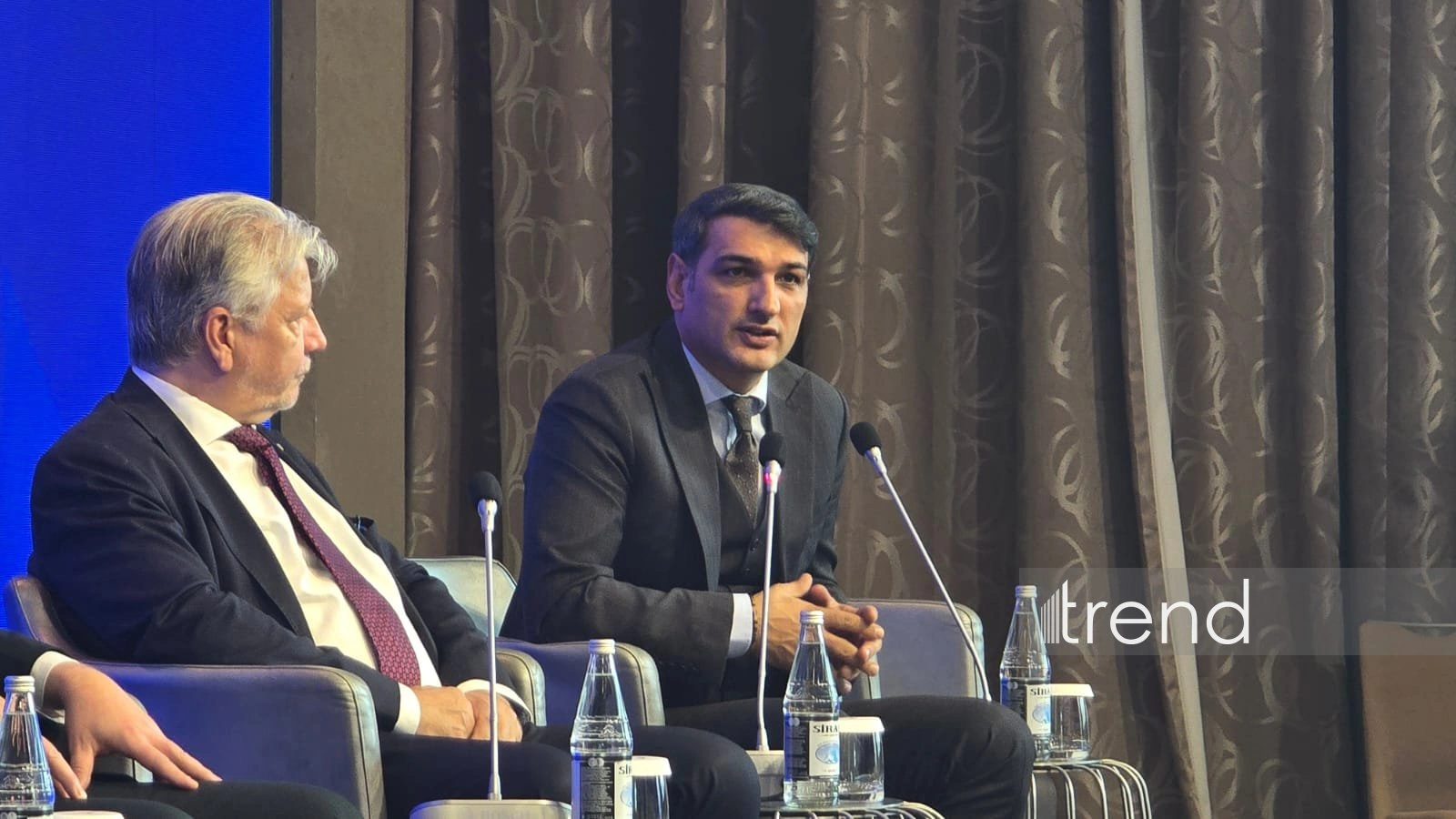
BAKU, Azerbaijan, October 6. In addition to
container shipping, the Baku International Seaport plans to expand
its general cargo terminal and specialized terminals, advisor to
the director of Baku International Seaport LLC, a subsidiary of
Azerbaijan Railways CJSC, Khudayar Hasanli, said, Trend's correspondent
reports.
He made the remarks at the German-Azerbaijani Conference on
Strategic Partnership and Connectivity in Baku on Tuesday.
Hasanli noted that the Port of Baku is one of the key elements
of Azerbaijan’s transportation sector and the Middle Corridor:
“We are developing the port not merely as a seaport, but as one
of the region’s main logistics centers. One of Azerbaijan’s main
goals is to become a regional logistics and transportation
hub.”
According to K. Hasanli, the growth in cargo traffic between
China and Europe, as well as the Black Sea countries, in recent
years, especially since the pandemic, has significantly increased
interest in the Middle Corridor.
He noted that, against the backdrop of this trend, there are
plans to expand the port’s container capacity and increase its
throughput capacity for other types of cargo.
“We plan to expand not only container shipping but also the
general cargo terminal and specialized terminals. For example, we
want to increase our capacity to handle cargo such as fertilizers
from Central Asia,” he said.
K. Hasanli added that the Baku Port’s container throughput
capacity currently stands at 150,000 TEU. In the near future, plans
call for increasing this figure to 260,000 TEU, and in the second
phase, the port’s total cargo handling capacity will increase to 25
million metric tons, including a container throughput capacity of
up to 500,000 TEU.
Moreover, he emphasized that expanding physical infrastructure
alone is not enough for the development of the Middle Corridor; it
is also important to improve operational efficiency along the
entire route.
“The two main factors in this corridor are time and cost.
Currently, time is the more significant factor. Timely and
scheduled transportation of cargo from East to West and vice versa
will enable the continued development of the corridor,” said
Hasanli.
He stated that the infrastructure and freight transport
capabilities of each country along the corridor must be coordinated
with one another. Problems with capacity or efficiency on any
section of the route could affect the functioning of the Middle
Corridor as a whole.
Hasanli noted that container traffic in Baku has been growing
rapidly in recent years. In 2024, the port handled more than 77,000
TEU, and in 2025, more than 107,000 TEU. By the end of 2026, this
figure is expected to exceed 120,000 TEU.
He noted that the growth rate of container traffic is outpacing
the development of physical infrastructure: “Therefore, all
participants in the Middle Corridor must simultaneously expand both
their infrastructure capacity and their operational
efficiency.”


