
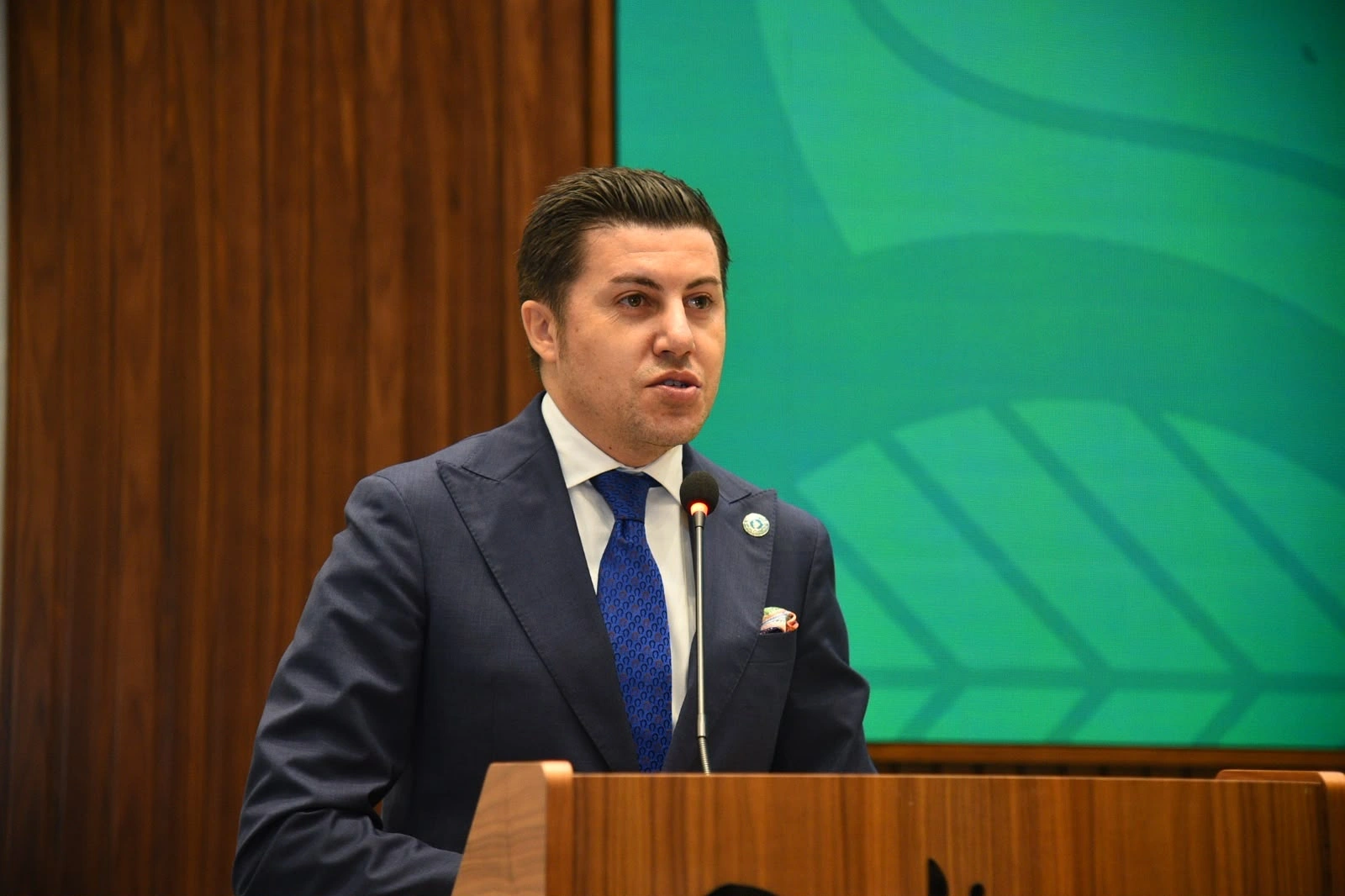
BAKU, Azerbaijan, October 9.
Azerbaijan's export potential for agricultural products can exceed
$10 billion once existing infrastructure capabilities are fully
developed, Chairman of the Agricultural Union of Turkic States
Doğan Başaran said during the 3rd International Agro Business
Forum, held in Baku on Friday, Trend's correspondent reports from the event.
He noted that Azerbaijan holds a significant position regarding
the organization and coordination of agricultural product trade
among Turkic states.
"Azerbaijan is one of the key countries in the trade of the
Turkic states' agricultural potential. It plays a crucial role in
the integration, intersection, and coordination of this trade," he
pointed out.
According to Başaran, the agricultural potential of the Turkic
states is rooted in farming and production traditions that have
developed over centuries. Reports from the Organization of Turkic
States indicate that within this region, home to a total population
of 180 million, more than 50 million people live in rural areas,
and over 8 million are engaged in farming.
He emphasized that one of the primary tasks facing the Turkic
states is ensuring food independence and security, as well as
developing joint production models.
"We mustn't become dependent suppliers to global powers. By
pooling the collective production capacity of Turkic states,
including value-added production capabilities for pomegranates,
hazelnuts, and other products, we must transform into nations that
play a pivotal role in global food security," he said.
The union chairman noted that Türkiye, with its accumulated
experience and technological expertise in agriculture and an annual
export volume exceeding $35 billion, offers significant
opportunities for cooperation with countries such as Azerbaijan and
Uzbekistan.
According to him, representatives from more than 20 Turkish
companies participating in the forum intend to explore
opportunities for collaboration and joint investment in
Azerbaijan.
Başaran also highlighted the importance of infrastructure
projects in boosting Azerbaijan's agricultural export potential. He
noted that while the country's agricultural exports currently stand
at $1.2 billion, this figure could be significantly increased once
infrastructure capabilities are fully developed.
"Although Azerbaijan's agricultural exports currently stand at
$1.2 billion, our calculations indicate that the country possesses
an export potential exceeding $10 billion once the infrastructure
is fully developed," he emphasized.
He also shared his expectation that Türkiye's agricultural
exports will surpass $50 billion in the near future.
In Başaran's view, achieving these targets requires the
efficient use of cooperation opportunities and financial
resources.
The union chairman also highlighted the importance of
Azerbaijan's transport and logistics capabilities for expanding
agricultural trade among Turkic states. According to him, the
Zangezur Corridor, projects implemented in Eastern Zangezur, and
the development of the region's transport infrastructure could
create additional opportunities for bringing products to
international markets.
"Turkic states are situated along road and rail routes
stretching from China to London. Against the backdrop of global
crises, issues at the straits, and challenges affecting food
prices, these transport corridors hold immense potential," he
said.
Başaran added that increasing agricultural exports serves not
only to expand trade turnover but also to improve national
prosperity and foster the development of farmers. In this regard,
equipping farmers with modern technologies, engaging youth in
agriculture, and developing agricultural innovation centers are of
particular importance.
Emphasizing the importance of pooling the agricultural strengths
of Turkic states, he highlighted Kazakhstan’s grain, Uzbekistan’s
cotton, Azerbaijan’s pomegranates, and Turkey’s agricultural
expertise as key areas for joint production and investment
opportunities.
"We believe in the principle of 'producing together.' We are
confident that combining the capabilities of Turkic states will
pave the way for achieving greater results in agriculture," he
noted. Başaran said that plans are in place to further expand
cooperation within the framework of the Caspian Agribusiness event
scheduled for next year and to continue discussions on joint
investment opportunities with the participation of international
agricultural experts.


