BAKU, Azerbaijan, October 9.
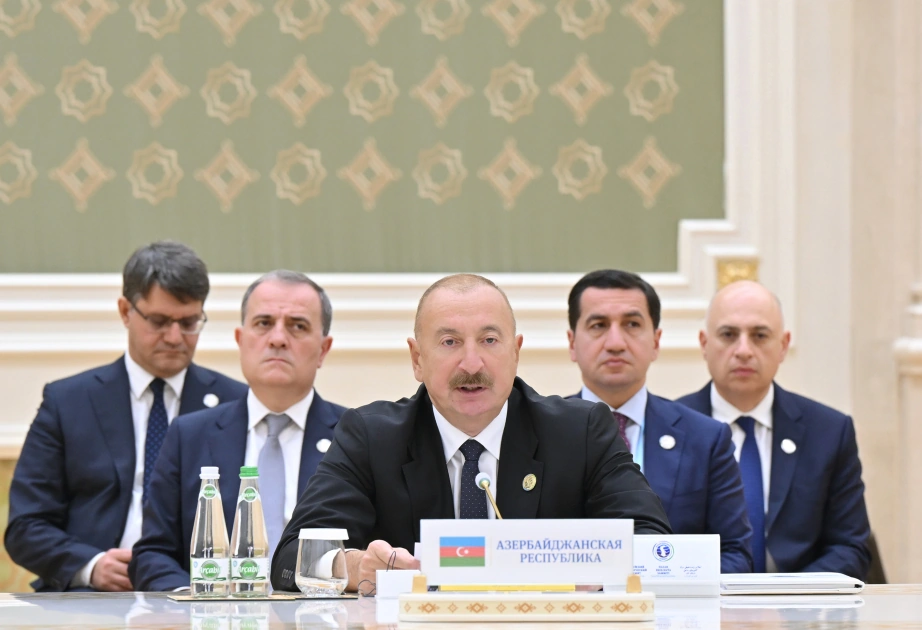
President of Azerbaijan Ilham Aliyev’s address at the First Caspian
Ecological Summit, held today in the Turkmen city of Turkmenbashi,
should be viewed as a renewed expression of Azerbaijan’s principled
stance regarding the future of the Caspian Sea on the international
stage. The head of state highlighted the accelerating shallowing of
the Caspian Sea, noting that the sea's surface area has shrunk by
more than 20,000 square kilometers and that approximately 30,000
hectares of land have emerged in Azerbaijan’s sector of the sea.
These figures demonstrate that the issue is no longer merely a
subject of theoretical discussion but is producing real, measurable
consequences.
A key point in the President’s speech is that the drop in the
Caspian’s water level is not presented solely as an environmental
issue. As the Head of State emphasized, this process directly
impacts the lives of coastal populations, the economy, transport,
and port infrastructure. For Azerbaijan, the shallowing of the
Caspian also concerns the preservation of strategic transport
capabilities, East-West cargo transportation, and the country’s
position as a regional logistics hub.
In this context, a comprehensive investigation into the causes
of the problem is of particular importance. Climate change,
evaporation, precipitation, and river inflows influence the Caspian
Sea's water balance. However, the management of river waters and
the impact of human activity on natural flows must not be
overlooked. The fact that the Volga River accounts for the majority
of the river water entering the Caspian makes changes within this
basin particularly significant. A reduction in the Volga's flow is
a key factor capable of affecting the Caspian's water balance.
For this reason, the issues surrounding reservoirs built on the
Volga, hydraulic structures, and water abstraction for irrigation
and other economic needs require serious scientific and political
attention. The primary objective here is not to preemptively assign
blame to any specific country, but to transparently examine all
factors influencing the flow of water from its source to the
Caspian Sea. Comparative data must be obtained regarding water
resource management in the Volga basin (located within Russian
territory), the impact of reservoir operations on seasonal flow
patterns, and how the volume of water reaching the Caspian has
changed over time.
Open discussion of this issue is entirely legitimate from the
perspective of Azerbaijan's national interests. If all littoral
states are experiencing the consequences of the Caspian Sea's
falling water levels, then information regarding the factors
affecting the water balance should be accessible to all. Decisions
concerning the future of the Caspian must not be limited to general
environmental statements; rather, they should be grounded in
concrete scientific findings regarding river basin management,
reservoir operations, and the volume of water flowing into the
sea.
The concern voiced by President Ilham Aliyev at the summit holds
political significance precisely in this context. Azerbaijan
illustrates the scale of the problem with figures and highlights
the risks its consequences pose to the economy, transport, and
coastal areas. The emergence of nearly 30,000 hectares of new land
in Azerbaijan’s sector of the Caspian Sea serves as a concrete
indicator of the changing coastline. This shift necessitates
long-term planning across various sectors, ranging from port
operations to coastal ecosystems.
In particular, the future of the Baku International Sea Trade
Port and cargo transportation across the Caspian Sea requires a
strategic approach. The receding sea level could impact shipping
routes, vessel loading capacities, port access conditions, and
infrastructure costs. If the decline in the Caspian’s water level
continues, Azerbaijan will need to allocate significant resources
toward adapting its transport system and mitigating associated
environmental and economic risks. Consequently, this issue must be
placed on the agenda not only of environmental protection agencies
but also of state institutions responsible for economic and
strategic planning.
Another critical aspect is the preservation of the Caspian’s
unique ecosystem. A drop in sea level could alter coastal wetlands
and shallow-water areas, disrupt fish habitats and breeding
grounds, and diminish biodiversity. This process will inevitably
affect the livelihoods of populations dependent on the Caspian
Sea’s natural resources. Thus, the decline in water levels
represents a complex crisis with interconnected environmental,
social, and economic consequences. Under these circumstances,
Azerbaijan's position calls for the establishment of concrete
regional mechanisms. A permanent scientific monitoring system
should be set up among the Caspian littoral states, data regarding
the water balance should be shared regularly, and joint research
programs should be implemented. Comparative assessments must be
conducted concerning the flow, water withdrawal, and operational
regimes of the major rivers discharging into the Caspian, including
the Volga. Based on the findings, an action plan agreed upon by the
states should be developed, and clear mechanisms for the
fulfillment of obligations must be established.
President Ilham Aliyev’s call to preserve the Caspian Sea as a
zone of peace, stability, and constructive partnership forms the
political basis of this approach. Cooperation among the Caspian
littoral states should not be limited solely to transport and
energy projects. Since the deterioration of the sea's ecological
condition affects the long-term interests of all parties, its
preservation must also become a priority area for regional
cooperation.
Ultimately, the views expressed by President Ilham Aliyev at the
Turkmenbashi summit demonstrate that Azerbaijan is not indifferent
to the fate of the Caspian Sea and considers international
cooperation essential to resolving the issue. Azerbaijan’s position
is clear: the causes of the Caspian’s receding water levels must be
scientifically determined, human activities impacting river flows
and water resources must be transparently investigated, and the
responsibilities of all littoral states must be defined through
concrete measures.
For Azerbaijan, preserving the Caspian Sea isn't simply an
environmental choice. This is a matter of safeguarding national
economic interests, transport security, the well-being of coastal
populations, and the natural resources for future generations. As
the level of the Caspian Sea drops, the need for timely and
coordinated measures becomes increasingly urgent. Azerbaijan must
maintain an active stance in keeping this issue on the
international agenda, developing scientifically grounded solutions,
and strengthening the principle of regional responsibility.