
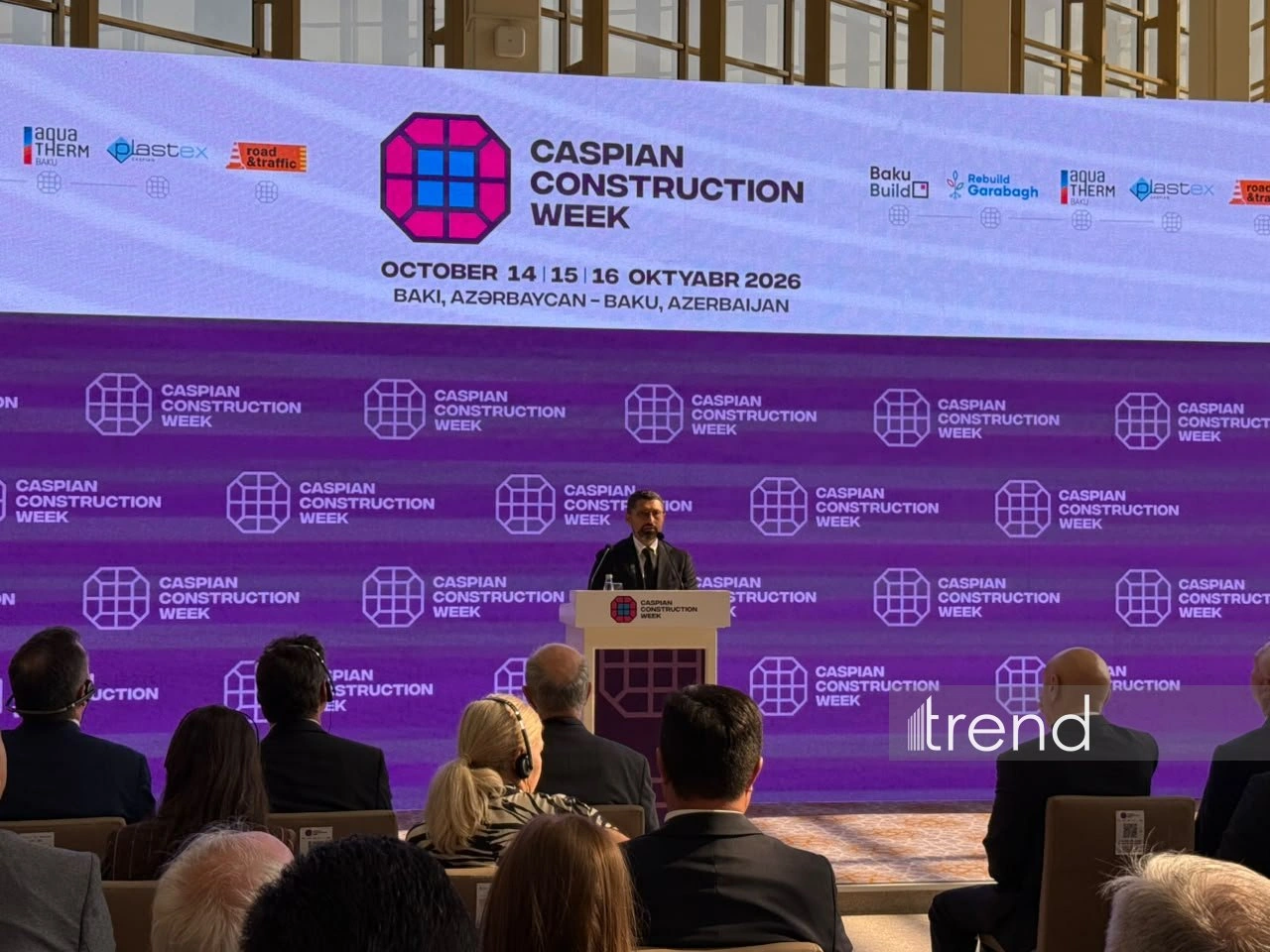
BAKU, Azerbaijan, October 14.
Mine clearance operations in Azerbaijan’s Karabakh are proceeding
at the fastest pace in the world, Chairman of the Board of the
Karabakh Revival Fund, Rahman Hajiyev, said at the opening ceremony
of the "Rebuild Garabagh" exhibition, held as part of Caspian
Construction Week, in Baku on Wednesday, Trend’s correspondent
reports from the event.
According to him, currently, more than 40,000 former internally
displaced persons have settled in Karabakh, and a total of nearly
100,000 people live, work, and study in the region. This
demonstrates that Karabakh has become an attractive destination not
only for former internally displaced persons but for all
Azerbaijanis.
He noted that the restoration and reconstruction efforts
underway in Karabakh represent an experience that can serve as a
model for other countries internationally.
According to Hajiyev, the situation in the territories liberated
from occupation went beyond the mere rendering of infrastructure,
land, and the natural environment completely unusable; the reality
was far more severe.
The chairman pointed out that the restoration of Karabakh began
with clearing the territories of mines prior to any construction or
reconstruction work. This deadly legacy significantly complicated
the tasks facing the state.
He emphasized that Azerbaijan's decision to clear the
territories of mines and subsequently launch reconstruction efforts
using its own resources, and with virtually no support from the
international community, serves as an example for other
countries.
"Mine clearance operations in Karabakh are currently proceeding
at the fastest pace in the world," Hajiyev said, noting that this
conclusion isn’t merely a subjective opinion but is substantiated
by statistical data. He added that the Karabakh Revival Fund
commissioned a film dedicated to the landmine issue, taking into
account the head of state's focus on the problem and the policies
being implemented to address it. The film was recently presented at
an international conference on landmines.
According to Hajiyev, the film reflects not only Azerbaijan's
experience but also the history and experiences of Laos, Colombia,
and Bosnia and Herzegovina, countries that have also faced the
challenge of landmines.
He said that the film successfully showcased to an international
audience the work being done in Azerbaijan in this area under the
leadership of President Ilham Aliyev. He emphasized that
comparisons with the experiences of other countries more clearly
highlight the determination Azerbaijan has demonstrated in
resolving the landmine issue and the scale of the work
undertaken.
The chairman also noted that Karabakh is no longer merely a vast
construction site; it has become a region where people live and
settle sustainably, and which holds appeal for investors.
He pointed out that, in addition to the resettlement of over
40,000 former internally displaced persons, the fact that nearly
100,000 people in total live, work, and study in the area
demonstrates the region's growing appeal.
"Karabakh is now a highly attractive destination not only for
former internally displaced persons but for all Azerbaijanis, and
in my view, this represents the primary success," Hajiyev
explained.
According to him, it would be incorrect to measure the success
achieved in Karabakh solely by the number of former internally
displaced persons returning to their native lands; the number of
people settling, living, working, and studying in the region is
also a key indicator of this success.
Hajiyev noted that the Karabakh Revival Fund supports this
process in various ways. A special scholarship program is being
implemented in collaboration with Karabakh University to support
education.
He pointed out that the Karabakh Revival Fund was the first
entity to support Karabakh University's scholarship program, an
initiative that was subsequently joined by various private
companies.
According to the head of the fund, 100 students are pursuing
their studies with the Fund's support as of the current academic
year, while hundreds of students in total are continuing their
education at Karabakh University with the backing of various
institutions and organizations. Hajiyev emphasized that following
their liberation from occupation, Karabakh and East Zangezur have
become attractive destinations for investment.
He noted that while the factor of patriotism played a major role
in investors' decisions during the initial stage, economic
interests began to gain significance in the subsequent period.
"The most sustainable investments are those driven not only by
patriotism but also by economic interests," Hajiyev remarked.
He added that the Karabakh Revival Fund strives to support
efforts aimed at making the region increasingly attractive to
investors.
Hajiyev also touched upon the role of culture in the development
of Karabakh. He noted that Shusha has served as Azerbaijan's
cultural capital, and Karabakh has always played a vital cultural
role in the life of the Azerbaijani state and people; today, the
revitalized Karabakh continues to fulfill this role in a new
form.
According to him, true revival and restoration aren’t limited
merely to the construction of concrete structures, cement works,
infrastructure, and roads.
"It is people who bring infrastructure to life, and it’s
impossible to imagine people without culture," said Hajiyev.
He noted that while numerous new cities and infrastructure
facilities have been created around the world, some have fallen
into disuse following major events, becoming a heavy budgetary
burden for the states that built them. Therefore, the development
of people and their social and cultural lives is essential to
ensuring the sustainable operation of infrastructure.
Hajiyev emphasized that the holding of various cultural events
in Karabakh, foremost among them the Khari Bulbul Festival, revived
on the initiative of President Ilham Aliyev, is a positive
development. These events add special meaning and value to the
lives of those who live, study, and work in the region.
He noted that the Karabakh Revival Fund is also pleased to
support the implementation of cultural projects.
The chairman recalled that the organization already has several
traditional cultural events, one of which is the "Karabakh Night"
charity concert.
According to Hajiyev, the fund recently organized a magnificent
concert in Lachin and gifted a grand piano to the city; a similar
gift had previously been presented to Shusha city.
He said that the number of cultural projects implemented in
Karabakh should at least match the number of construction
projects.
Hajiyev remarked that while it’s possible to speak at length
about the environmental and construction projects, new urban
planning and management models, and various other initiatives being
implemented in Karabakh, the exhibition stands themselves offer
ample opportunity to see these efforts firsthand.
He thanked everyone who showed interest in the exhibition and
wished the organizers success in the years to come.
Hajiyev added that this exhibition should continue to be held
for as long as Karabakh exists. According to him, the name of the
exhibition might be modified to some extent in the future, but the
primary objective, presenting Karabakh to the public, must remain
unchanged.


