BAKU, Azerbaijan, August 7. It is time to move
forward the Trump Route for International Peace and Prosperity
(TRIPP), as one year passes since the Washington summit, Robert
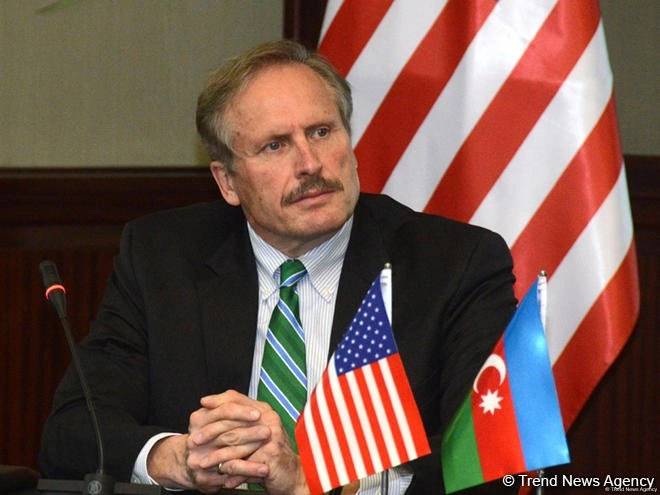
Cekuta, former ambassador of the U.S. to Azerbaijan, told Trend.
Talking about the progress since the historic Washington summit
of Azerbaijani President Ilham Aliyev and Armenian Prime Minister
Nikol Pashinyan, brokered by the U.S. President Donald Trump, he
noted that visits by Vice President Vance, Secretary of State
Rubio, and other senior U.S. figures to the South Caucasus region
demonstrate how much progress has been made towards lasting peace
and also the seriousness of U.S. interest in the region’s people
and development.
“That said, more needs to be done. First of all the signature
and ratification of a final peace agreement between Azerbaijan and
Armenia — the conditions are in place for this to happen, and Prime
Minister Pashinyan’s victory in the recent elections reaffirms
Armenians’ interest in peace and continuing to move forward. It
would be good to see Washington engage more actively to help
Azerbaijan and Armenia complete the work of ending the conflict and
putting in place a lasting peace agreement,” he said.
Cekuta pointed out that another area where more needs to be done
is getting the work on the Trump Route for International Peace and
Prosperity — the TRIPP — moving ahead.
“While it is necessary to have discussions and to develop plans,
we need to see them being moved forward, i.e., actual construction
starting. Getting projects off the drawing board and into the
execution stage will show Armenians and Azerbaijanis that real
progress is being achieved and is benefitting them in concrete
ways.
I would also come back to something I have long stressed: the
need for increased, ongoing contacts between Armenians and
Azerbaijanis to change the dynamics in the region after decades of
conflict, of killings, of fear of each other. Again, the United
States has a lot of experience in helping former enemies build
positive, friendly relations after years and even generations of
hatred. We — the United States — should be bringing this experience
to the region to help Azerbaijanis and Armenians build the lasting
peace they both want,” noted the former ambassador.
He believes that a lasting peace agreement would mean benefits
for both sides, and for the broader region as well.
“Among the benefits would be increased trade and other business
opportunities. These opportunities would come not just from
increased transit — road and rail — through the region, including
the TRIPP serving as a connection between other parts of Europe
with Central Asia and beyond to India and China, but also from
foreign investment and local entrepreneurs establishing new
ventures or expanding existing ones that take advantage of the
improved access within the region and from the region to other
parts of the world.
One of the things I learned working in the region and after is
that the old Silk Road was not a highway connecting China with
Europe, but really more of a web of cities where goods were
invented and produced, where value was added. That web of
creativity brought benefits, not just to the Chinese and Europeans,
but to the cities and towns along the way. That history can be
repeated in the region today with the TRIPP, with the opening of
the border between Türkiye and Armenia, with increased linkages
across the Caspian and beyond,” he said.
Cekuta noted that the essential thing right now is to get
projects off the drawing board and out of the MOU stage and to
start turning over earth, pouring concrete, seeing buildings being
built.
“I know the U.S. has made money available through the Export
Import Bank and the Development Finance Corporation. As I noted
above, the potential benefits to Azerbaijanis and Armenians, to
Turks, Kazakhs, Uzbeks, to Europeans on the western side of the
Black Sea and others are well-known. The best way to mark the
August 8th anniversary of last year’s historic White House meetings
would be to see the infrastructure and business projects talked
about in Azerbaijan and Armenia actually underway,” he
concluded.
On August 8, 2025, following a trilateral meeting with U.S.
President Donald Trump in Washington, President of Azerbaijan Ilham
Aliyev and Prime Minister of Armenia Nikol Pashinyan signed a joint
declaration on establishing peace between Baku and Yerevan and
restoring transport connectivity between mainland Azerbaijan and
the Nakhchivan Autonomous Republic. The initiative was named the
"Trump Route for International Peace and Prosperity."
As part of the meeting, Azerbaijan's Foreign Minister Jeyhun
Bayramov and Armenia's Foreign Minister Ararat Mirzoyan initialed
the draft "Agreement on the Establishment of Peace and Interstate
Relations between the Republic of Azerbaijan and the Republic of
Armenia" and signed a joint appeal by the foreign ministers of
Azerbaijan and Armenia to the OSCE Chairperson-in-Office calling
for the termination of the OSCE Minsk Process, the mandate of the
Personal Representative of the OSCE Chairperson-in-Office on the
conflict dealt with by the Minsk Conference, and the High-Level
Planning Group.