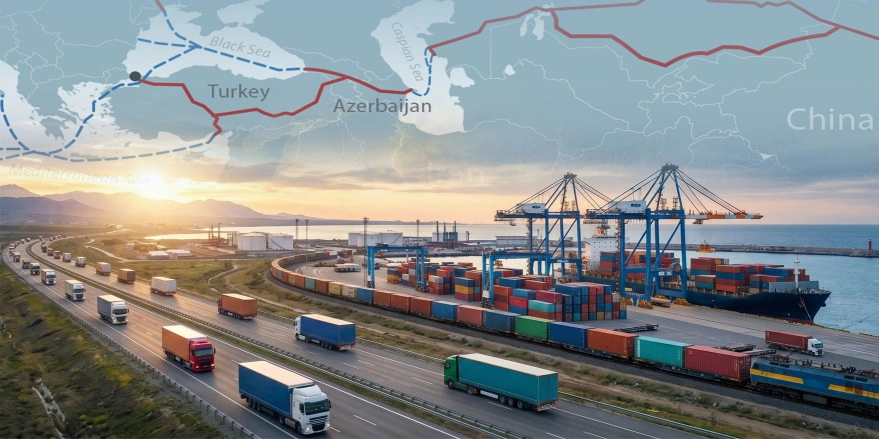
BAKU, Azerbaijan, August 10. Azerbaijan
continues to strengthen its position as an international
transportation and logistics hub. Thanks to the development of the
East–West and North–South international transport corridors, as
well as the implementation of major infrastructure projects in
recent years, the volume of transit cargo for the first seven
months of 2026 exceeded 9.1 million metric tons, reaching a
five-year high.
According to data from the Ministry of Digital Development and
Transport, this figure is 11.6% higher than during the same period
last year. Specifically, the volume of transit freight traffic
along the East–West route increased by 16.5%, and along the
North–South route by 14.3%.
Furthermore, it is noted that these results demonstrate a
significant strengthening of Azerbaijan’s strategic position and
competitiveness amid changes in global trade routes, as well as
thanks to reforms implemented in recent years in the areas of
transportation and logistics, digitalization, infrastructure
modernization, and the expansion of international cooperation. At
the same time, Azerbaijan’s position and competitiveness within the
Middle Corridor and the North–South Corridor have been
significantly strengthened.
“This trend is a direct result of the reforms implemented in
recent years in the transportation and logistics sectors. These
include infrastructure modernization, improved operational
efficiency through coordination among relevant agencies,
digitalization, and expanded international cooperation. Changes in
global trade routes have also played a role. Taken together, these
factors have significantly strengthened Azerbaijan’s position and
competitiveness on the Middle Corridor and North–South routes,” the
statement says.
Transportation time is reduced, and competitiveness
is enhanced.
In addition, it was emphasized that one of the most significant
outcomes of the reforms implemented along the Middle Corridor is
the acceleration of freight transport: “A few years ago, transport
along the China-Europe route took 38–53 days, but now that time has
been reduced to an average of 12 days. The introduction of
electronic permit systems, digital solutions such as e-TIR and
e-CMR, real-time cargo tracking, the streamlining of customs and
border procedures, and the acceleration of information exchange
between government agencies have significantly contributed to
reducing transit times.
As part of this approach, Azerbaijan has implemented several
large-scale projects: increasing the capacity of the
Baku-Tbilisi-Kars railway to five million metric tons per year;
modernizing border crossings; electrifying and upgrading the
railway network; constructing and renovating highways; and
developing airport infrastructure.
One of the key steps in this direction is the “Single Window”
information system, a digital logistics platform created by the
Ministry of Digital Development and Transport. This platform
accelerates document processing, simplifies procedures, and creates
a more flexible logistics ecosystem for businesses. The next phase
involves integrating the platform with similar systems in partner
countries along the Middle Corridor, which will further improve
efficiency along the route.
At the same time, the Ministry of Digital Development and
Transport, in collaboration with international partners, is working
on the phased implementation of modern digital tools for
transportation, such as the electronic consignment note systems
“e-CMR,” “e-Permit,” and “e-CIM/SMGS.” The implementation of these
tools will expand the use of paperless technologies in
international transportation and ensure a more efficient exchange
of transportation data among participants in international
transport corridors.
Maritime transport capabilities are being
strengthened.
In addition, it was noted that the efficient operation of the
Caspian section is crucial for enhancing the competitiveness of the
Middle Corridor: “In recent years, measures taken to strengthen the
Port of Alat and maritime transport infrastructure have created
favorable conditions for the smooth and efficient transport of
growing volumes of transit cargo.
In light of growing demand, the container throughput capacity of
the Port of Alat has been increased from 100,000 TEU to 150,000
TEU, and the 7th bridge and a new-generation crane with a lifting
capacity of 125 metric tons have been put into operation.
Currently, the port’s annual throughput capacity stands at 15
million metric tons. Upon completion of the ongoing expansion
project, these figures are expected to increase to 25 million
metric tons and 500,000 TEU, respectively.
The high demand for the port is also confirmed by its
performance metrics: last year, the Baku International Sea Trade
Port handled more than 8.2 million metric tons of cargo and 107,000
TEU of containers.
“Alat's Development” Transportation and Logistics Center.
Another important initiative is the construction of a cargo airport
in Alata. The new airport will become part of a multimodal
logistics complex that integrates the capabilities of maritime,
rail, road, and air transport, which will improve cargo handling
efficiency and expand the potential of the Middle Corridor.
At the same time, to meet the growing volume of cargo shipments
across the Caspian Sea, construction of four cargo ships under the
first international commercial order is continuing at the Baku
Shipyard. In addition, on September 16, 2025, a contract was signed
between Baku Shipyard LLC and the AD Ports Group for the
construction of two container ships, each with a capacity of 780
TEU, intended for operation in the Caspian Sea. Furthermore,
measures such as the project to build large-capacity ferries, the
expansion of ro-ro transport, joint initiatives with the private
sector, and the phased modernization of the fleet will further
increase the throughput capacity of the Caspian Strait and
strengthen the stability of cargo transportation along the Middle
Corridor.
These measures are already yielding concrete results. For
example, from January through July 2026, container traffic at the
port of Alyat increased by 20% compared to the same period last
year, reaching 72,370 TEU, while dry cargo transshipment grew by
82%, reaching 1.4 million metric tons.
Cooperation within the Middle Corridor is
expanding.
The report notes that Azerbaijan is actively cooperating with
its partner countries along the Middle Corridor to strengthen
transportation links, streamline border crossing procedures, and
expand digital information exchange: “The modernization of the
Baku–Tbilisi–Kars railway line and the increase in its capacity,
the signing of contracts for the procurement of new, modern
passenger and freight cars, the strengthening of coordination among
Caspian Sea ports, and joint projects implemented within the
framework of the Trans-Caspian International Transport Route,
further enhance the route’s reliability and competitiveness.
Azerbaijan is actively cooperating with all countries located
along the Middle Corridor to synchronize the development of
transport infrastructure and improve the efficiency of
transportation along the route. To this end, several bilateral and
multilateral roadmaps, agreements, and memorandums of understanding
have been signed, aimed at coordinating joint infrastructure
projects, developing transport links, and improving the efficiency
of transport operations. Work is currently underway to draft a
multilateral agreement, which will be an important step toward the
future development and institutional strengthening of the Middle
Corridor.”
Transportation infrastructure contributes to
sustainable development.
“The observed growth in transit freight traffic not only drives
the development of the transportation sector but also boosts value
added and economic activity in the non-resource sector as a whole.
At the same time, strengthening transit capacity reinforces
Azerbaijan’s role as a reliable partner in global supply chains,
increases its attractiveness to foreign investment, and further
enhances the country’s geo-economic significance. “Azerbaijan’s
development as a transit and logistics hub extends beyond the
transportation sector and forms an important foundation for the
diversification of the non-resource economy, the deepening of
regional economic integration, and long-term sustainable economic
growth,” the statement reads.