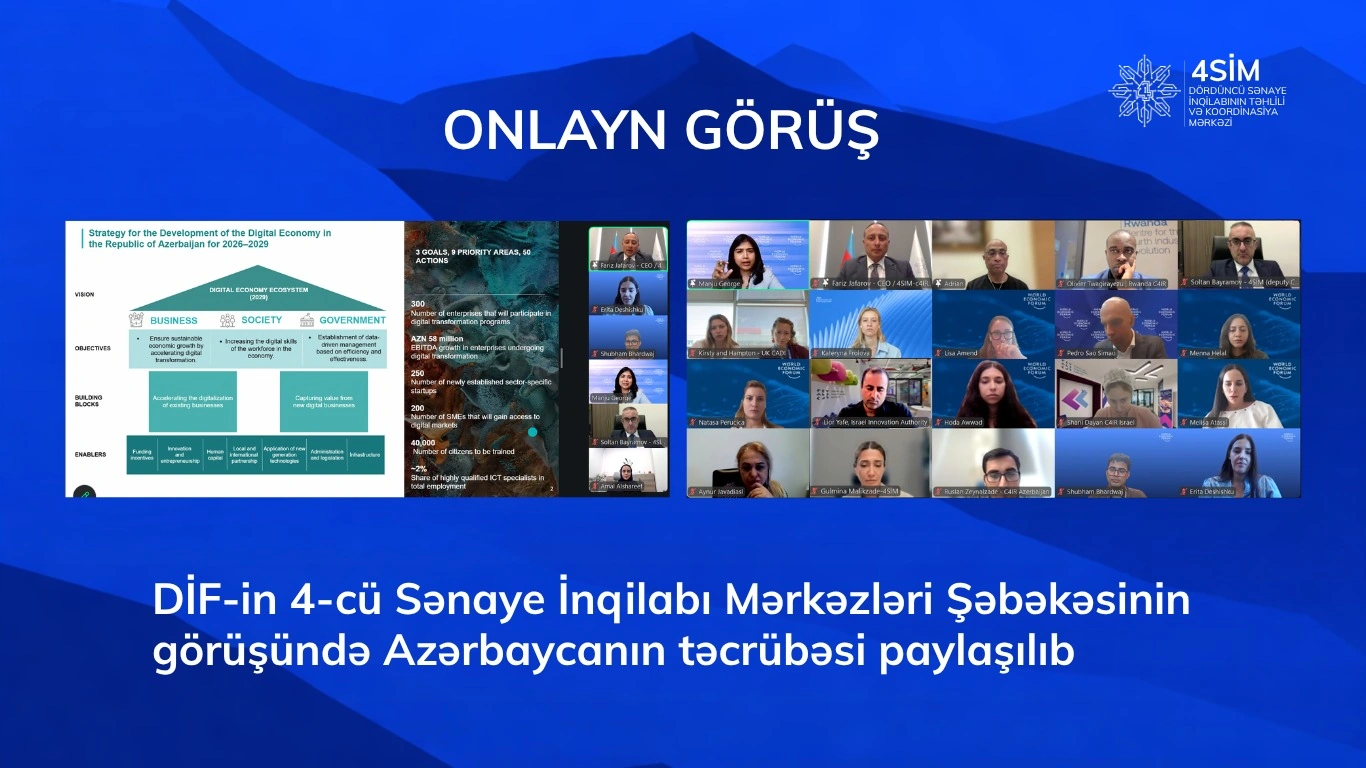
BAKU, Azerbaijan, August 13. Fariz Jafarov,
Executive Director of the Center for Analysis and Coordination of
the Fourth Industrial Revolution (C4IR) under the Ministry of
Economy of Azerbaijan, took part in an online meeting dedicated to
shaping national agendas within the framework of the World Economic
Forum’s Network of Fourth Industrial Revolution Centers (WEF).
This was announced in a report published by C4IR.
According to the report, the meeting discussed the contribution
of the centers within the network to the development of strategic
initiatives at the national level, as well as successful
experiences in this area.
Fariz Jafarov presented information on the “Strategy for the
Development of the Digital Economy of the Republic of Azerbaijan
for 2026–2029.” It was noted that the strategy aims to accelerate
digital transformation in business, society, and the public sector,
develop digital skills, and strengthen data-driven governance.
The strategy covers 9 priority areas and 50 initiatives.
The presentation covered the Industry 4.0 ecosystem established
in Azerbaijan, support for the technological and “green”
transformation of enterprises, the development of human capital,
and the adoption of new technologies. It was noted that, as part of
the strategy, the plan is to engage 300 enterprises in digital
transformation programs by 2029, create 250 new industry-specific
startups, provide access to digital markets for 200 SMEs, and
involve 40,000 citizens in specialized training.
At the meeting, attended by the heads of 24 centers within the
network, as well as Manju George, Head of Strategic Impact and
Integration for the Centre for Frontier Technologies and
Innovation, she shared her experience working with Fourth
Industrial Revolution centers in Azerbaijan, Rwanda, and Malaysia.
During the meeting, participants exchanged views on effectively
contributing to the development of national programs, collaborating
with stakeholders, successful approaches, and current
challenges.
Meanwhile, earlier, Fariz Jafarov, Executive Director of the
Center for Analysis and Coordination of the Fourth Industrial
Revolution (С4IR), told Trend that the adoption in 2025 of the
documents “Strategy for the Development of Artificial Intelligence
in the Republic of Azerbaijan 2025–2028” and the “Strategy for the
Development of the Digital Economy of the Republic of Azerbaijan
2026–2029” in 2025 had, for the first time, brought the country’s
digital and technological transformation together into a unified,
measurable, and results-oriented system.
“Starting in 2026, С4IR’s priorities will be directly linked to
the implementation of the ‘Strategy for the Development of the
Digital Economy of the Republic of Azerbaijan for 2026–2029’ and
will focus on the practical implementation of the key initiatives
outlined in this strategy. In this context, С4IR’s main priorities
will be to expand the application of Fourth Industrial Revolution
technologies, such as artificial intelligence, data analytics,
digital twins, and generative artificial intelligence, across
various sectors of the national economy, particularly in industry
and the business sector, as well as the implementation of
technological transformation programs at enterprises and the
establishment of data-driven decision-making mechanisms,” he
noted.
In addition, Anton Aristov, managing director and partner at the
global consulting firm Boston Consulting Group, headquartered in
Boston (U.S.), stated in an exclusive interview with Trend that
Azerbaijan could play a key role in the implementation of
artificial intelligence in the energy sector.
"Our top priority in transforming Azerbaijan into a regional
innovation hub is to establish sustainable ties with the global
artificial intelligence ecosystem. We are working with investors
from Silicon Valley and aim to attract venture capital so that the
project can develop independently on a large scale and ultimately
provide services to other energy companies. “Once our first pilot
project is approved, we will be able to export to the world the
knowledge created in Azerbaijan—knowledge developed here and tested
on challenges in the country’s energy sector,” he said.