BAKU, Azerbaijan, August 17. Central Asia has
$71.7 billion in ongoing and planned transport projects across 114
initiatives, with Kazakhstan accounting for 45% of regional
investment, the EDB 2026 Transport Observatory says.
The Observatory, updated as of July 1, 2026 and covering 402
projects with a combined value of $345 billion across 13 Eurasian
countries, identifies Central Asia as one of the key areas for
transport corridor development. "The TRACECA corridor, including
the Trans-Caspian International Transport Route (or Middle
Corridor), attracts $42.8bn, making it the region’s largest
investment destination. The ten largest projects account for 42% of
all transport infrastructure investment in Central Asia," the
Observatory says.
Of the region’s 114 projects, 62% by value are under
implementation, 29% remain in planning, and 9% are at the
documentation stage. Roads account for 56% of Central Asian
transport investment, while rail projects represent nearly 30%.
During 2025 and early 2026, more than $10 billion worth of Eurasian
transport projects were completed, including approximately $6
billion in Central Asia. Major completed projects include the
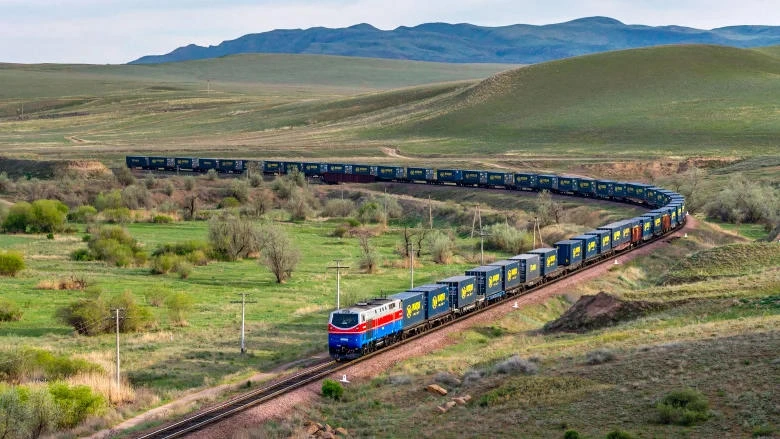
modernized Dostyk-Moyinty railway in Kazakhstan, the
Ashgabat-Mary-Turkmenabat motorway, the
Turkmenbashi-Garabogaz-Kazakh border section of the International
North-South Transport Corridor in Turkmenistan, the Kök-Art Pass
tunnel in Kyrgyzstan, sections of the Obigarm-Nurobod road in
Tajikistan, and the electrified Bukhara-Urgench-Khiva railway in
Uzbekistan.
China’s involvement in Central Asian transport infrastructure
exceeds $12 billion in project value, with more than $7 billion
provided from Chinese financing sources. The
China-Kyrgyzstan-Uzbekistan railway remains the largest individual
project at $4.7 billion. Among the 402 Eurasian projects, 123
involve private sector participation, including 27 PPP projects and
eight potential cross-border PPP initiatives.
International development institutions continue to play an
important role in supporting regional connectivity projects.
Secretary General of the Permanent Secretariat of the
Intergovernmental Commission TRACECA Jasurbek Choriev told Trend that international
financial institutions remain interested in further investments in
the Middle Corridor.
"I recently took part in a major conference in Brussels,
attended by representatives of the European Bank for Reconstruction
and Development, the World Bank and other international financial
institutions. They are all ready to continue investing in improving
the Middle Corridor," Choriev said.
According to him, the European Union has already allocated $10
billion for further development of the corridor’s infrastructure.
He noted that European partners view the Middle Corridor as an
integrated project covering the Black Sea region, the South
Caucasus and Central Asia, with a focus on harmonizing transport
infrastructure.
The Asian Development Bank is also considering further support
for Middle Corridor-related projects in Kazakhstan. ADB Country
Director for Kazakhstan Utsav Kumar told Trend that the bank is currently discussing
projects in road and rail infrastructure under the corridor
framework.
"In March 2026, the government of Kazakhstan and the Asian
Development Bank signed a Memorandum of Understanding on the
implementation of 15 promising projects totaling approximately $5.4
billion between 2026 and 2029," Kumar said.
According to him, the memorandum covers potential cooperation in
road and rail infrastructure, power transmission, disaster risk
reduction and water management. The first two projects already
agreed under the framework - the Saryagash bypass road and a
housing finance project with Otbasy Bank - have a combined
financing volume of $550 million.
Trend’s analysis
shows that the $42.8 billion TRACECA investment figure is among the
most significant indicators in the Observatory for assessing future
corridor development. It places the Middle Corridor among the
largest investment destinations in Central Asia and reflects
growing interest in improving connectivity between Asia and Europe.
The Middle Corridor continues to expand its infrastructure base,
while operational capacity, border procedures, and multimodal
coordination remain key factors determining how quickly additional
transit volumes can be attracted. Trend’s calculations show that 29% of Central Asian
transport investment - approximately $20.8 billion - remains at the
planning stage, meaning that project preparation and financing
arrangements will remain important factors for future
implementation.
Kazakhstan’s share of 45% of Central Asian transport investment
- approximately $32.3 billion - reflects its role as the region’s
largest transit hub and its position along major east-west routes.
The country’s geographic location makes it a central link between
China, the Caspian region and European markets, while its larger
economic base provides additional capacity for infrastructure
development. At the same time, the scale of planned investments
highlights the importance of diversified financing models. More
than 62% of project value is financed through national budgets,
while development banks and international partners provide
additional support for large-scale infrastructure initiatives. The
growing involvement of institutions such as the ADB, EBRD, EDB and
World Bank indicates that regional connectivity projects are
increasingly being developed through a combination of public
financing, international support and private-sector
participation.
The China-Kyrgyzstan-Uzbekistan railway, supported through a
combination of financing mechanisms, illustrates the broader trend
toward cross-border projects designed to connect multiple markets.
Similar approaches are also emerging around the Middle Corridor,
where infrastructure development requires coordination between
several countries and transport systems. In Trend’s assessment, the
future expansion of Central Asian transport corridors will depend
not only on the volume of investment but also on the effectiveness
of project implementation, digitalization of transit procedures and
coordination among participating countries.