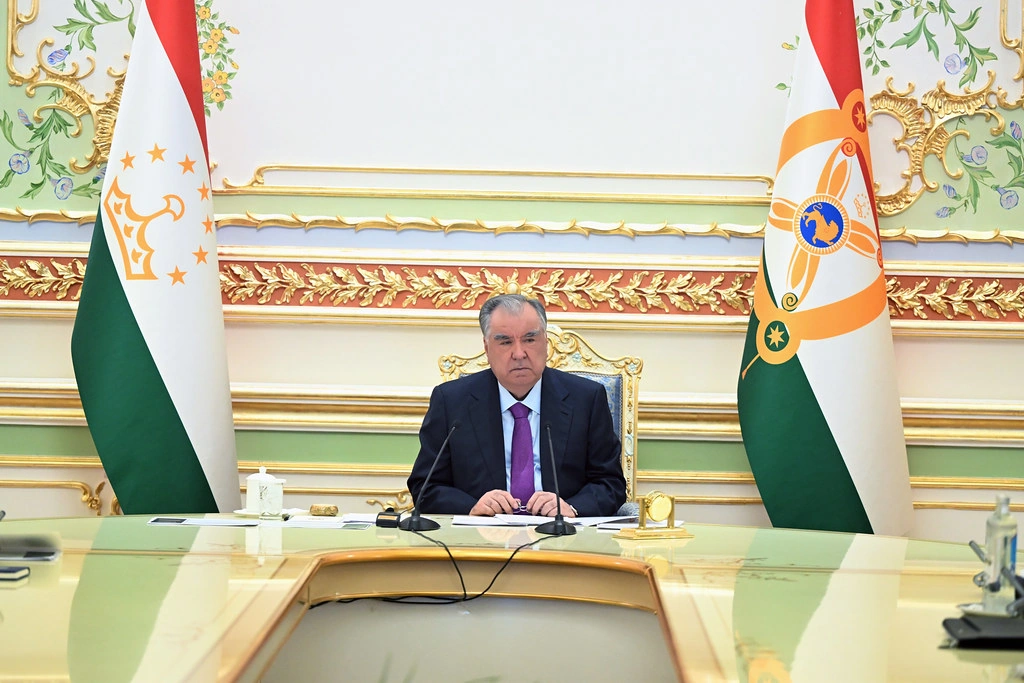
BAKU, Azerbaijan, August 19. The first meeting
of the Council for the Development of the Digital Economy of
Tajikistan was held on August 19 under the chairmanship of
President and Council Chairman Emomali Rahmon.
The information was announced by press service of the President
of Tajikistan.
The meeting focused on priority areas and measures for
implementing the Medium-Term Digital Economy Development Program
for 2026-2030, as well as a proposal on the full digitalization of
public services and integration of databases.
Emomali Rahmon said the establishment of the Council is a
continuation of the government’s policy aimed at modernizing the
national economy, improving public administration and expanding the
use of digital technologies.
He noted that the designation of 2026–2030 as the “Years of
Development of the Digital Economy and Innovation” and the adoption
of the medium-term program had created a foundation for advancing
digital transformation in the country.
According to Emomali Rahmon, digitalization should improve
living standards, save time for citizens and businesses, reduce
additional costs, increase transparency in public administration
and strengthen the competitiveness of the national economy.
The meeting noted that Tajikistan has introduced information
systems and electronic services, but their fragmented operation,
repeated requests for the same data, paper-based procedures and
uncertainty over the implementation of some projects remain
challenges.
In this regard, the integration of digital systems, personal
data protection, cybersecurity, transparency of expenditures and
the "once-only" principle for providing data were identified as key
priorities.
First Deputy Prime Minister and Deputy Chairman of the Council
Khokim Kholikzoda presented a report on the priority areas and
measures for implementing the Medium-Term Digital Economy
Development Program.
Chairman of the State Committee on Investment and State Property
Management Sulton Rahimzoda spoke about attracting investment and
financing mechanisms for digital projects, while Minister of
Education and Science Rahim Saidzoda outlined measures for
workforce training and improving digital literacy.
Director of the Agency for Innovation and Digital Technologies
Khurshed Mirzo presented proposals on the full digitalization of
public services and integration of databases.
The meeting emphasized that each digitalization initiative
should have a specific outcome, implementation deadline, financing
source and designated responsible officials. Annual targets and
final results for 2027–2030 should also be established, while
duplication of projects and financing of unjustified initiatives
should be avoided.
Rahmon identified four key principles for digitalization:
achieving tangible results for citizens and the economy,
establishing a unified state digital infrastructure, applying the
“once-only” principle for data provision, and ensuring equal access
to public services.
Priority areas include developing a unified digitalization
management system, expanding digital infrastructure, creating a
national data system and integrating state registries, fully
transferring public services online, digitalizing the real and
social sectors, developing human capital, digital entrepreneurship
and innovation, attracting investment, using artificial
intelligence and strengthening cybersecurity.
Government bodies at the central and local levels were
instructed to appoint technical specialists responsible for
coordinating and developing digital systems and to establish
permanent cooperation with the Agency for Innovation and Digital
Technologies.
State bodies providing public services were instructed to take
immediate measures to include their services on the unified portal
and ensure their full electronic delivery. Before services are
digitized, their procedures should be simplified, excessive
requirements eliminated and repeated requests for documents and
visits to several government agencies reduced.
The Agency for Innovation and Digital Technologies, together
with the Ministry of Justice and relevant ministries and agencies,
was instructed to prepare a phased plan for the full digitalization
of priority public services.
The Communications Service was instructed to ensure the full and
timely implementation of the sector development plan, with a
particular focus on improving Internet quality and expanding
coverage, especially in remote areas.
The Customs Service, together with the Agency for Innovation and
Digital Technologies, Ministry of Finance, Tax Committee and other
relevant bodies, was instructed to develop and implement a roadmap
for transitioning to fully paperless procedures.
The Ministry of Economic Development and Trade, Ministry of
Finance, State Committee on Investment and State Property
Management, National Bank and Agency for Innovation and Digital
Technologies were tasked with preparing proposals to attract
private capital and develop digital entrepreneurship.
The meeting stressed that state support should be transparent,
competitive and results-oriented, while creating greater
opportunities for domestic companies and the introduction of
innovative products.
The Ministry of Education and Science was instructed to work
with the Ministry of Labor, Migration and Employment, the Committee
for Primary and Secondary Vocational Education, educational
institutions and the private sector to align training and
retraining programs with labor market needs.
The meeting also called for stronger measures to improve digital
literacy among the population alongside professional skills
development.
The Agency for Innovation and Digital Technologies, together
with relevant bodies, was instructed to submit proposals on the
responsible use of artificial intelligence in the national economy
and measures to strengthen cybersecurity.
The government was tasked with assessing the performance of
ministries and agencies based on the results of digitalization.
Heads of state bodies will bear personal responsibility for system
integration, data quality, service simplification, efficient use of
funds and the actual results of digital projects.
Concluding the meeting, Rahmon said the Council should serve as
a platform for making strategic decisions, removing interagency
barriers and exercising strict control over the results of digital
transformation.