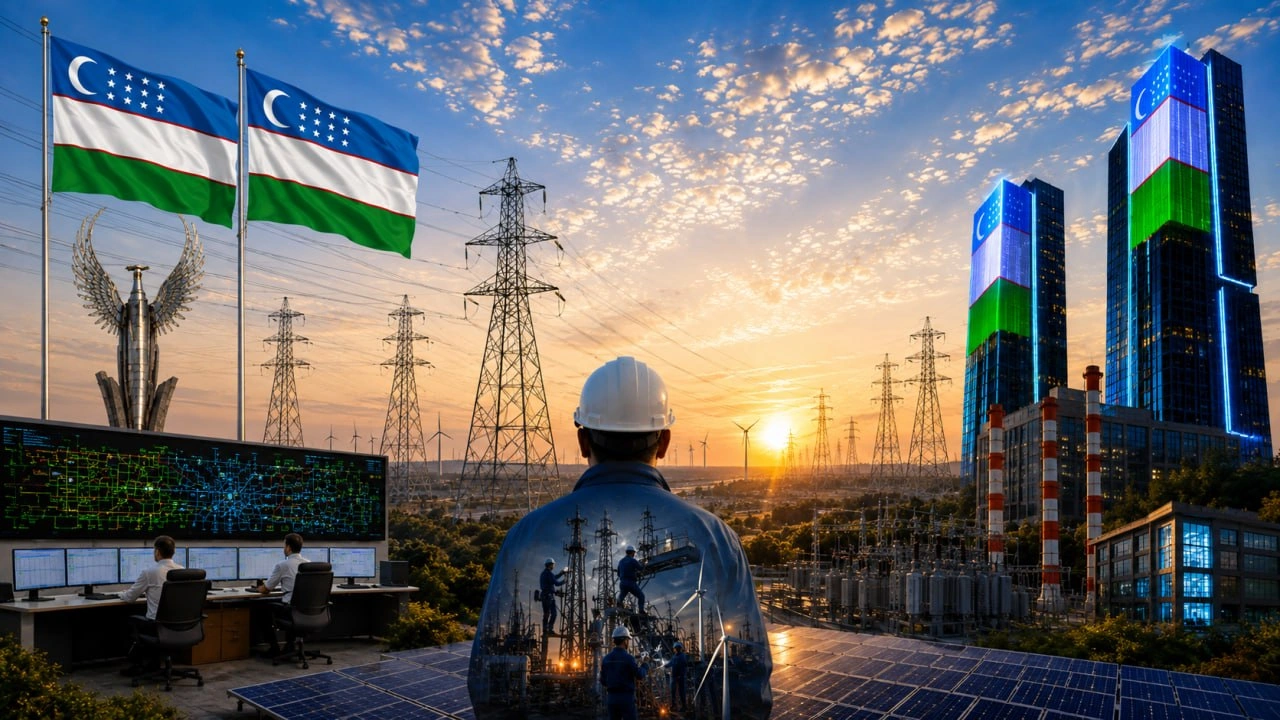
BAKU, Azerbaijan, August 28. Uzbekistan has
commissioned power-generation and energy-storage facilities with a
combined capacity of 2,423 megawatts, including projects in
thermal, solar and wind power.
This was reflected in a statement by the Ministry of Energy of
Uzbekistan.
According to the Ministry, the facilities were commissioned as
part of preparations for Uzbekistan's 35th anniversary of
independence, with total project costs estimated at $1.7
billion.
The largest project is a 1,573-MW thermal power plant in the
Boyovut district of Sirdaryo region. The facility is designed to
generate about 13 billion kilowatt-hours of electricity annually
and has an efficiency rate of 61.7%.
The plant is expected to save about 1.1 billion cubic meters of
natural gas a year. Its $900 million construction project was
implemented with direct investment from a consortium involving
France's EDF, Qatar's Nebras Power, and Japan's Sojitz Corporation
and Kyuden International.
About 3,000 jobs were created during construction, while the
plant is expected to employ 120 people permanently.
Uzbekistan also commissioned a 300-MW solar photovoltaic plant
and a 150-MW energy-storage system in Nurota district of Navoi
region. The $390 million project was implemented in cooperation
with China's China Energy Overseas Investment.
The solar facility is expected to generate 657 million kWh of
electricity annually, equivalent to the yearly consumption of about
273,000 households, while saving 175 million cubic meters of
natural gas and preventing about 377,000 tons of harmful
emissions.
A 200-MW wind power plant and 100-MW energy-storage system were
also commissioned in Karauzak district of Karakalpakstan. The $263
million project, developed with Saudi Arabia's ACWA Power, is
expected to generate 701 million kWh annually, enough to cover the
electricity consumption of about 292,000 households.
The project is also expected to save 187 million cubic meters of
natural gas and prevent about 403,000 tons of harmful emissions
each year.
In Namangan region, a separate 100-MW energy-storage system was
commissioned for $110 million. The facility can store electricity
at 100 MW for two hours, providing up to 200 megawatt-hours of
storage capacity and helping the grid manage peak demand.
Trend's analysis
shows that the newly commissioned facilities combine conventional
generation with renewable energy and storage, giving Uzbekistan
additional capacity while also addressing the growing need for a
more flexible electricity system.
The figures show the scale of the expansion. The 2,423 MW added
across the projects consists of 1,573 MW of thermal generation, 300
MW of solar power, 200 MW of wind power and 350 MW of
energy-storage capacity. Renewable generation capacity therefore
accounts for 500 MW, or about 20.6% of the total installed capacity
announced, while storage represents another 14.4%.
The two renewable-generation projects alone are expected to
produce 1.358 billion kWh annually. Their combined projected
natural-gas savings amount to 362 million cubic meters per year,
while their combined avoided emissions reach approximately 780,000
tons annually.
The projects also demonstrate the growing role of foreign
capital in Uzbekistan's energy sector. The four specifically valued
projects listed above account for about $1.663 billion, or roughly
98% of the announced $1.7 billion total investment.
In Trend's
assessment, the combination of new thermal capacity, renewable
generation and energy storage could help Uzbekistan address rising
electricity demand while reducing pressure on natural-gas supplies.
The storage facilities are particularly important because they can
shift electricity availability toward periods of peak demand and
improve the reliability of renewable-heavy generation.
At the same time, the economic impact will depend on how
effectively the new capacity is integrated into the national grid
and maintained at high utilization rates. For Uzbekistan, the
projects represent not only an increase in generation capacity but
also a broader shift toward a more diversified and flexible energy
system.
The calculations further highlight the scale of the expansion:
of the 2,423 MW of newly commissioned capacity, thermal generation
accounts for 64.9%, renewable energy — solar and wind — for 20.6%,
and energy storage for 14.4%. The solar and wind facilities are
expected to generate a combined 1.36 billion kWh annually, save
about 362 million cubic meters of natural gas, and prevent roughly
780,000 tons of harmful emissions each year. The two renewable
projects alone will generate enough electricity to cover the
estimated annual consumption of about 565,000 households, while the
four projects with disclosed investment costs total approximately
$1.66 billion, accounting for nearly 98% of the announced $1.7
billion investment package.