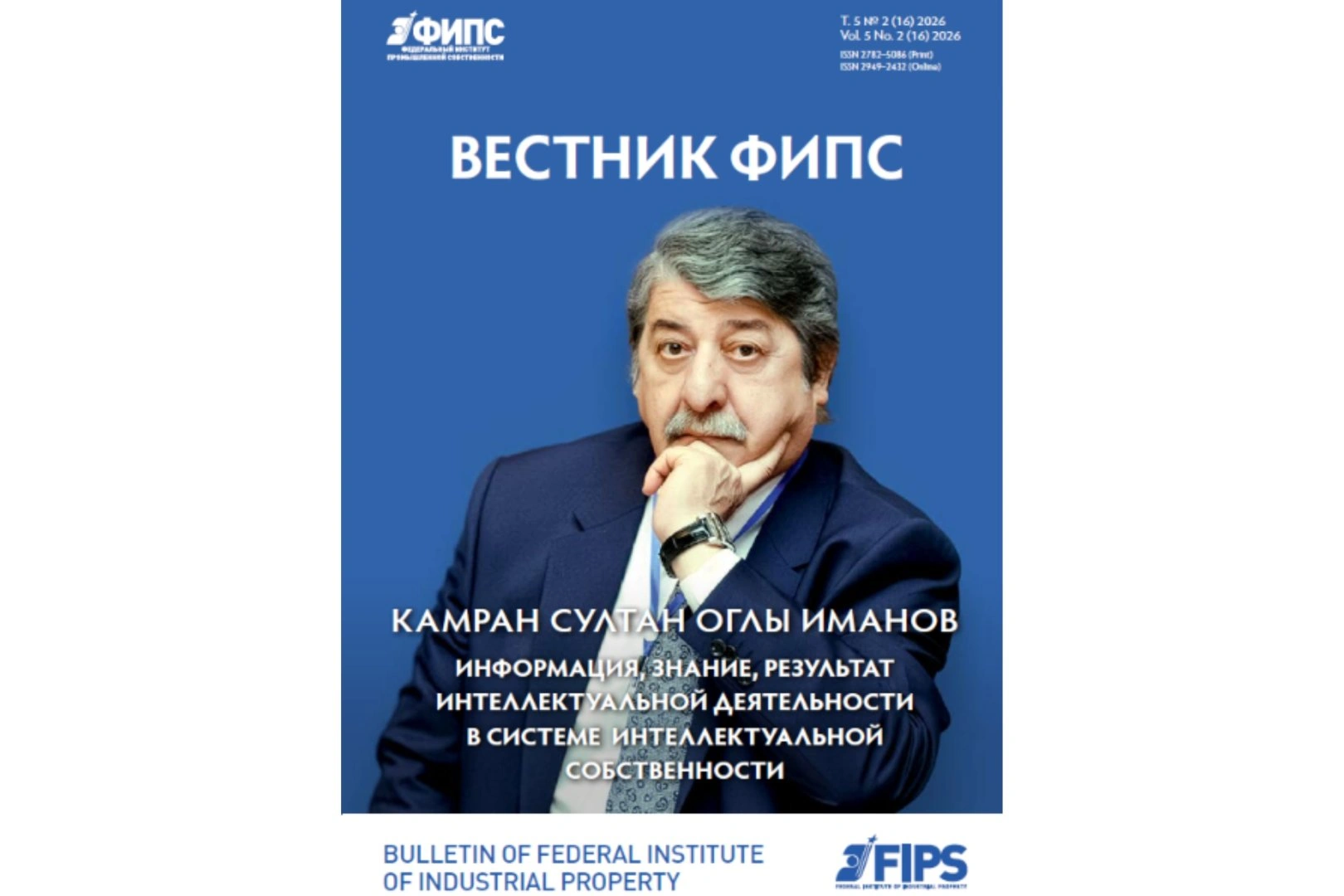
BAKU, Azerbaijan, August 28. Issue No. 2 of the
scientific and practical journal 'Vestnik FIPS', published in 2026
by the Federal State Budgetary Institution “Federal Institute of
Industrial Property” of the Federal Service for Intellectual
Property of the Russian Federation (ROSPATENT), a comprehensive
article by Kamran Imanov, Chairman of the Board of the Intellectual
Property Agency of the Republic of Azerbaijan, titled “Information,
Knowledge, and the Results of Intellectual Activity in the
Intellectual Property System” has been published.
This was announced in a statement by the Intellectual Property
Agency.
Notably, the “Vestnik FIPS” is among the publications that exert
significant influence worldwide. It covers the results of
scientific research in the field of intellectual property, devotes
considerable space to cutting-edge ideas and research in the field
of industrial property and the patent system, and publishes
articles by renowned experts on current issues in intellectual
property.
An article published in the journal by K. Imanov, Chairman of
the Board of the Intellectual Property Agency of the Republic of
Azerbaijan, also provides a detailed analysis of the nature,
origins, and circulation of intellectual property in the modern
world, where the knowledge economy has become the dominant paradigm
of development. The author, characterizing intangible assets
(namely, knowledge, information, and creative ideas) as the primary
resources of production, emphasizes that their legal and economic
classification is associated with a number of fundamental
complexities. He notes that new realities driven by
innovation-based socioeconomic development make the institutional
rethinking and strengthening of the very category of “intellectual
property” (IP) a necessary condition. According to the author, in a
context where knowledge serves as the primary resource of
production, the category of “IP” is closely intertwined with the
economic and sociocultural spheres and requires an
interdisciplinary approach.
Imanov also draws readers’ attention to the fact that “the
modern understanding of the concept of ‘IP’ implies not only the
exclusive rights of a natural or legal person to the results of
intellectual activity (RIA), but first and foremost the RIA
themselves, which are protected by legal rights.”
This is a very important scientific finding. It demonstrates a
systematic understanding of the origins of the institution of
intellectual property, which, alongside law (jurisprudence), also
requires an understanding of the economic and sociocultural
significance of this institution.
Professor Imanov’s article presents an analysis of the interplay
between information, knowledge, the results of intellectual
activity, and intellectual property. The author emphasizes that
intellectual property originates as knowledge, acquires legal
protection only after being transformed into an objective form, and
turns knowledge into an economic resource through exclusive
rights.
This article analyzes the differences between philosophical and
legal concepts of the results of intellectual activity, as well as
the relationship between the concepts of “information” and
“knowledge” in the context of contemporary challenges in the field
of intellectual property. The scientific novelty of this
study lies in its examination of the relationship between the
results of intellectual activity and intellectual property using a
classical approach and fuzzy logic. The author demonstrates that it
is more appropriate to use methods of fuzzy logic and fuzzy neural
networks to model interrelationships in the field of intellectual
property, as well as to apply them in artificial intelligence
systems.
This article, based on the formula “Information – Knowledge –
IIP – Intellectual Property,” interprets intellectual property (IP)
as the results of intellectual activity (IP) protected by rights.
The author prefers to refer to IP as IP protected by rights, and
this approach is of great interest to intellectual property
specialists.
According to K. Imanov, “the right to IP arises in the process
of objectification or transformation of knowledge, which is
subjective and belongs solely to an individual; that is, knowledge
becomes an objective, transferable form on a tangible medium. In
this process, IP “materializes,” becomes perceptible, and thereby
acquires the status of an “intellectual property object.”
Thus, intellectual property, by protecting intangible assets
such as knowledge and information, safeguards creativity and
innovation, which are perceived as universal natural resources.
One of K. Imanov’s conclusions is that “as a category situated
between subjective knowledge and objective cultural fact, IP has a
broader significance from a philosophical standpoint than the scope
of the legal concept.”
The author provides a comprehensive explanation of the
interrelationship between the concepts of “information,”
“knowledge,” and “intellectual property,” and identifies the mutual
transformation of information and knowledge in the process of the
subjectivization of information and the objectivization of
knowledge. The article also presents comparative frameworks for
these concepts in terms of their essence, form, subjectivity, and
legal status.
The definition of the concept of intellectual property is
reflected in a number of legislative acts, including the Law of the
Republic of Azerbaijan “On the Protection of Intellectual Property
Rights and the Fight Against Piracy.”
The article was prepared at the intersection of knowledge in the
fields of intellectual property, law, philosophy, information,
artificial intelligence, and cybersecurity. The findings are of
particular significance for improving legislation and asset
management in the digital environment.
Scholars, young researchers, lawyers, and students can benefit
from K. Imanov’s article “Information, Knowledge, and
Results of Intellectual Activity in the Intellectual Property
System,” published in Issue 2 of the journal “Vestnik
FIPS.”
The full text of K. Imanov's article can be read here.