BAKU, Azerbaijan, September 1. New mechanisms
have been established in Azerbaijan to regulate the activities of
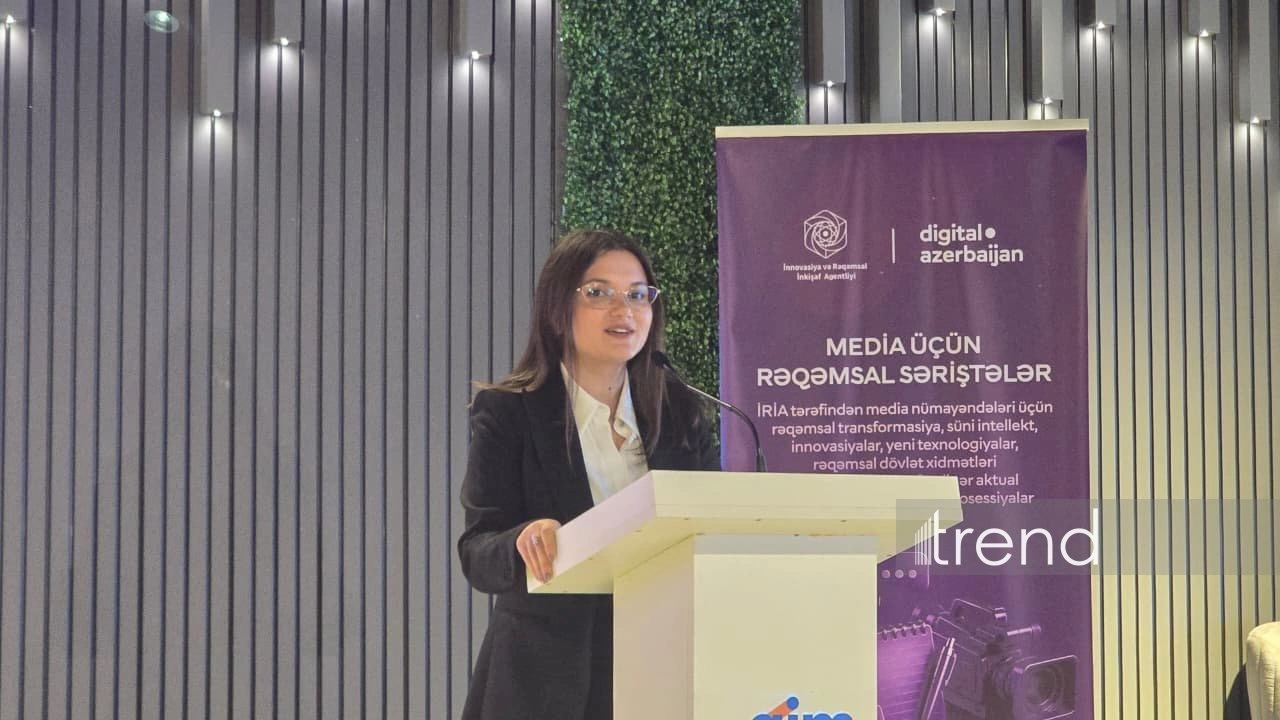
venture funds to finance startups, Head of Corporate Law Department
of the Innovation and Digital Development Agency (IDDA), Turkan
Hajiyeva, said during her speech on the topic "Development of the
digital and innovation ecosystem in Azerbaijan: new legislative
opportunities" organized within the framework of the educational
session "Digital skills for the media", Trend's correspondent
reports from the event.
According to her, traditional banking and financing mechanisms
are not always available for startups that have high potential but
also carry high risk.
"Traditional banking and financial access mechanisms are not
fully functional for startups. Because banks and insurance
organizations usually require collateral or other security during
financing. Startups do not always have the financial resources to
provide such security," Hajiyeva noted.
She pointed out that although state support mechanisms exist,
the limited volume of grants creates certain difficulties in
financing large innovative projects.
"The funds allocated in the form of grants are smaller than in a
number of other countries. This does not allow creating sufficient
financial access for large innovative ideas that apply artificial
intelligence and high technologies," the department head
emphasized.
According to Hajiyeva, the need for financing also changes
during the development stages of startups.
"At the initial idea stage, startups usually start operating
with initial support from family and relatives. Later, they can use
certain state support mechanisms. However, most local startups are
able to pass the initial grant stage in some form. The main problem
arises at the stage of testing after the development of a minimum
viable product (MVP)," she explained.
According to her, one of the most effective financing mechanisms
at this stage is venture financing.
"One of the most ideal financing mechanisms for startups that
have an idea, are at the stage of developing a prototype, or have
already developed an initial prototype is to attract funds from
external investors. This is carried out through venture financing,
unlike the state support mechanism," Hajiyeva said.
She underscored that technological failure in innovation
projects should also be accepted as a possible outcome.
"Innovation activity is an area where there is no guarantee that
an idea will always be successful. Technological failure is also
one of the possible outcomes of the innovation process," the head
of the department noted.
Hajiyeva also noted that based on this approach, the legal basis
for venture financing and crowdfunding activities in Azerbaijan has
been formed.
According to her, relevant amendments have been made to the law
"On investment funds" regarding the activities of venture
capital.
"Along with traditional investment funds, mechanisms have been
created that can attract and implement investments more flexibly,
attracting funds from a special category of accredited investors,"
Hajiyeva clarified.
She highlighted that when developing new mechanisms, the
protection of investors' interests was also taken into account.
"We approach this from the aspect of protecting investors'
interests. Not every investor can place funds through a venture
financing instrument or manage those funds. Because there are
sufficient financial and systemic risks in this area," she
stressed.
The official further said that within the framework of the new
approach, not only the organizational and legal principles of
venture funds, but also issues related to their investors and
investment instruments have been regulated.
"Improvements have been made in three main areas: who should be
the investors of venture funds, how should the investment
instruments of the funds be determined, and how should the
flexibility of these instruments be ensured," Hajiyeva noted.
According to her, a specific investment mandate for the
activities of venture funds has also been determined.
"Venture funds must direct at least 70% of their capital
directly to the innovation ecosystem through funds raised from
professional investors. These funds should be invested in startups,
residents of the Technology Park, companies with innovative ideas
and meeting the established requirements," the head of the
department said.
Hajiyeva added that the goal is for venture funds to become an
investment instrument that actively participates in the development
and sustainable formation of the innovation ecosystem.
She noted that the time-consuming processes of buying and
selling securities, formalizing them, and documenting them through
the deposit system necessitated the creation of flexible mechanisms
in venture investments.
"The technological field is developing very rapidly. In cases
where attracting foreign investment or a rapid investment phase is
necessary, a flexible mechanism is needed. Therefore, we have
formed mechanisms that can operate more quickly and flexibly," said
Hajiyeva.
According to her, within the framework of the new operating
regimes, free-reporting venture activities and licensed venture
activities have been determined.
Hajiyeva said that the creation of free-reporting venture funds
doesn't mean that they will operate completely unsupervised.
"In relation to these funds, all the heavy identification and
prudential requirements that the Central Bank applies to licensed
funds won't be applied to the same extent. A simplified declaration
mechanism is applied to these funds as long as the volume of
managed assets is up to 50 million manat ($29 million)," she
noted.
The official noted that this mechanism involves declaring the
direction of activity to the Central Bank after the fund is
established.
"A venture fund declares its activities to the Central Bank
after determining its legal and organizational form and necessarily
indicating the phrase "venture capital fund" in its name. The
prudential requirements applied to other licensed funds do not
fully apply to these funds during the period when the volume of
managed assets is up to 50 million manat," Hajiyeva said.
She added that independent reporting venture funds must involve
an external auditor at least once a year and submit the results of
the audit to the relevant authority.