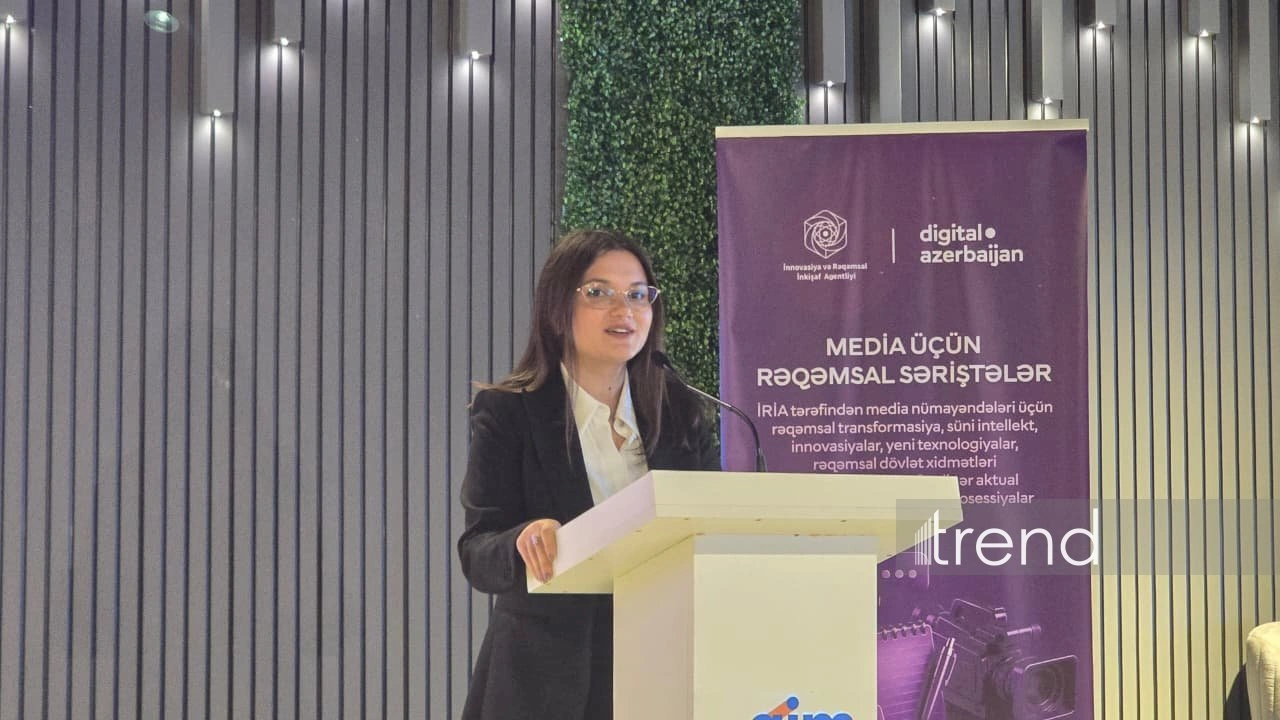
BAKU, Azerbaijan, September 1. New investment
instruments are being created for venture funds in Azerbaijan, Head
of Corporate Law Department of the Innovation and Digital
Development Agency (IDDA), Turkan Hajiyeva, said during her speech
on the topic "Development of the digital and innovation ecosystem
in Azerbaijan: new legislative opportunities" organized within the
framework of the educational session "Digital skills for the
media", Trend's
correspondent reports from the event.
According to her, the legal basis for new financial instruments
such as SAFE (Simple Agreement for Future Equity) and convertible
securities has been formed for investing in startups in
Azerbaijan.
"After attracting funds from professional investors, these funds
can be invested in startups through SAFE and convertible
securities," Hajiyeva noted.
According to her, the SAFE mechanism facilitates investment,
especially in startups, which are at an early stage and whose
shares or stakes haven't yet been formed.
"SAFE is a deal concluded in relation to property rights that
will be acquired in the future. The startup may not have shares or
stakes that it can give to the investor today. In such a case, how
can the investor secure his rights in return for the funds he has
invested? For this purpose, the legal basis of SAFE agreements was
formed within the framework of the amendments to the Civil Code,"
the official pointed out.
Hajiyeva emphasized that this mechanism envisages granting the
investor appropriate rights in the event that certain conditions
occur between the investor and the startup in the future.
"When a certain conversion event occurs in the future, for
example, when the startup reaches a certain stage of development or
the commercialization of the product is ensured, the shares and
other property rights that the investor will acquire in the future
are secured in advance on the basis of a contract. This creates a
legal basis for protecting the rights and interests of the investor
in the event that the startup is successful and grows," she
said.
The head of the department noted that the previous legislation
didn't have sufficiently clear mechanisms for regulating such
relations.
"The main purpose of these legislative changes is to clarify the
investor. The investor should know what rights he has in return for
the funds he has invested and at what level and by what legal
mechanisms these rights are protected," Hajiyeva stressed.
According to her, within the framework of the new approach, a
number of new legal institutions have also been formed regarding
the corporate agreement, special transactions regulating relations
between investors and shareholders, and emission rights.
"Instead of creating special economic zones, we have directly
integrated the legal institutions necessary for this area into
civil legislation. The corporate agreement, special agreements
regulating relations between investors and shareholders, emission
rights, and other mechanisms have been formed within this
framework," she added.
Hajiyeva also highlighted that venture funds can operate under
two different regimes.
"We have identified two approaches: free reporting venture
activities and licensed venture activities. There is no license
requirement for free reporting venture funds. They can start
operating by applying in a simplified manner," the head of the
department said.
She noted that a venture capital fund can also operate as a
licensed fund by applying to the Central Bank if it wishes. In this
case, the fund is subject to reporting, identification and other
prudential requirements.
"Free-reporting funds do not mean completely unregulated funds.
It is just that all the heavy prudential and identification
requirements applied to licensed funds aren't applied to them to
the same extent. These funds are required to engage an external
auditor once a year and submit the audit results to the relevant
body," Hajiyeva underscored.
The department chief further said that the list of documents
required for the activities of free-reporting venture funds has
also been simplified.
"The main documents, such as the fund's constituent documents,
investment and risk policy, are submitted. The main goal here is to
ensure informing investors about the potential risks by the fund
manager, as a financial intermediary," she noted.
According to Hajiyeva, innovative projects are considered
high-risk investment instruments, and therefore, it's especially
important for investors to be informed about the risks in
advance.
"Innovative projects are risky projects in any case. In such
investments, a significant part of the funds may result in an
unsuccessful investment. Therefore, it's important to disclose the
risk policy and inform investors," she added.