BAKU, Azerbaijan, September 3. Germany is
proposing financing for green projects in Azerbaijan for up to 22
years, Underwriter for Africa, Eastern Europe, Southern Caucasus
and Central Asia, Annika Richter-Rahman, said during the online
webinar “Azerbaijan: infrastructure development, electromobility
and solutions for energy storage from renewable sources”, Trend's correspondent
reports.
According to her, the German side provides protection against
default on export receivables, including in individual
transactions, as well as various types of insurance coverage for
export credits, supplier-buyer loans, and project financing.
"Project financing is quite relevant in the renewable energy
sector," she explained.
Richter-Rahman noted that when purchasing from a German
exporter, the Azerbaijani side can receive long-term financing.
"We offer financing terms of up to 15 years, and for green
projects, which most renewable energy projects are, repayment terms
can reach 22 years.
One of the main advantages is the AAA rating, which is supported
by the German government and reduces the cost of financing. Germany
also provides expert support in project structuring, including in
the early stages. If you are in the early stages of project
structuring and are considering various financing options, we are
ready to discuss and explore how the project can be structured so
that you can take advantage of our offer," she pointed out.
Speaking about the terms of insurance coverage for Azerbaijan,
Richter-Rahman clarified that the country's policy in this area is
quite open.
"We don't have a limit, so we're truly unlimited in the amount
we can insure. For short-term coverage, additional guarantees are
not required. For medium- and long-term coverage, a bank guarantee
or financial statements prepared in accordance with International
Financial Reporting Standards (IFRS) are usually required. We
typically require financial statements prepared in accordance with
IFRS. If they are close to IFRS, it's also worth contacting us, and
we can see if an exception is possible. This is considered on a
case-by-case basis," she said.
According to Richter-Rahman, to receive support for regular
projects, a German exporter must be involved in the transaction,
and significant German content must be ensured.
"For all regular transactions, we generally require at least 51%
of the transaction to be of German origin. For green deals, the
minimum requirement is 30%," she announced.
She also said that when assessing a project, the German side
analyzes not only its compliance with the support requirements but
also the justification for the risk. Specifically, the buyer's
financial statements for the past three years are typically
reviewed.
"In the case of project financing, this will also include
offtake contracts," she added.
Richter-Rahman also spoke about expanded coverage conditions for
green projects.
"Longer financing terms are available for such projects—up to 22
years—and the German content requirements are more flexible.
It is possible to include up to 70% foreign content in the
transaction. This can also be financed as part of the overall
project. This could be relevant, for example, when incorporating
local costs and additional supplies in the solar energy sector.
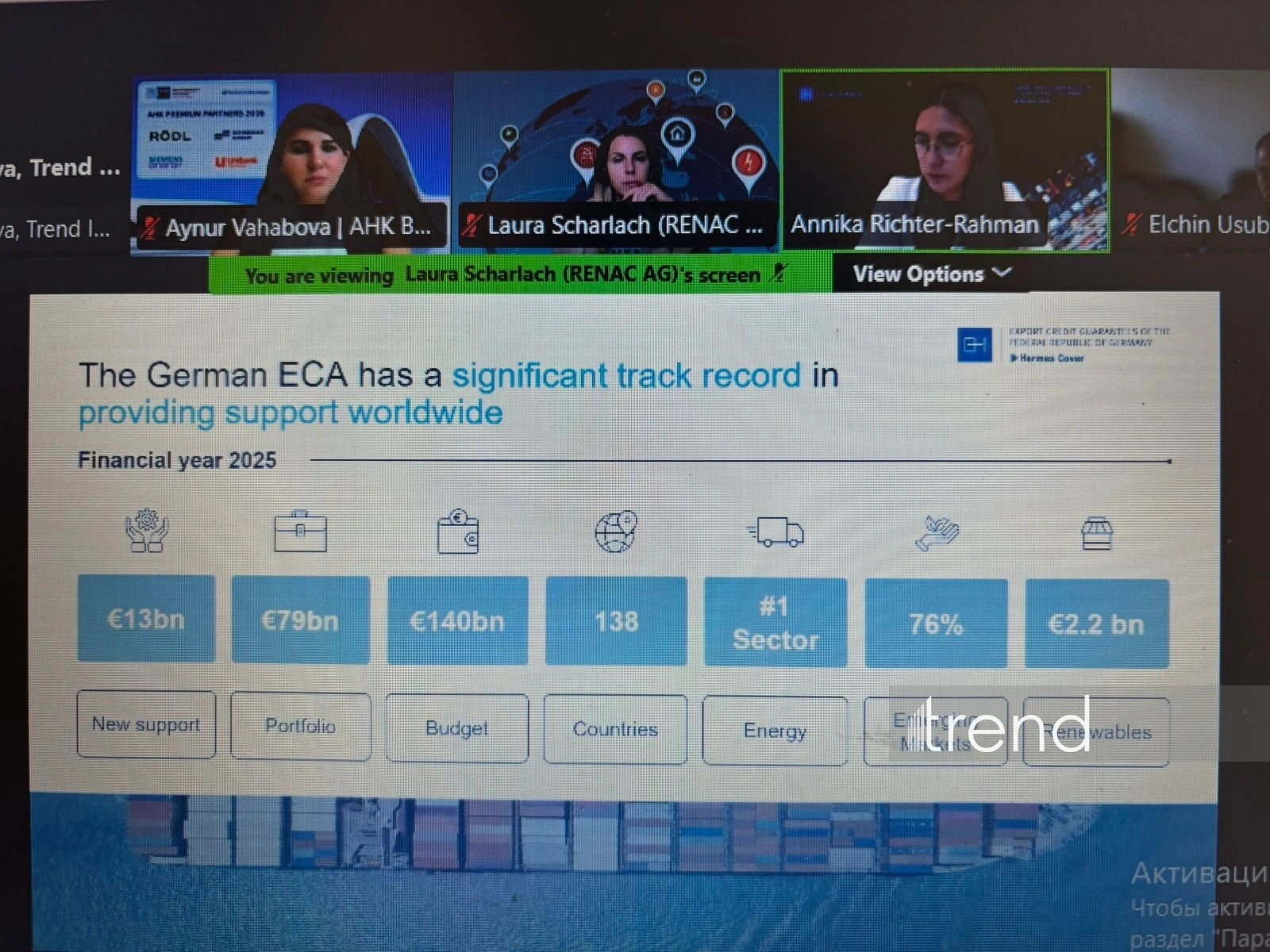
Last year, new insurance coverage was provided for projects worth
13 billion euro. That same year, we supported projects in 138
countries. 76% of our portfolio was in emerging markets," she
said.
According to her, last year, insurance coverage was also
provided for new renewable energy projects worth 2.2 billion
euro.
"These were primarily wind and solar energy projects, as well as
energy storage systems," she also explained.
She added that the German side had previously provided insurance
coverage for wind and other renewable energy projects in
Azerbaijan.