BAKU, Azerbaijan, September 3. An Energy Trade
Mission will be held in Baku with the participation of German
companies operating in the energy sector on December 7-10 this
year.
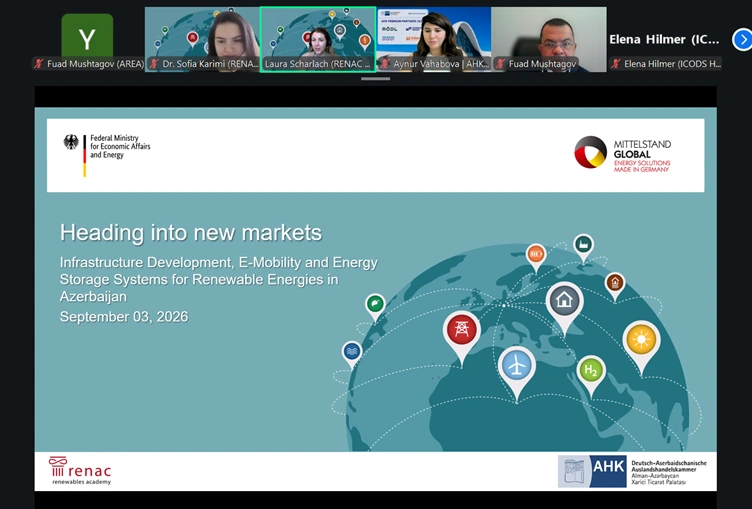
This was announced by the Azerbaijan Renewable Energy Agency
(AREA) under the Ministry of Energy following an international
webinar on "Infrastructure development, e-mobility and renewable
energy storage solutions in Azerbaijan."
According to the agency, the trade mission will be organized
within the framework of the German Energy Export Promotion
Initiative at the initiative of the German Federal Ministry for
Economics and Energy.
Head of Stakeholder Engagement and Partnerships,
German-Azerbaijani Chamber of Commerce (AHK Azerbaijan), Julia
Egel, noted that the mission includes meetings with representatives
of the Azerbaijani Ministry of Energy, a business roundtable,
briefings, and B2B meetings.
"B2B meetings are especially important for you, because you want
to establish direct contacts and explore your opportunities. AHK
Azerbaijan will coordinate B2B meetings, taking into account the
interests of the participating German companies, and will support
in finding relevant partners," Egel said.
According to her, diversification and the introduction of new
technologies in the energy sector of Azerbaijan expand cooperation
opportunities for German companies. In particular, the
modernization of energy networks, integration of energy systems,
energy storage systems, and charging infrastructure for
electromobility are considered promising areas.
"Azerbaijan has great potential for solar and wind energy. When
we talk about large-scale solar and wind energy projects, we see
great demand, as well as numerous opportunities. Given Azerbaijan's
geographical location and role in the Middle Corridor, in the
future, the production of electricity from renewable sources may
also be of interest for export to Europe," Egel pointed out.
She added that the measures taken to diversify the energy
balance and increase its sustainability create opportunities for
the application of relevant technologies and solutions.
Head of Hydrogen and Green Technologies, AREA, Fuad Mushtagov,
said that along with renewable energy infrastructure in the
country, modernization of the electricity grid and increasing the
flexibility of the energy system are among the main priorities.
"The development of renewable energy is closely related to the
development of infrastructure and the electricity grid. The fifth
national priority also covers environmentally friendly vehicles and
other "green" technologies. In particular, work is underway to
develop a National Plan for electromobility," he noted.
According to Mushtagov, Azerbaijan is also exploring the
possibilities of hydrogen production and its use in various
sectors, energy storage, bioenergy, and green geothermal energy, as
well as the application of carbon capture, utilization, and storage
(CCUS) technologies.
"Energy storage systems can help manage the variable nature of
renewable energy," he noted.
He said that one of the main tasks of Azerbaijan is to transform
the existing renewable energy potential into economically viable
projects and integrate them into the energy system.
"The main task is to transform this potential into economically
viable projects and connect them to the energy system. The goal is
not only to build new renewable energy facilities - we also need
the appropriate transmission and distribution infrastructure,"
Mushtagov noted.
The webinar also presented projects already implemented in the
renewable energy sector of Azerbaijan. According to Mushtagov, the
annual electricity production at the Garadagh Solar Power Plant
with a capacity of 230 MW reaches about 500 million kWh. He also
noted that the Khizi-Absheron Wind Power Plant with a total
capacity of 240 MW consists of 37 turbines and allows saving about
220 million cubic meters of natural gas per year.
The webinar was organized by the German Academy of Renewable
Energy (RENAC) and AHK Azerbaijan. Representatives of state and
private institutions operating in the energy sector of Azerbaijan
and Germany attended the event.
The event featured speeches from representatives of SOCAR Green,
Roedl & Partner and Euler Hermes AG, as well as discussed market
opportunities, legal framework, project financing tools for German
small and medium-sized entrepreneurs in Azerbaijan.
Egel also said that German companies can consider participating
in the Baku Energy Week to be held in June next year with their
stands.
According to her, in addition to energy, there are opportunities
for expanding business relations between Azerbaijan and Germany in
areas such as digitalization, transport, and the Middle
Corridor.
"Digitalization is also one of the development directions of
Azerbaijan. The development of the Middle Corridor creates
opportunities for the implementation of various projects and
business activities. Azerbaijan can be considered as a strategic
hub located in the center of the Middle Corridor. German
technologies and solutions can be applied in projects related to
the development of the Middle Corridor," Egel concluded.