BAKU, Azerbaijan, October 1. Changes in the
global economic landscape in the region encompassing Central Asia,
Mongolia, the Caucasus, and Afghanistan present both challenges and
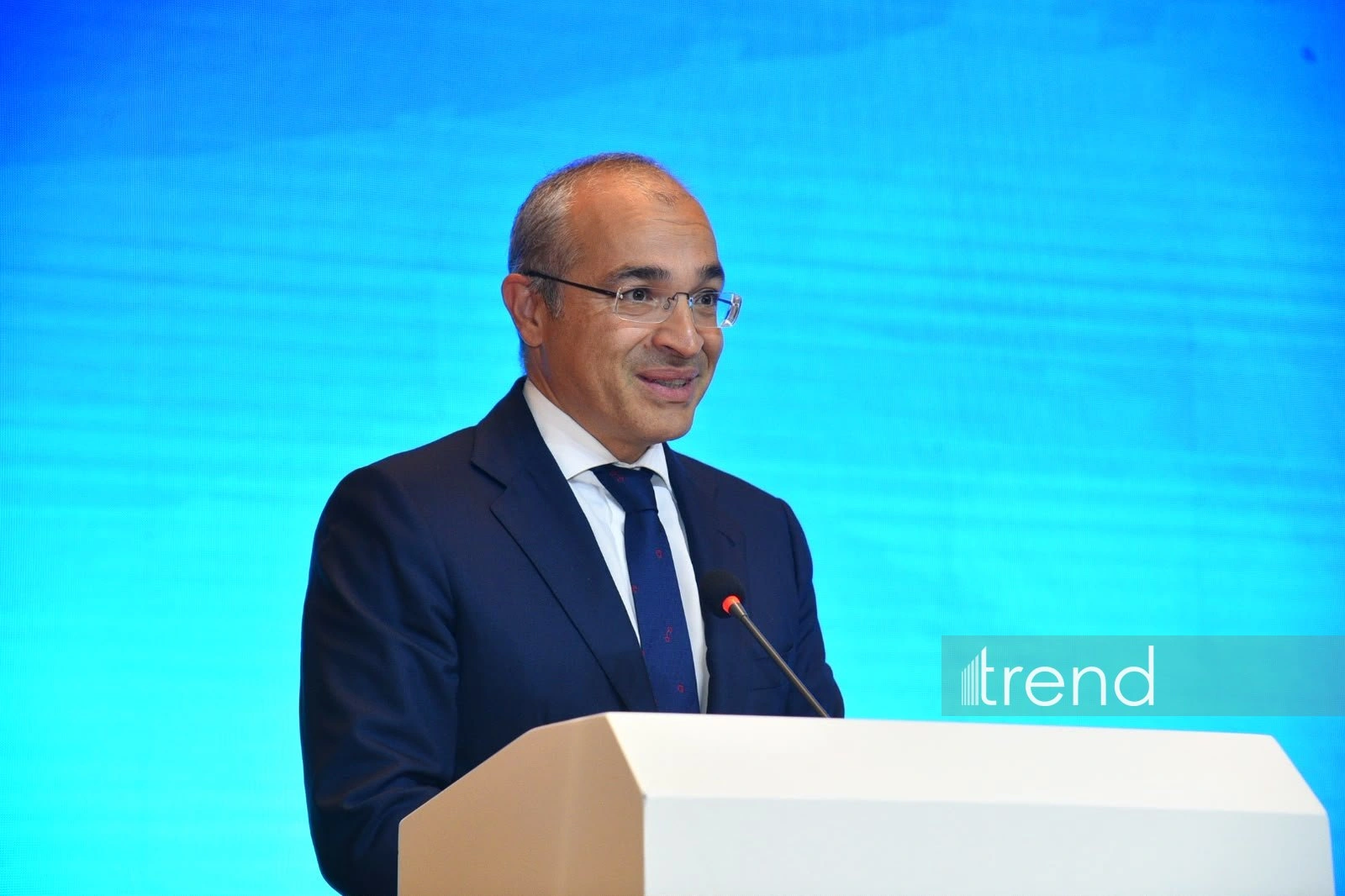
new opportunities, Azerbaijan’s Minister of Economy Mikayil
Jabbarov said at the CAMCA Regional Forum, held in Baku on October
1, Trend's
correspondent reports from the event.
The minister noted that since its first meeting in 2014, the
CAMCA Regional Forum has launched a unique initiative.
“The forum has brought together representatives of government,
academia, business, and young leaders from Central Asia, Mongolia,
the Caucasus, and Afghanistan on a single, nonpartisan platform. I
believe that this year’s theme, ‘A Region at a Crossroads,’ was
chosen appropriately and timely manner,” Mikayil Jabbarov
noted.
He noted that several changes have taken place in the eight
years since the 2018 forum in Baku. According to him, one of these
is the peace process in the South Caucasus.
“I would like to specifically highlight the peace process in the
South Caucasus. For the first time since the countries of the South
Caucasus and Central Asia gained independence, this process has
freed the region from wars, territorial conflicts, and territorial
claims,” the minister stated.
Mikayil Jabbarov noted that Azerbaijan’s relations with the
countries of Central Asia are also developing at the political
level.
“I would like to highlight Azerbaijan’s political participation
in the consultative meetings between Central Asia and Azerbaijan at
the head-of-state level, which took place last November. A meeting
at the head-of-state level will take place in less than a week. In
this regard, the western coast of the Caspian Sea is also
represented in this process,” he emphasized.
The minister then turned his attention to developments in the
global economy.
“The global economy is evolving amid various influencing
factors. On the one hand, we are seeing a slowdown in global
economic growth, which is falling below the average of the past few
years. On the other hand, digitalization, particularly the
application of AI and its associated consequences, is creating new
demand and economic opportunities,” said Mikayil Jabbarov.
According to him, the ongoing crisis in the Middle East is also
one of the factors influencing global economic processes and energy
markets.
“The ongoing crisis in the Middle East is disrupting energy
markets and having a serious impact on a global scale,” the
minister noted.
Mikayil Jabbarov stated that a shift in investor behavior is
also being observed.
“According to UNCTAD data, investors are focusing on fewer but
larger projects in capital-intensive sectors. This means, on the
one hand, that capital has become more selective, and on the other,
that the scale of projects is becoming increasingly important,” he
said.
According to the minister, the fact that most countries in the
region have medium-sized or small economies presents both a warning
and an opportunity in this regard.
“For a country like ours, where most economies are medium-sized
or small, this is both a warning and an opportunity. Because
together we can offer something different: interconnected markets,
larger markets, and, perhaps most importantly, human capital and
talent. I believe all of this applies to CAMCA as well,” Mikayil
Jabbarov added.