BAKU, Azerbaijan, October 6.
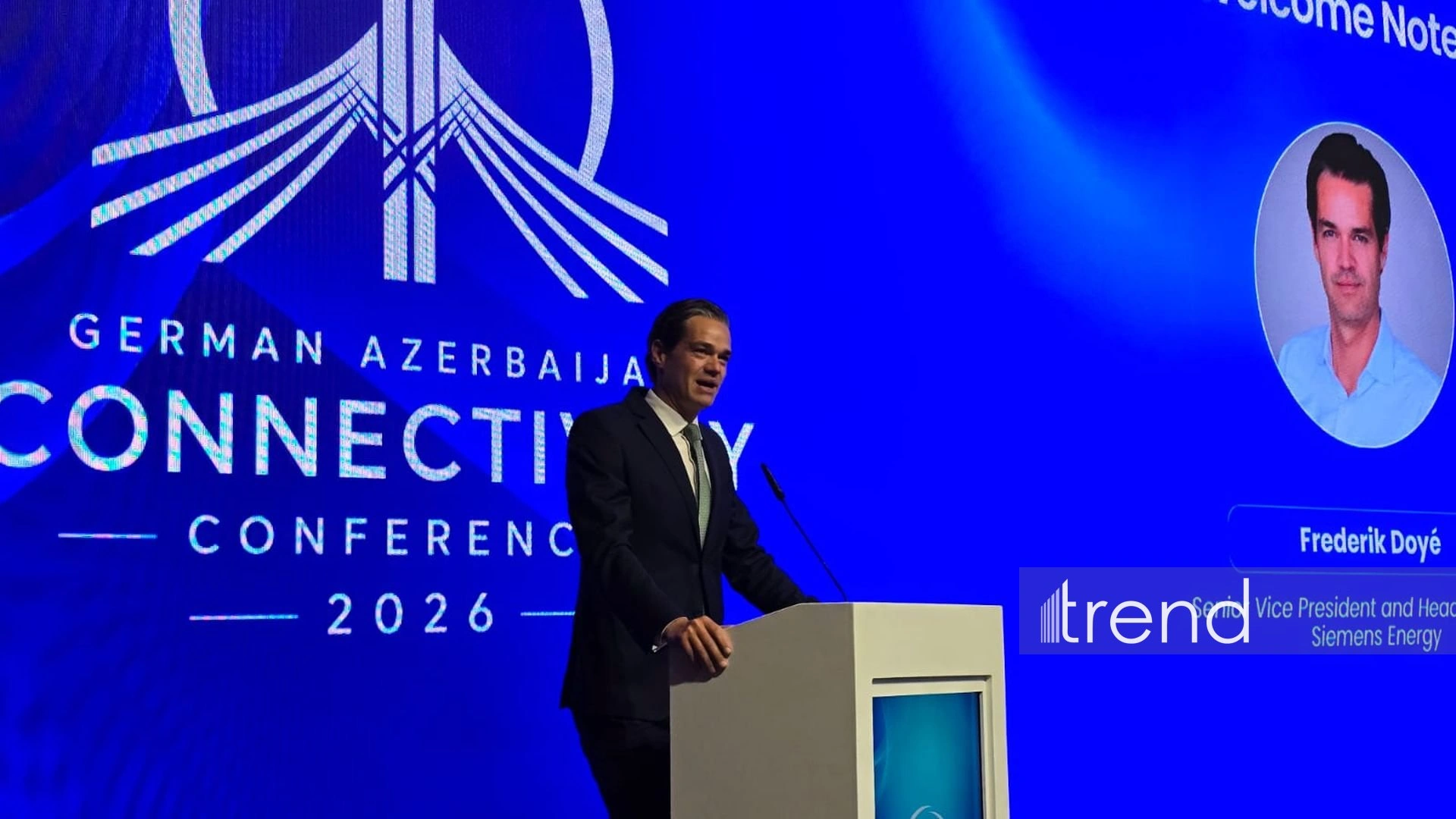
Azerbaijan can play an important role for Europe not only as an
energy producer, but also as an energy link connecting Europe, the
South Caucasus, Central Asia and the Caspian region, Siemens Energy
Senior Vice President and Head for Europe Frederick Doye said at
the German-Azerbaijani Strategic Partnership and Connectivity
Conference in Baku on Tuesday, Trend’s correspondent reports from the event.
He said Siemens Energy is one of the world’s leading energy
technology companies, employing around 100,000 people.
“Our technologies help generate about one-sixth of the world’s
electricity. We manufacture gas turbines, connect offshore wind
farms to power grids, modernize electricity grids and develop
systems that transmit electricity over thousands of kilometers,”
Doye said.
According to him, Siemens Energy has been working with customers
and partners in Azerbaijan for many years and remains committed to
supporting the country’s energy transformation.
Doye noted that Europe is currently redefining its economic,
industrial and energy partnerships.
“Supply chains are changing, new trade routes are emerging, and
energy security has become one of the key strategic issues of our
time. Against this backdrop, the German-Azerbaijani Connectivity
Conference is being held at exactly the right time,” he said.
He praised the German-Azerbaijani Chamber of Commerce (AHK
Azerbaijan) for bringing together business representatives from the
two countries.
According to Doye, AHK Azerbaijan has become one of the key
platforms for German-Azerbaijani economic cooperation over the past
decade. He said the chamber, which brings together around 200
member companies, serves as a bridge between businesses, investors
and policymakers and makes an important contribution to
strengthening dialogue between the two countries.
“This dialogue is already producing results. More than 250
German companies are currently operating in Azerbaijan, while
annual bilateral trade has reached around 1.7 billion euros. Our
cooperation is expanding from traditional energy trade into
logistics, technology, industry and renewable energy,” he said.
The Siemens Energy regional head said connectivity is usually
associated with roads, railways, ports and trade routes. However,
he said energy connections could become at least as important as
these factors in the coming decades.
“The ability to transmit clean, reliable and affordable energy
between countries is becoming increasingly important. It is about
connecting regions rich in renewable energy resources with
industries and communities that need secure access to electricity,
ultimately turning energy into a source of resilience, growth and
prosperity,” Doye said.
He called this approach “Energy Security 2.0.”
“For decades, energy security was primarily about securing fuel
supplies. Today, it is increasingly about the security of systems.
This means resilient infrastructure, strong electricity grids,
diversification and flexibility. Increasingly, reliable and clean
access to electricity is also becoming part of energy security,” he
said.
Doye said Azerbaijan could have particular importance in this
new reality.
“Many still see Azerbaijan primarily as an energy producer. I
believe Europe should increasingly see Azerbaijan from another
perspective – as an energy link. Azerbaijan is located at the
crossroads of Europe, the South Caucasus, Central Asia and the
Caspian region and can connect the world’s promising renewable
energy resources with European consumers and industry,” he
said.
According to him, this opportunity is most clearly reflected in
the green energy corridor initiatives currently taking shape.
Doye said these projects are of strategic importance for
Europe’s future. The first is the Black Sea Green Energy Corridor,
which connects Azerbaijan, Georgia, Romania and Hungary.
“The goal of this project is highly ambitious: to transmit up to
4 gigawatts of renewable electricity from the Caspian region to the
European Union through new high-voltage direct current (HVDC)
transmission infrastructure. The project has already been included
in Europe’s planning processes, and feasibility studies are
ongoing,” he said.
Doye noted that the second initiative expands this vision
further. By connecting Azerbaijan with Kazakhstan and Uzbekistan,
it aims to tap into Central Asia’s vast renewable energy potential
and link it with European demand centers.
“Together, these projects could fundamentally reshape energy
flows across Eurasia. For centuries, the Silk Road connected East
and West through the movement of goods. Green energy corridors can
connect East and West through the movement of clean energy,” the
Siemens Energy executive said.
According to him, this opens significant opportunities for
deeper cooperation between energy companies in Azerbaijan, Germany
and Europe.
Doye first highlighted the importance of developing renewable
energy generation. According to him, the Caspian region has
significant potential for both offshore wind and large-scale solar
projects, and these opportunities could contribute both to regional
development and Europe’s decarbonization goals.
He said transmission infrastructure is the second key area,
noting that renewable electricity creates no economic value if it
cannot reach consumers.
“For this reason, building HVDC connections, substations,
interconnectors and modern electricity grid infrastructure will be
as important as developing renewable energy generation,” Doye
said.
Doye also emphasized the important role of digitalization and
system integration in the energy systems of the future.
“The energy systems of the future must be not only clean, but
also resilient, flexible and smart,” he added.
He said cooperation between governments and technology providers
is essential to creating long-term value.
“This is also why the European Union attaches strategic
importance to these initiatives. European Commission President
Ursula von der Leyen has supported this vision from the outset, and
the European Commission has proposed allocating up to 2.3 billion
euros to support its implementation,” Doye said.
According to him, the next stage of the energy transition will
be determined not by how much renewable energy can be generated,
but by how efficiently that energy can be connected and
transmitted.
“This requires modern infrastructure, but above all, it requires
partnership. No country can build these systems alone. No company
can do it alone either. Europe’s energy future will not be built by
countries acting separately. This future will be shaped through
partnerships,” he said.
Doye noted that these partnerships should involve cooperation
between governments and industry, between Europe, the South
Caucasus and Central Asia, as well as joint efforts to turn vision
into infrastructure and connectivity into competitiveness.
“Azerbaijan has the opportunity to play an important and
decisive role in this process,” he said.
Doye said Siemens Energy is ready to support the development of
Azerbaijan’s energy potential and the creation of green energy
corridors.
“At Siemens Energy, we are very pleased about these
opportunities and remain committed to deploying our technologies,
experience and expertise to support Azerbaijan’s energy goals and
the development of green energy corridors,” he said.
“Azerbaijan can consider Siemens Energy a reliable and long-term
partner on this