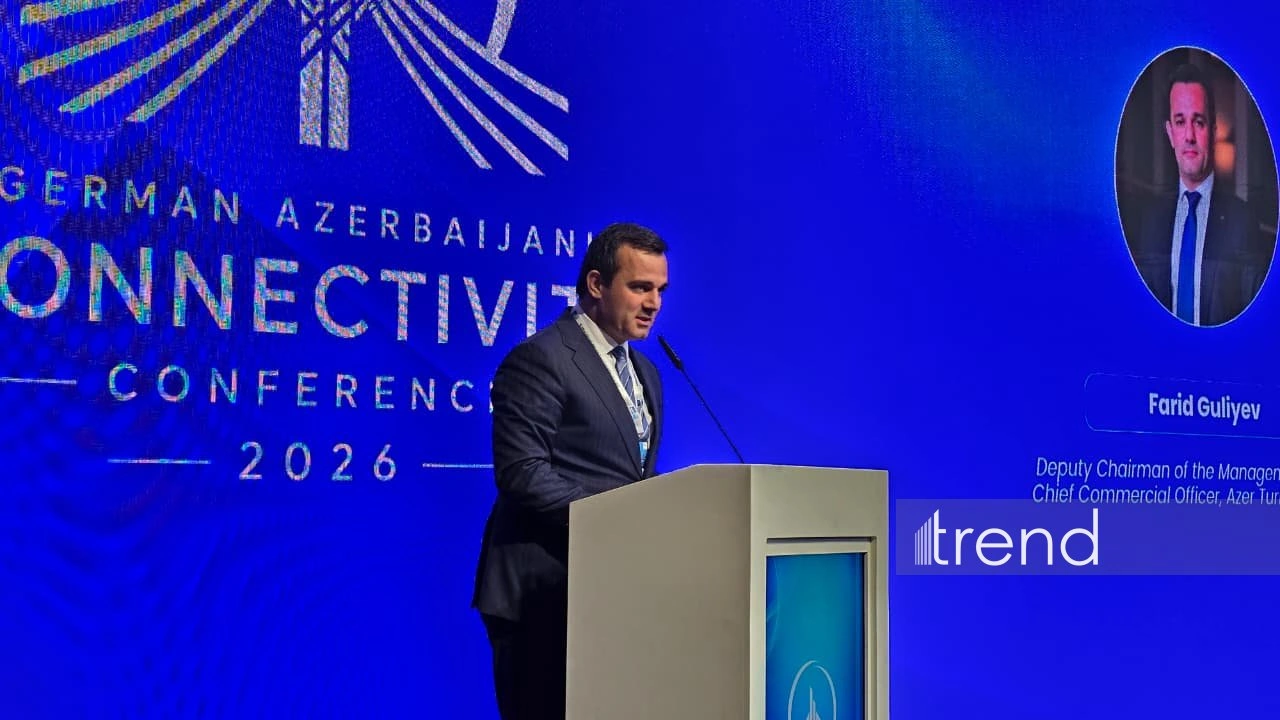
BAKU, Azerbaijan, October 6. Banks can play an
important role in connecting strategic priorities related to the
development of the Middle Corridor, said Farid Guliyev, Deputy
Chairman of the Management Board and Chief Commercial Officer of
Azer-Turk Bank, Trend's correspondent reports.
Guliyev made the remarks at the Azerbaijan-Germany Strategic
Partnership and Connectivity Conference held in Baku on
Tuesday.
According to him, banks can contribute to the development of the
Middle Corridor with private and international capital, as well as
in financing infrastructure and energy projects. He said the key
importance of today's conference lies in bringing government
representatives, business leaders, project owners, and financial
institutions together on a single platform.
"Such meetings are important not only for exchanging views, but
also for identifying real opportunities for cooperation," Guliyev
said.
According to him, the strategic importance of the Middle
Corridor is growing.
"In the first eight months of this year, container traffic along
the Middle Corridor increased by 58%. A few weeks ago, the European
Union announced plans to mobilize up to 12 billion euros in public
and private investment in the Middle Corridor to triple trade flows
by 2030," Guliyev noted.
He emphasized that the banking sector also has an important role
to play in developing the Middle Corridor.
"The Azerbaijan 2030: National Priorities for Socio-Economic
Development document clearly states the need to ensure the
attraction of direct foreign investment from strategic investors
into the country's economy, including infrastructure," the Chief
Commercial Officer said.
According to Guliyev, banks can connect strategic priorities
with private and international capital and support the structuring
of project financing and proper risk assessment.
"The strategic importance of a project does not automatically
mean that it is bankable. This requires a clear business model, a
realistic implementation plan, and proper risk allocation. When
these conditions are met, projects become more attractive to both
banks and investors," he said.
Guliyev noted that implementing large-scale infrastructure and
energy projects requires broad cooperation.
"A good example is the 315-megawatt Neftchala Solar Power Plant.
Last month, the project reached financial close with financing from
three international financial institutions - the Asian
Infrastructure Investment Bank, the European Bank for
Reconstruction and Development, and the Asian Development Bank," he
emphasized.
According to him, commercial banks, international financial
institutions, development banks, investors, technology companies,
and project owners each have an important role in this process.
Guliyev said Azer-Turk Bank considers sustainable development
and green projects to be among the key drivers of future economic
growth.
He noted that Azerbaijan Green Energy Company, which will
participate in a panel discussion as part of the conference, is one
of the companies operating in this area in Azerbaijan.
"The company's project portfolio includes a 50-megawatt solar
power plant in Jabrayil, a wind project with capacity of up to 240
megawatts in Kalbajar, a solar energy project in Nakhchivan, and
preliminary work on offshore wind energy in the Caspian Sea. Last
month, Azerbaijan Green Energy Company signed an agreement with
Masdar on an additional 350-megawatt solar power project in
Garadagh, a battery energy storage system, and studies into
round-the-clock renewable energy capabilities," Guliyev said.
The Chief Commercial Officer also highlighted Azerbaijan's
specific national targets in renewable energy.
"By 2030, the share of renewable energy sources in electricity
generation capacity is expected to reach 30 percent, while
greenhouse gas emissions are to be reduced by 35%," he said.
Guliyev said the Neftchala Solar Power Plant alone is expected
to generate enough clean electricity annually to supply
approximately 140,000 households and prevent around 280,000 tons of
carbon emissions each year.
He emphasized that renewable energy and modern energy
infrastructure are important not only from an environmental
perspective, but also for energy security, economic
diversification, and long-term competitiveness.
According to Guliyev, trade turnover between Azerbaijan and
Germany amounted to approximately 1.7 billion euros last year.
"Since the beginning of this year, Azerbaijani gas has been
transported to Germany under a 10-year agreement providing for
annual supplies of 1.5 billion cubic meters of gas," he said.