
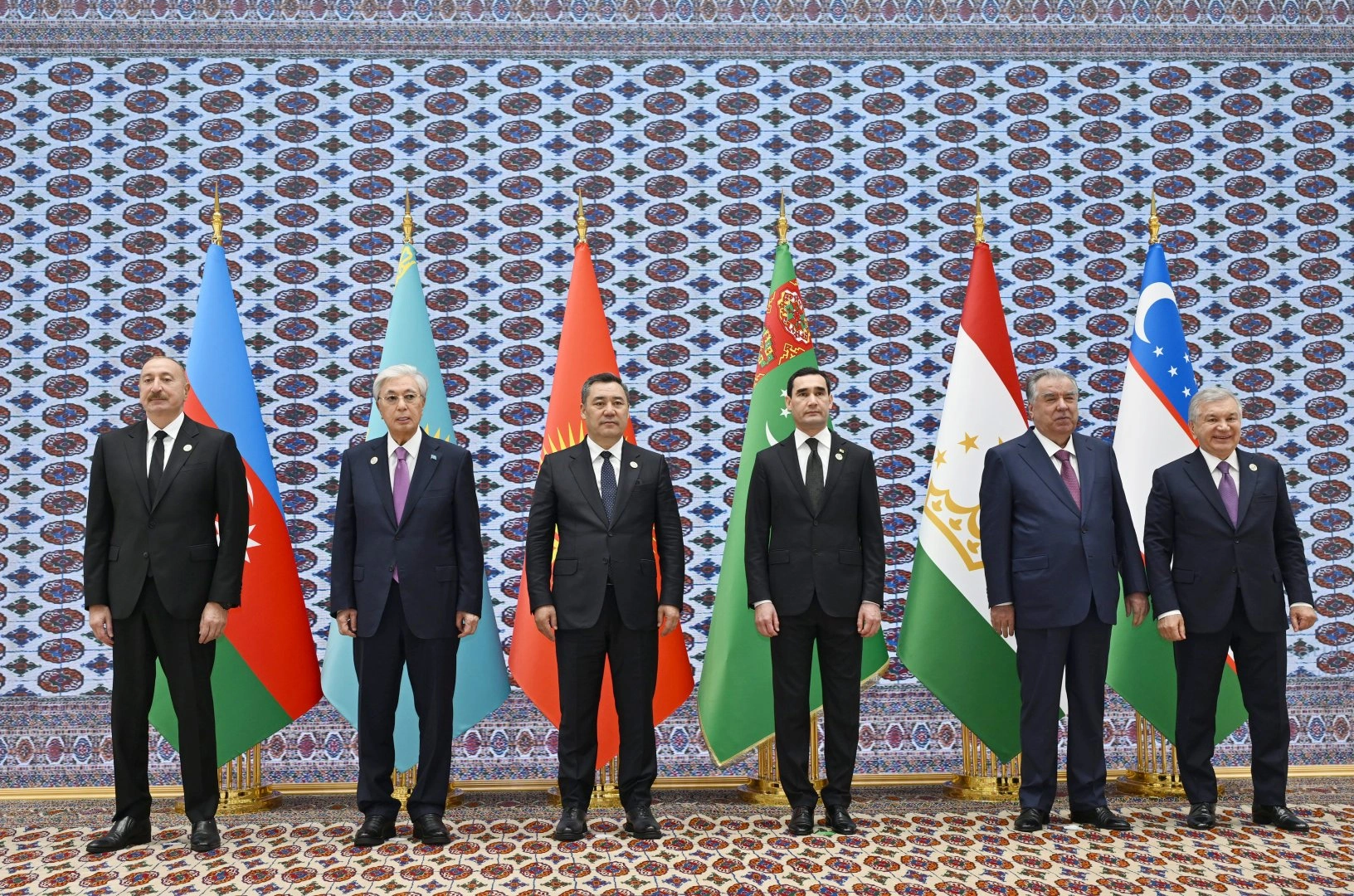
BAKU, Azerbaijan, October 8. Today, Azerbaijani
President Ilham Aliyev is taking part in the 8th Consultative
Meeting of the Heads of State of Central Asia and Azerbaijan in
Turkmenistan. For Baku, this is the first summit at this level
since Azerbaijan was granted full membership in the format. We look
at how a country that is not geographically part of Central Asia
has become an essential part of the region’s architecture.
On October 8, Azerbaijani President Ilham Aliyev is taking part
in the 8th Consultative Meeting of the Heads of State of Central
Asia and Azerbaijan during a working visit to Turkmenistan.
Formally, it is another item on the regional diplomatic calendar.
In substance, however, it marks the culmination of a three-year
evolution in Baku’s status within the format: from an invited guest
to a full-fledged - and increasingly indispensable -
participant.
The Consultative Meetings of the Heads of State of Central Asia
were first held in 2018 in Astana. Since then, seven official and
one informal meeting have taken place. For the five Central Asian
republics, the format provides a platform to coordinate positions
on security, water, trade and transit without external mediators.
For Azerbaijan, it has become one of the key ways to
institutionalize relations with a region with which Baku shares
historical and cultural ties, linguistic affinity and a common
Caspian dimension.
Azerbaijan moved toward its current status step by step. In 2023
and 2024, at the 5th and 6th Consultative Meetings, Ilham Aliyev
attended as an honorary guest and addressed the gatherings. It was
a status that demonstrated interest but guaranteed nothing: a guest
is invited to a particular meeting, while a participant becomes a
permanent part of the format.
The turning point came on November 16, 2025. At the 7th meeting
in Tashkent, a decision was made to grant Azerbaijan full
participation. In effect, Central Asia recognized that its Caspian
and transit agenda was incomplete without Baku. A logical
continuation came at the informal meeting in Cholpon-Ata,
Kyrgyzstan, on July 31, 2026, which Aliyev attended during a state
visit. The leaders signed the Cholpon-Ata Declaration following the
meeting. Today’s gathering in Turkmenistan is therefore the first
official meeting in the new configuration, while Cholpon-Ata
served, in a sense, as a rehearsal for it.
The most visible consequence is that the format once commonly
referred to as “C5” has de facto become “C6.” Azerbaijan’s
inclusion as a full participant changes the group’s logic: it is no
longer exclusively Central Asian, but has evolved into a
Caspian-Central Asian format with a direct link to the South
Caucasus.
There is an important caveat here. Azerbaijan is not
geographically part of Central Asia, and Baku makes no attempt to
conceal that fact. But the country’s links with the region -
through historical and cultural affinity, linguistic ties, energy
resources, trade and transport routes - provide a foundation that
makes its participation a natural step.
And finally, the key question: what does the C6 format offer its
participants - both Azerbaijan and the Central Asian states? Four
main areas stand out.
First, political dialogue across this vast space is likely to
become even more active. Regular contacts at the leaders’ level
make cooperation more systematic, while the format allows bilateral
relations and multilateral initiatives to be coordinated in one
place. This should make it possible to develop decisions and
mechanisms more efficiently.
Second, the format is set to give a major boost to integration
in transport and logistics - arguably its main practical dimension.
Azerbaijan is located on the western shore of the Caspian Sea and
occupies a key position in transport links between Europe and Asia.
The Port of Baku, railway infrastructure and East-West corridors
make the country an important transit link between Central Asia and
Europe. Full participation in the C6 format brings discussions on
regional projects into a broader institutional framework. This
includes the Trans-Caspian International Transport Route, known as
the Middle Corridor: coordinating infrastructure, streamlining
logistics procedures and improving the efficiency of freight
transportation.
Third, there is energy. Azerbaijan is both an energy producer
and a participant in the development of energy infrastructure. The
delivery of Caspian energy resources to European markets,
cooperation in electricity and renewable energy, and the
development of new energy links could, according to the Azerbaijani
side, create new avenues for economic cooperation.
And, of course, humanitarian cooperation cannot be overlooked. A
shared historical and cultural heritage and linguistic affinity
provide a natural basis for expanding contacts in education,
science, culture, tourism and many other areas.
Indeed, the agenda of the consultative meetings is broad:
developing political relations, expanding cooperation in the
Caspian basin, strengthening transport and logistics links,
increasing trade, implementing energy projects, digital
transformation, renewable energy, combating climate change,
agriculture, sustainable water management and humanitarian
cooperation. Nor should the “behind-the-scenes factor” be
overlooked. Alongside official talks, such events generate numerous
informal contacts and discussions. Often, these interactions play
no less important a role in reaching new agreements.
Full membership gives Azerbaijan an instrument it did not have
before: a permanent platform where transport, energy and trade
issues can be addressed systematically rather than from one meeting
to the next. And the C6 has all the necessary elements to make this
work.
The transport and energy agenda is now ready to move from
declarations to implementation. The interests of the parties
converge most clearly in these areas: Central Asia needs reliable
access to European markets, while Azerbaijan has the port, railway
infrastructure and experience in transit logistics. The Middle
Corridor is already operating as a route, and it now has an
institutional framework within which infrastructure can be
synchronized, procedures streamlined and transportation efficiency
improved. Add renewable energy, digital transformation and
humanitarian ties, and it becomes clear that the format has a
foundation for years to come.
For the region, this means the emergence of a new hub linking
the Caspian, Central Asia and the South Caucasus. For Azerbaijan,
it means consolidating its role not as a peripheral neighbor, but
as a structural partner without which the region’s Caspian and
transit agenda is genuinely incomplete. The Cholpon-Ata Declaration
and today’s meeting in Turkmenistan show that this process is
gaining momentum. The task now is to turn political will into
concrete projects - and all six participants have both the
motivation and a shared interest to do so.


