
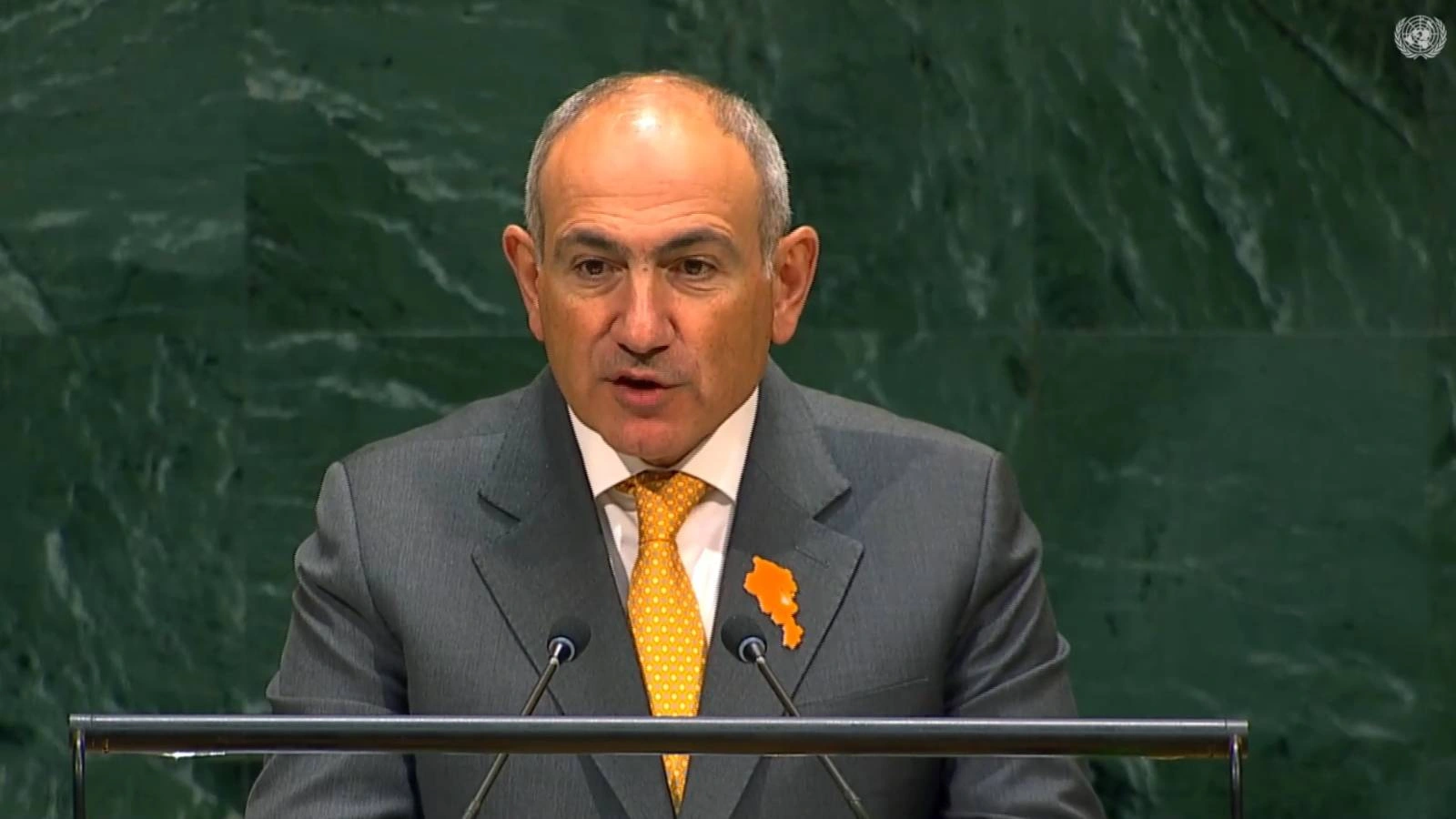
TURKMENBASHI, Turkmenistan, October
9. Peace between Armenia and Azerbaijan is an
accomplished fact, Armenian Prime Minister Nikol Pashinyan said at
the meeting of the Council of Heads of State of the CIS in Avaza on
October 9, Trend’s
special correspondent reports from the event.
"After the 2020 war, we spent a long time moving toward peace.
In this context, I wish to emphasize the role of the President of
the Russian Federation, Vladimir Vladimirovich Putin, in securing
the ceasefire of November 2020. However, even after the signing of
the statement on November 9, 2020, we, in practice and
unfortunately, failed to achieve peace. It was evident that there
was only one realistic path to peace between Armenia and
Azerbaijan, and that framework is built upon the principles of the
Alma-Ata Declaration. It must be acknowledged that the adoption of
the Alma-Ata Declaration in 1992 didn’t prevent the escalation of
the conflict between Armenia and Azerbaijan. The conflict persisted
for over thirty years while the Alma-Ata Declaration was in effect,
yet its existence seemed to go unnoticed. To establish a genuine
peace, it was necessary, figuratively speaking, to bring the
Alma-Ata Declaration back into play; this is precisely what the
President of Azerbaijan and I did on October 6, 2021, following a
quadrilateral meeting in Prague initiated by French President
Emmanuel Macron and European Council President Charles Michel.
Peace between Armenia and Azerbaijan is now a reality. Today, we
can state that for more than two years, there have been no
fatalities or injuries resulting from skirmishes between Armenians
and Azerbaijanis—a stark contrast to the preceding thirty-plus
years," he said.
Pashinyan pointed out that a twelve-kilometer section of the
state border between Armenia and Azerbaijan has undergone
delimitation and demarcation.
“One of the foundational documents of the CIS is the Alma-Ata
Declaration of December 21, 1991. Through this document, eleven
Soviet republics, recognizing and respecting each other's
territorial integrity and the inviolability of existing borders,
acknowledged the cessation of the existence of the Union of Soviet
Socialist Republics. The Alma-Ata Declaration played a key role in
establishing peace between the Republic of Armenia and the Republic
of Azerbaijan. In 2024, Armenia and Azerbaijan signed and ratified
the regulation on the joint activity of commissions regarding the
delimitation of the state border between the Republic of Armenia
and the Republic of Azerbaijan. This regulation became the first
bilateral, legally binding document concluded between independent
Armenia and independent Azerbaijan. The document stipulates that
the respective commissions of Armenia and Azerbaijan will base the
state border delimitation process on the Alma-Ata Declaration as a
fundamental principle. This foundational CIS document also holds a
key place in the initial text of the agreement on establishing
peace and interstate relations between the Republic of Armenia and
the Republic of Azerbaijan. The document's preamble references the
Alma-Ata Declaration, and Article 1 says, I quote: "Confirming that
the borders between the Soviet Socialist Republics of the former
USSR became the international borders of the respective independent
states and were recognized as such by the international community,
the Parties recognize and respect each other's sovereignty,
territorial integrity, inviolability of international borders, and
political independence.
And Article 2 of the same agreement says: "In full accordance
with Article 1, the parties confirm that they have no territorial
claims against each other and will not advance such claims in the
future. The parties shall not undertake any actions, including the
planning, preparation, encouragement, or support of actions, aimed
at the dismemberment or violation, in whole or in part, of the
territorial integrity or political unity of the other party." End
of quote. The agreement containing these articles was initialed on
August 8, 2025,” he emphasized.


