
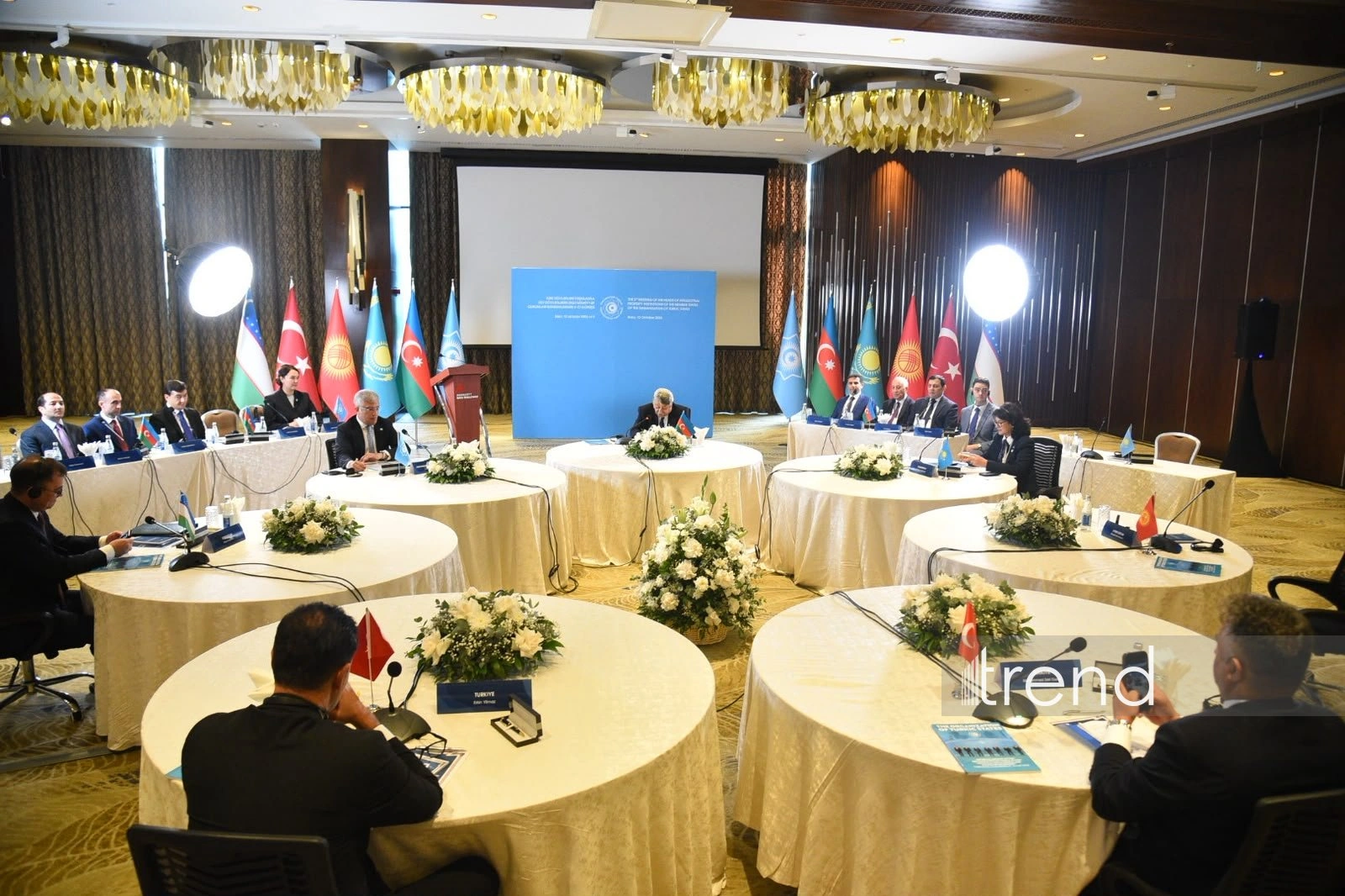
BAKU, Azerbaijan, October 12.
The Joint Declaration of the 2nd Meeting of Heads of Intellectual
Property Agencies of the Organization of Turkic States (OTS) Member
States was signed in Baku today, Trend's correspondent reports from the
event.
The meeting, organized by the Intellectual Property Agency of
Azerbaijan, was attended by Deputy Secretary General of the OTS
Ömer Kocaman, Chairperson of the Intellectual Property Rights
Committee of the Ministry of Justice of Kazakhstan, Sholpan
Abdreyeva, Ambassador Extraordinary and Plenipotentiary of
Kyrgyzstan to Azerbaijan, Maksat Mamytkanov, Head of the Turkish
Patent and Trademark Office (TÜRKPATENT), Muhammed Zeki Durak, and
Deputy Minister of Justice and Head of the Intellectual Property
Agency of Uzbekistan, Muzraf Ikramov.
Delivering the opening remarks, Chairman of the Board of the
Intellectual Property Agency of Azerbaijan, Kamran Imanov, said
that copyright is protected in parallel with rights regarding
industrial property objects.
According to him, the copyright holder must declare that he/she
does not object to reproduction in the form in which the patent
application or the description of the invention is entered into the
Patent Register, and in this case, he/she retains their
copyright.
In his address, Kocaman said that this responsibility has become
increasingly relevant today as knowledge, technology, and
intellectual capital transform into the primary sources of economic
power and competitiveness.
He noted that, consequently, cooperation in the field of
intellectual property is not merely a technical matter but is vital
to our broader efforts to build a future defined by innovation and
enduring competitiveness.
The event continued with speeches and discussions.
Hosting the Second Meeting in Azerbaijan during the country’s
chairmanship of the OTS is of great importance; beyond contributing
to the development of cooperation within the organization, it
serves to promote Azerbaijan’s initiatives in the field of
intellectual property, strengthen institutional ties with member
states, and demonstrate our country’s active role within the
organization.


