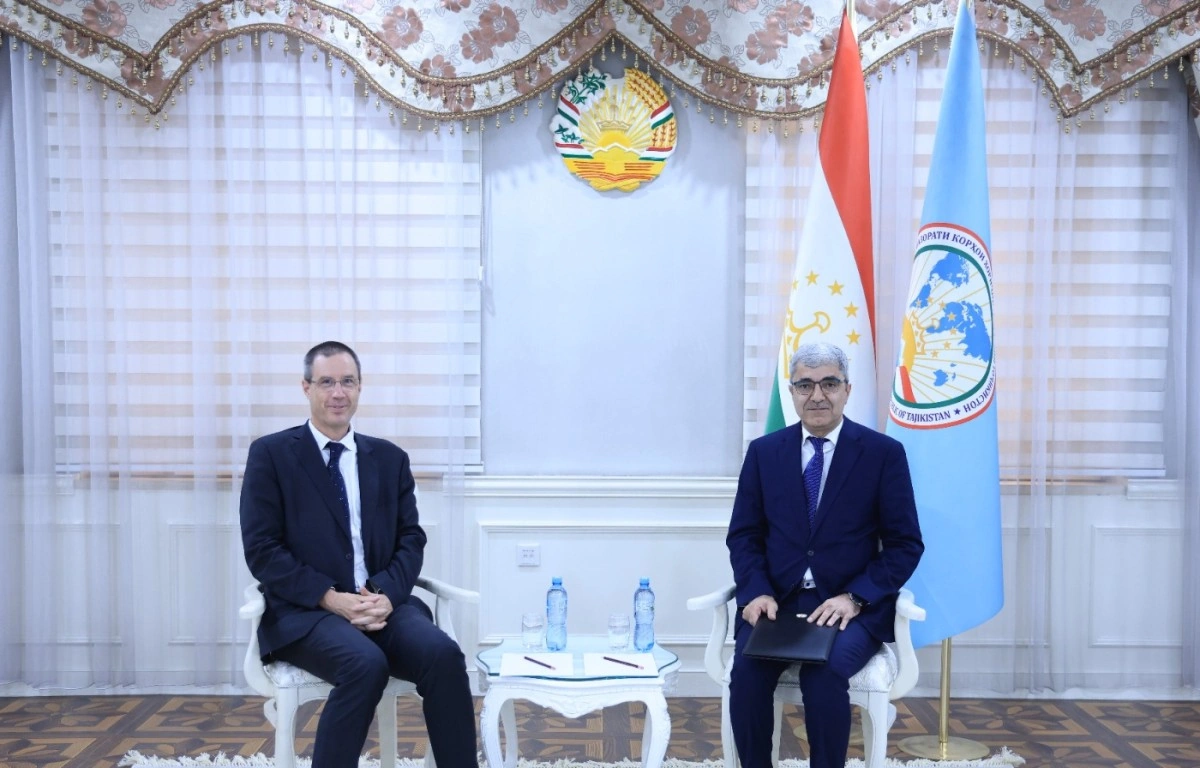
BAKU, Azerbaijan, October 13. Deputy Minister
of Foreign Affairs of Tajikistan Idibek Kalandar met with Director
of the Political Department of Austria’s Federal Ministry for
European and International Affairs Thomas Mühlmann in Dushanbe on
October 12, 2026, to discuss the development of bilateral
cooperation.
This was reported by the press service of the Ministry of
Foreign Affairs of Tajikistan.
The meeting between the deputy minister and the director of the
Political Department took place as part of political consultations
between Tajikistan and Austria.
"On October 12, 2026, as part of political consultations between
Tajikistan and Austria, Deputy Minister of Foreign Affairs of the
Republic of Tajikistan Idibek Kalandar met with Director of the
Political Department of the Federal Ministry for European and
International Affairs of the Republic of Austria Thomas Mühlmann,"
the statement said.
During the meeting, the parties exchanged views on the current
state and prospects for the development of relations between
Tajikistan and Austria, and expressed their interest in
strengthening and expanding cooperation in various fields.
Meanwhile, Tajikistan continues to pursue economic
diversification and attract foreign investment, with international
cooperation playing a role in developing trade, infrastructure,
energy and industry. The country’s geographic position in Central
Asia also creates opportunities to strengthen transport
connectivity and expand economic ties with European and Asian
markets.
Austria, as a member of the European Union, maintains economic
relations with international partners in areas such as industrial
development, technology, financial services and environmental
protection. European companies and institutions can contribute
expertise in modernizing infrastructure, improving business
practices and supporting sustainable development.
For Tajikistan, expanding international partnerships can create
opportunities to access new technologies, attract investment and
develop export-oriented sectors. Cooperation with European
countries may also support knowledge exchange, professional
training and the introduction of modern standards across different
areas of the economy.