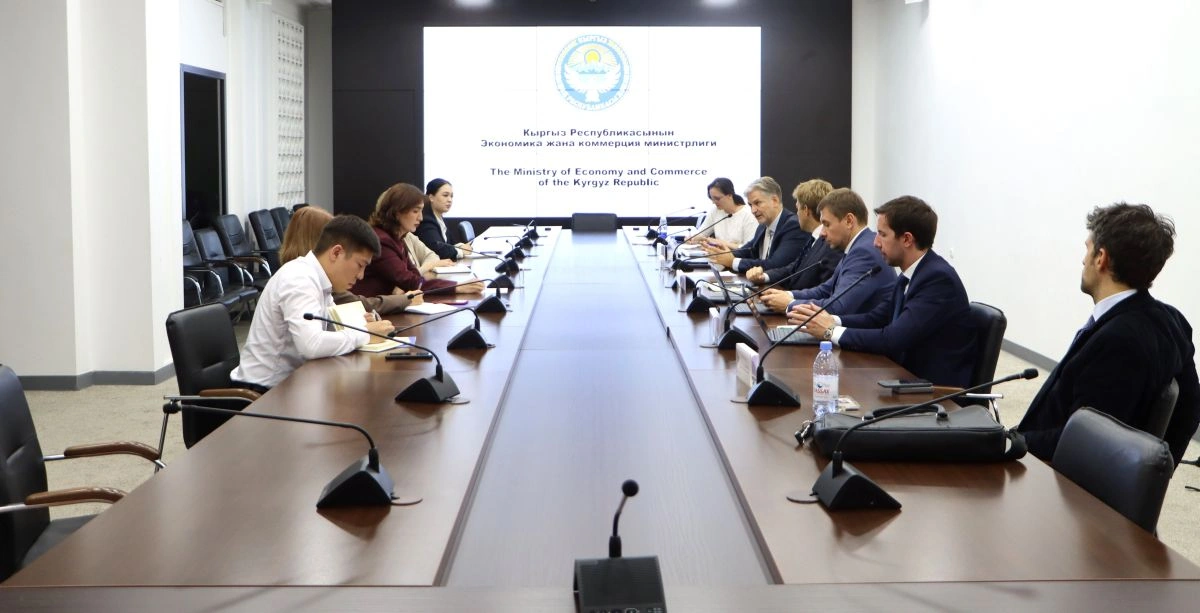
BAKU, Azerbaijan, October 13. Kyrgyzstan’s
Deputy Minister of Economy and Commerce Benazir Nurlanova met with
World Bank Group Country Manager for the Kyrgyz Republic Hugh
Riddell and other representatives to discuss advancing reforms in
the state-owned enterprise sector.
This was reported by the press service of the Ministry of
Economy and Commerce of the Kyrgyz Republic.
"The main topic of the meeting was the practical implementation
of reforms in state-owned enterprises, including improving the
efficiency of state asset utilization, introducing modern
approaches to corporate governance, and developing a competitive
environment," the statement said.
During the meeting, the parties highlighted the importance of
the joint project "Strengthening Capacity for State-Owned
Enterprise Sector Reform," funded by the Swiss State Secretariat
for Economic Affairs (SECO) and implemented by the World Bank.
The parties also emphasized the importance of international
experience and expert support in improving the regulatory
framework, increasing transparency in the management of state-owned
enterprises, and creating favorable conditions for private sector
development.
Following the meeting, the sides reaffirmed their readiness to
continue constructive cooperation to implement priority economic
reforms in the Kyrgyz Republic.
Meanwhile, state-owned enterprises play an important role in
Kyrgyzstan’s economy across a number of sectors, including
infrastructure, energy, transportation, and public services. Their
performance and governance can affect the efficiency of public
asset use, the quality of services and the state’s fiscal
position.
Reforms in the state-owned enterprise sector commonly involve
improving corporate governance, strengthening financial oversight,
increasing transparency and clarifying the responsibilities of
management and public authorities. Such measures can also help
establish more predictable conditions for private businesses and
competition.
The World Bank provides analytical, technical and financial
support to countries implementing institutional and economic
reforms. Cooperation with international development partners,
including SECO and the World Bank, can provide access to
international expertise and help public institutions strengthen
regulatory frameworks and management practices.