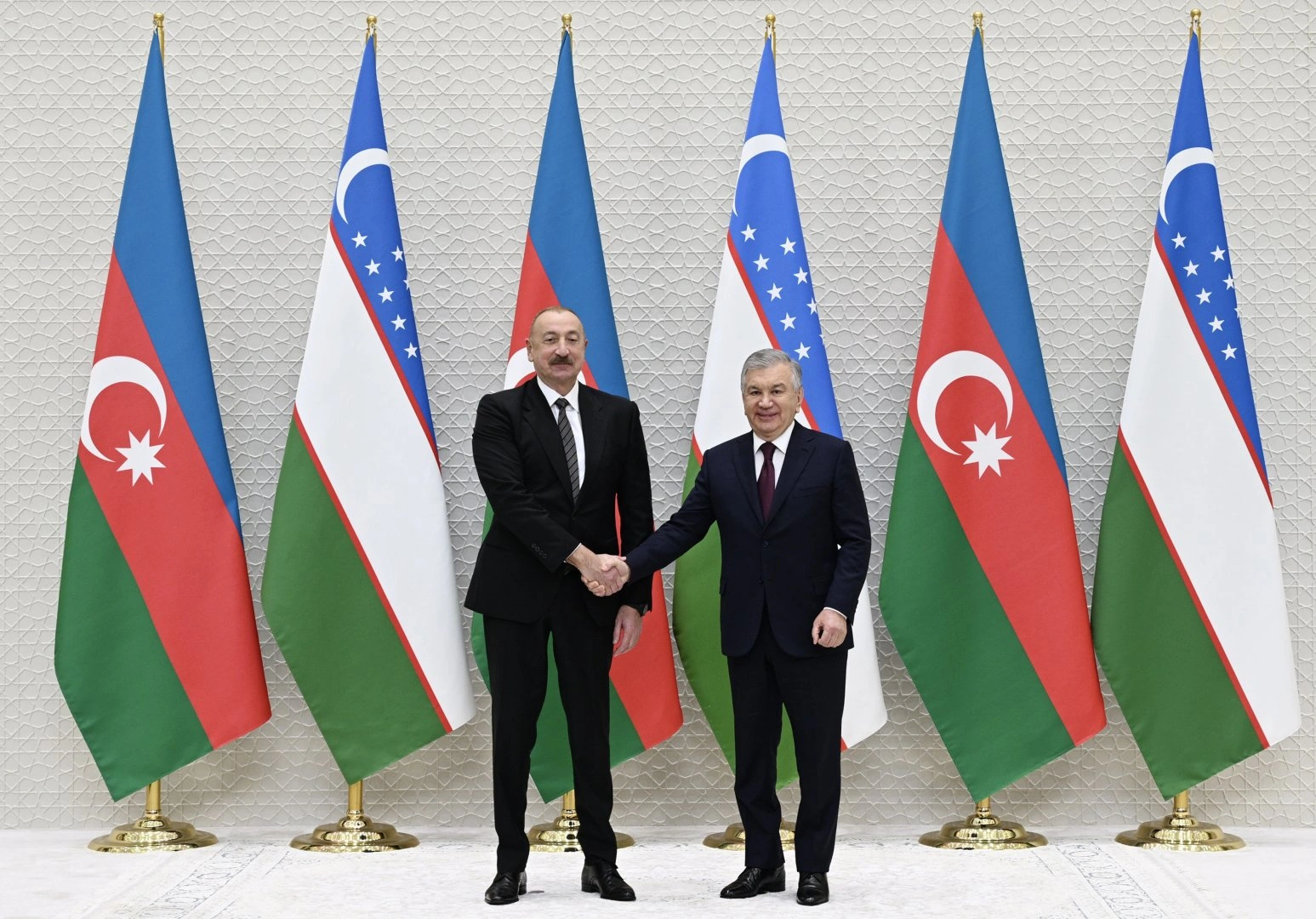
BAKU, Azerbaijan, October 14. Uzbek President
Shavkat Mirziyoyev will visit Baku on October 14–15 to attend the
7th Summit of the Conference on Interaction and Confidence Building
Measures in Asia (CICA), which Azerbaijan will host under its
chairmanship on October 15, against the backdrop of expanding
bilateral cooperation and joint regional initiatives.
Earlier, Uzbekistan's First Deputy Chairman of the Senate, Sodiq
Safoev, exclusively told Trend about Mirziyoyev's planned visit on the
sidelines of the 2026 CAMCA Regional Forum in Baku.
"As part of the visit, a package of agreements on economic
cooperation and the joint development of Karabakh is scheduled to
be signed," Safoev said, noting that the strategic partnership
between Uzbekistan and Azerbaijan had reached an all-time high in
recent years.
The upcoming visit will build on active political dialogue
between the two countries, which gained fresh momentum in 2026. In
August, Azerbaijani President Ilham Aliyev paid a state visit to
Uzbekistan, during which the two sides signed a Treaty on Eternal
Friendship and agreed to expand cooperation in trade, investment,
energy, transport and other sectors. The leaders are now set to
continue their engagement in Baku, including through multilateral
diplomacy.
Economic cooperation remains one of the key pillars of the
Azerbaijan-Uzbekistan partnership. President Ilham Aliyev
previously highlighted that bilateral trade reached $795 million in
2025, a 3.2-fold increase from the previous year. In January-June
2026, mutual trade totaled approximately $170.3 million, up 30.8%
year on year, according to Uzbekistan's Ministry of Investment.
At the third meeting of the Azerbaijan-Uzbekistan Supreme
Interstate Council in Tashkent on August 23, President Shavkat
Mirziyoyev noted that bilateral trade had tripled over the previous
five years, while the combined portfolio of joint projects had
exceeded $5 billion.
Baku and Tashkent have set a target of increasing bilateral
trade to $1 billion by 2030. A corresponding program and roadmap
were signed in August 2026. However, both presidents see this
figure more as an interim milestone than a ceiling on economic
cooperation.
"Today, however, we are talking about the goal of reaching $1
billion in trade turnover not as some distant dream, but as
something we will probably achieve within a couple of years,"
President Ilham Aliyev said during his visit to Tashkent.
Growing trade is accompanied by increased investment activity.
The Azerbaijan-Uzbekistan Investment Company, established in 2023
with a capital of $500 million, supports the implementation of
joint projects. At the Supreme Interstate Council meeting,
President Ilham Aliyev said that approximately $160 million from
the fund had already been earmarked for project financing. The
total value of planned investments and projects for which contracts
have been signed, however, is significantly higher than the fund's
capital.
"The volume of investments for the projects we have envisioned
and already contracted significantly exceeds the capacity of the
fund," President Ilham Aliyev noted, highlighting cooperation on
tourism projects, hotels and residential complexes in
Uzbekistan.
The overall portfolio of joint initiatives spans industry,
energy, construction, agriculture, tourism and financial services.
According to Uzbekistan's National Statistics Committee, 473
enterprises with Azerbaijani capital are operating in the
country.
A joint automotive venture between Uzavtosanoat and AzerMash at
Azerbaijan's Hajigabul Industrial Park is a practical example of
industrial cooperation. The facility has already produced more than
10,000 Chevrolet vehicles and Isuzu buses. The two sides are also
exploring a transition to a full production cycle, with investment
exceeding $84 million.
Other promising areas include the development of oil and gas
fields in Uzbekistan, construction and tourism projects, raw
material processing and the production of industrial goods.
Another tangible outcome of closer economic ties is the entry of
Azerbaijani bank ABB into the Uzbek market. The ABB Davr project
was launched in Tashkent on August 23, with Presidents Ilham Aliyev
and Shavkat Mirziyoyev participating online in an event marking the
launch and groundbreaking of projects being implemented by
Azerbaijan in Uzbekistan.
The project предусматривает ABB's acquisition of a controlling
stake in Davr Bank, followed by operations in the Uzbek market
under the ABB Davr brand. The relevant agreement was signed on
August 22 by ABB Chairman of the Management Board Abbas Ibrahimov
and Davr Bank Supervisory Board Chairman Lutfulla Ubaev on the
sidelines of the fourth Uzbekistan-Azerbaijan Interregional
Forum.
Entry into the Uzbek market is in line with ABB's geographic
expansion strategy for 2026–2028. The bank plans to provide
financial services to corporate and retail customers across
Uzbekistan, using digital solutions, artificial intelligence-based
technologies and tools to support small and medium-sized
enterprises.
"It is a great honor for us that the first historic step in the
implementation of ABB Bank's geographic expansion goal for the new
strategic period was taken in brotherly Uzbekistan," Abbas
Ibrahimov said.
He said the bank viewed the project as the beginning of a
long-term presence in the country and aimed to become a financial
partner for businesses and individuals. Bilateral cooperation is
therefore extending beyond trade and industry to encompass
financial services and digital solutions.
A separate area of cooperation concerns the reconstruction of
Azerbaijan's liberated territories. President Ilham Aliyev has
emphasized that Uzbekistan was the first country to provide
practical assistance in this effort. A school named after Mirzo
Ulugbek, designed to accommodate nearly 1,000 students, was built
in Fuzuli, while a garment manufacturing facility was established
in Khankendi with Uzbek participation.
"Naturally, creating jobs in the Karabakh region - especially
for women - is currently of paramount importance. Once again, the
first investment project to establish a modern production facility
and create over 200 jobs is being implemented by the Uzbek side,"
President Ilham Aliyev said, thanking Mirziyoyev for his support
for Karabakh's reconstruction.
These projects demonstrate that the bilateral partnership
extends beyond trade and investment to include social
infrastructure and job creation. In this context, the planned
agreements on the joint development of Karabakh, announced by
Safoev in comments to Trend, could build on initiatives already
underway.
Energy is another important component of the bilateral agenda.
Uzbekistan is seeking investment in gas projects, while Azerbaijan
could become a partner in developing the relevant infrastructure.
Both countries are also involved in advancing a green energy
corridor designed to transmit electricity from Central Asia through
Azerbaijan to Europe.
The Middle Corridor as a shared economic
opportunity
Transport connectivity is another area where the interests of
Baku and Tashkent directly converge. The development of the
Trans-Caspian International Transport Route, known as the Middle
Corridor, is creating opportunities to expand trade between Central
Asia, the South Caucasus and European markets.
In 2025, transit freight between the two countries totaled 1.4
million tons, an increase of 6.7%. In the first half of 2026, the
figure reached 675,000 tons, up 12.2% from the same period a year
earlier.
Tashkent is also interested in developing Caspian port
infrastructure and expanding logistics capacity. As Safoev
previously told Trend, Uzbekistan intends to participate in the
development of a designated section of the Port of Alat and the
Middle Corridor infrastructure.
In August, Mirziyoyev stressed the need for joint efforts in
this area. "We will jointly develop the potential of the
Trans-Caspian Corridor, improve the efficiency of logistics
infrastructure and promote freight transportation. To this end, we
will step up efforts to establish a joint fleet in the Caspian
Sea," he said.
At the Supreme Interstate Council meeting, the Uzbek president
also proposed accelerating the launch of a joint Caspian fleet and
considering the creation of a dedicated Uzbekistan-Azerbaijan
corridor with a single operator. President Ilham Aliyev, in turn,
noted the increase in freight traffic from Uzbekistan through
Azerbaijan and the need to expedite the joint fleet project.
Transport cooperation is therefore gradually moving beyond the
organization of individual shipments. Its development could help
establish more resilient production and logistics chains, reduce
dependence on a limited number of routes and strengthen economic
ties across the region.
CICA as a platform for broader regional
cooperation
Against this backdrop, the CICA summit takes on added
significance. Azerbaijan has chaired the organization for
2024–2026, promoting an agenda focused on connectivity,
digitalization and sustainable development in Asia. For Baku, the
upcoming meeting will also provide an opportunity to consolidate
the results of its chairmanship and further strengthen the
organization's institutional role.
The agenda of the seventh summit includes peace and security,
confidence-building among states, transport infrastructure,
digitalization and sustainable economic growth. The adoption of the
Baku Declaration and a package of decisions aimed at improving
CICA's effectiveness is expected.
For Uzbekistan, participation in the summit offers an
opportunity to advance its economic and transport priorities within
a broader Asian framework. For Azerbaijan, Tashkent's support is
important to the development of interregional ties and closer
cooperation between Central Asia and the South Caucasus.
However, engagement between the two countries is not limited to
CICA. At the October Consultative Meeting of the Heads of State of
Central Asia and Azerbaijan in Awaza, Mirziyoyev proposed moving
beyond conventional trade toward the joint production of finished
goods.
"We have reached a point where ordinary trade with one another
is no longer enough. We need to create finished products together.
The formula 'six economies - one product' captures what we should
be striving for," the Uzbek president said.
This approach also reflects the economic agenda pursued by Baku
and Tashkent: the two countries aim not only to increase bilateral
trade but also to establish joint ventures, deepen industrial
cooperation and develop new transport and energy links.
Building a common agenda at the presidential
level
The sequence of high-level meetings reflects the two countries'
determination to translate political agreements into tangible
economic results. The signing of the Treaty on Eternal Friendship
in August was an important symbolic step, while joint investment
and infrastructure projects are laying the practical foundations of
the partnership.
Mirziyoyev has described Azerbaijan as a reliable ally,
strategic partner and brotherly state, emphasizing the shared
historical roots and cultural ties underpinning relations between
the two countries. President Ilham Aliyev, in turn, has described
Central Asia and Azerbaijan as a single geopolitical and economic
region with significant growth potential.
Closer regional engagement has been another important outcome of
the political dialogue. At the Supreme Interstate Council meeting,
Mirziyoyev noted that Azerbaijan's accession to the Consultative
Meeting of the Heads of State of Central Asia had opened up new
opportunities for economic and humanitarian cooperation between the
two regions. President Ilham Aliyev separately thanked his Uzbek
counterpart for supporting Azerbaijan's full participation in the
format.
"We always support each other in the bilateral format and across
all international organizations in which we participate. This
happens automatically," President Ilham Aliyev said.
Such coordination takes on added importance ahead of the CICA
summit in Baku. While bilateral mechanisms help the two countries
coordinate specific projects and investment priorities,
multilateral platforms offer an opportunity to promote common
approaches to transport connectivity, economic development and
confidence-building across the wider region.
Mirziyoyev's participation in the summit will continue this
pattern of engagement. Meetings on the sidelines are expected to
give the two sides an opportunity to discuss bilateral projects and
coordinate their positions on regional issues.
Further progress will depend on how consistently political
agreements are translated into new investment, joint production and
efficient transport routes. In this respect, cooperation within
CICA complements the bilateral agenda by providing an additional
platform for advancing initiatives that link the economic interests
of Azerbaijan and Uzbekistan with the broader development
priorities of Asia.