BAKU, Azerbaijan, October 24. The Preliminary
schedule of the Caspian-Black Sea-Europe Green Energy Corridor
project has been made public.
The data on the Green Energy Corridor Power Company (GECO)
website shows that it is planned to commission the Link 1 - Baku –
Ksani – Anaklia – Constanța Sud; extended onshore from Constanța
Sud to Albertirsa (HU) at 2,000 MW in 2032, Link 2 - Baku –
Tskaltubo – Poti – Domnești in 2036 and Link 3 - Baku – Tskaltubo –
Poti – Constanța Sud in 2040.
Total corridor capacity at full build-out is expected to be
commissioned in 2040.
The schedule will be confirmed in the roadmap to the final
investment decision.
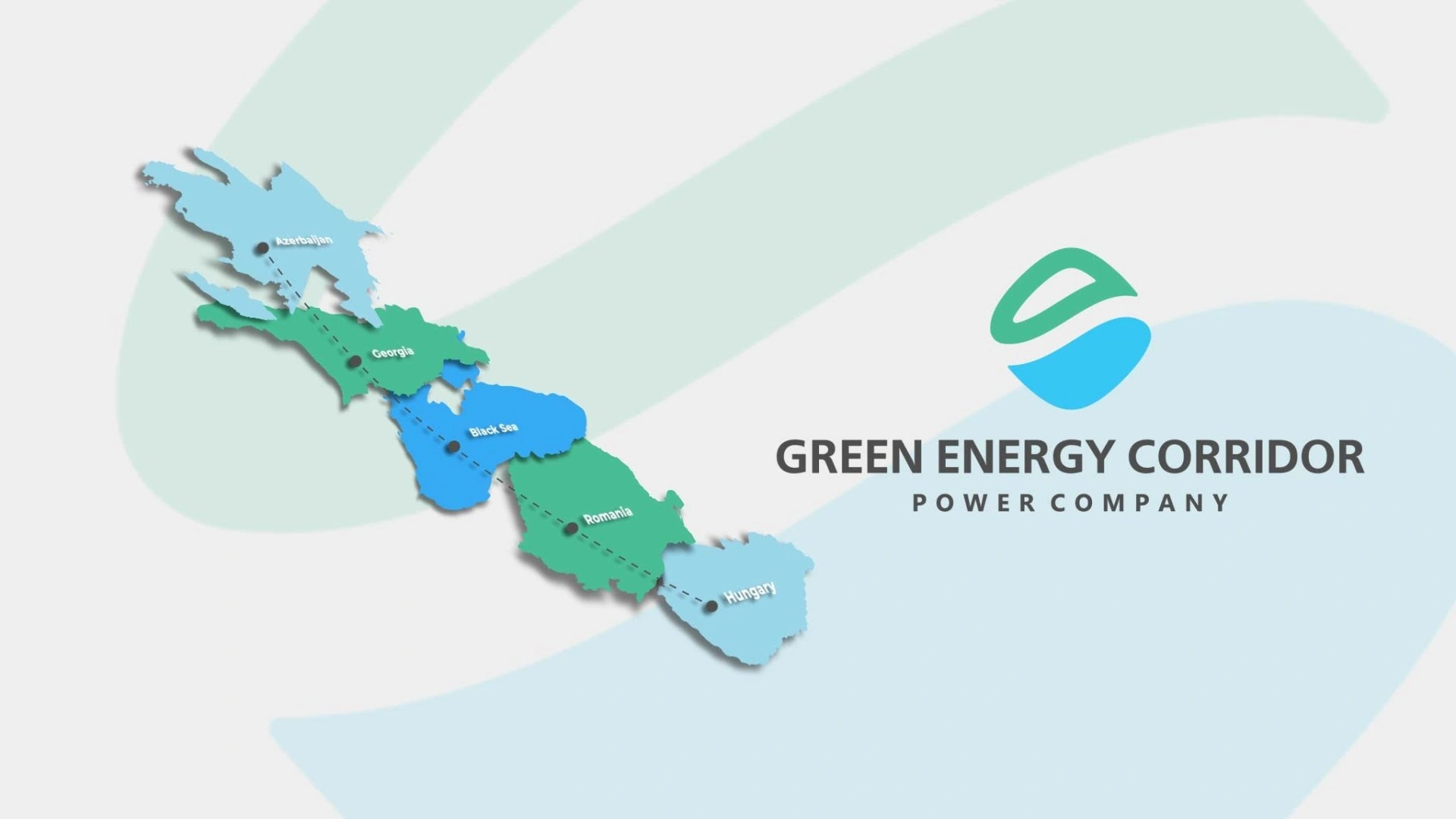
The Caspian–Black Sea–Europe Green Energy Corridor will carry
solar, wind and hydro electricity from Azerbaijan through Georgia
and across the Black Sea to Romania and Hungary.
Reportedly, the corridor consists of three independent
voltage-source converter (VSC) HVDC links operating at ±525 kV,
each rated at 1,300 MW, giving 3,900 MW of transfer capacity at
full build-out. Overhead and underground lines cross Azerbaijan and
Georgia to the coast at Anaklia and Poti. Converter stations at
Ksani and Tskaltubo connect the corridor to the Georgian grid in
both directions, so Georgia can export its renewable surplus and
import when it needs to.
“From the Georgian coast, submarine cables of about 1,120 km
each cross the Black Sea, mostly over the abyssal plain at depths
of up to about 2,200 metres, to the Constanța Sud landfall in
Romania. In Romania and Hungary the corridor connects to the EU
grid at Constanța Sud, Domnești (Bucharest) and, through an onshore
extension to Hungary, at the Albertirsa substation near Budapest,”
reads the message.
A Feasibility Study by CESI, covering resources, demand,
technology, routing, grid integration and the business model, was
approved at the 12th Ministerial Meeting of the Parties in Baku on
8 July 2026. The project is now in its development phase, preparing
tenders and the roadmap to the final investment decision.
On December 17, 2022, Azerbaijan, Georgia, Romania and Hungary
signed a strategic partnership agreement for the project.
In September 2024, electricity transmission system operators
Transelectrica of Romania and Georgian State Electrosystem,
Azerbaijan's AzerEnerji and Hungary's MVM established a joint
venture to implement the Black Sea undersea cable project.