BAKU, Azerbaijan, October 25. The
Azerbaijani Army launched a counter-offensive operation, later
called the "Iron Fist", on September 27, 2020, in response to the
large-scale provocation of the Armenian armed forces along the
frontline.
The erupted 44-day second Karabakh war ended with the
liberation of Azerbaijan’s territories from nearly 30-year Armenian
occupation and the restoration of territorial integrity.
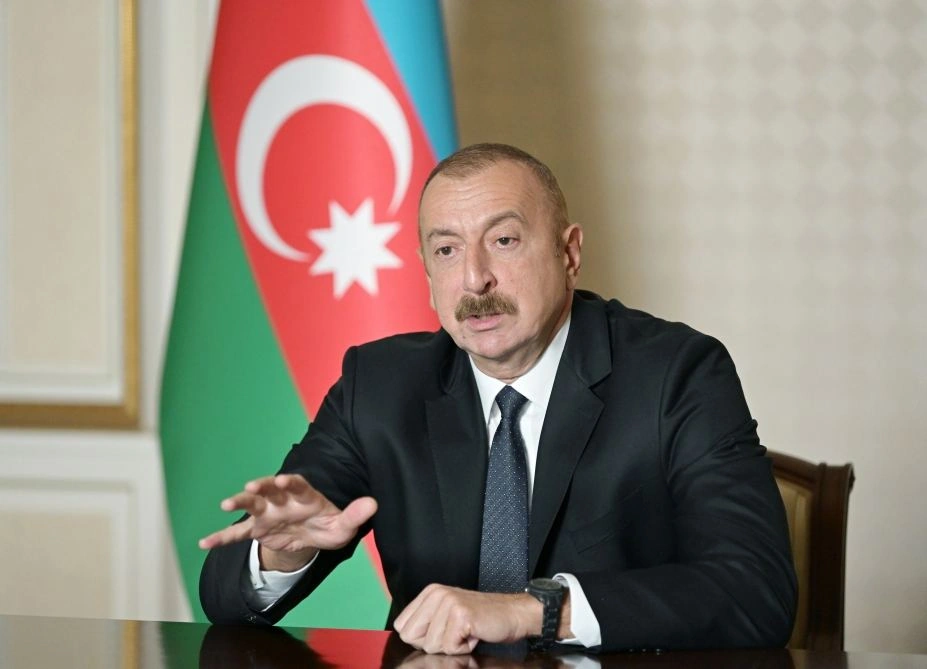
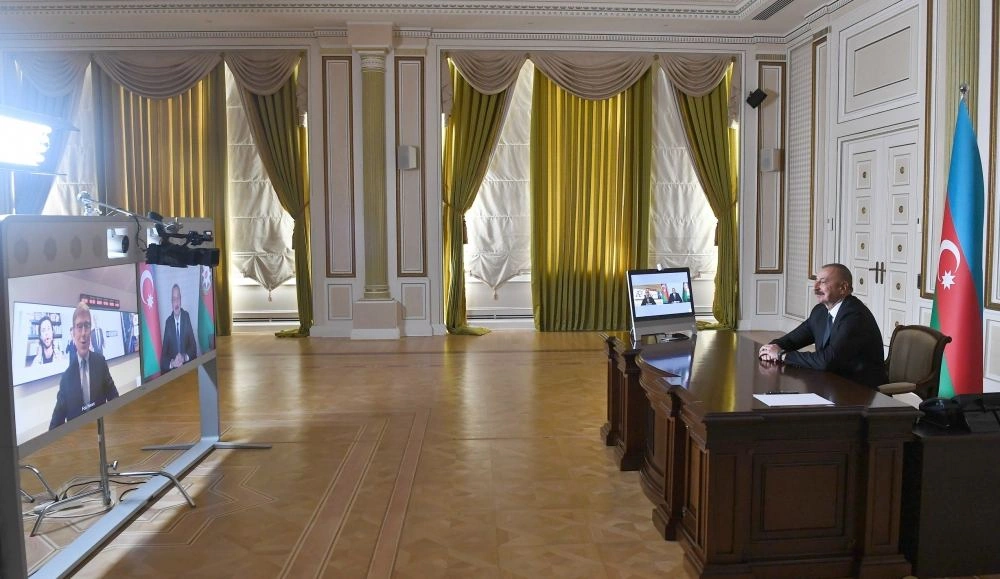
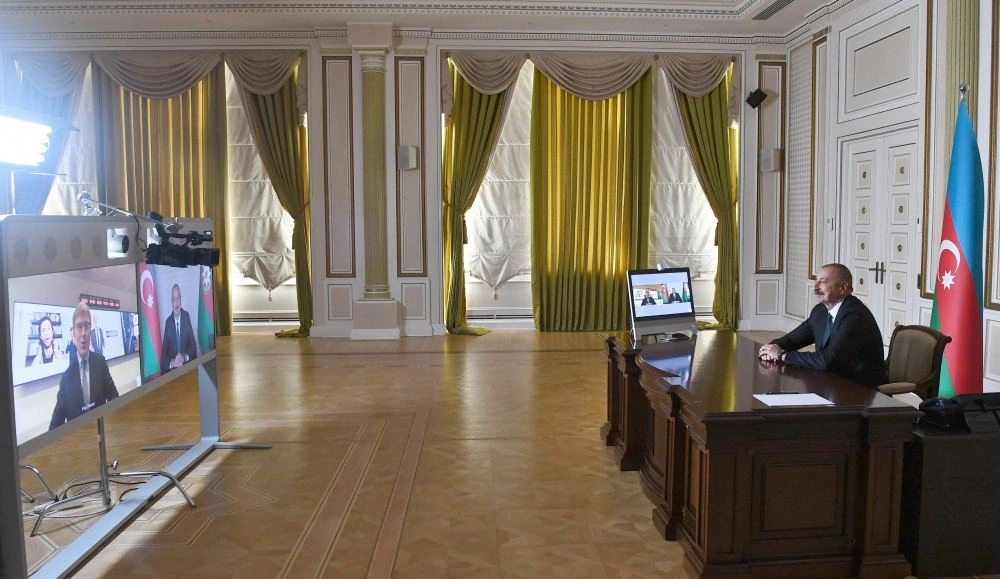
President Ilham Aliyev gave an interview to U.S. Fox News TV
channel.
Trend presents
the interview.
-Good morning.
-Good morning to you
-I worked in Europe for 30 years. I have never been to
your region. I apologize. We will have to correct that in the
coming months.
-I hope you will have time to visit us also. Some time in the
future.
-I also. It’s beautiful. Well, I like Formula 1, and I
like Zaha Hadid architecture, I like the movies. You have done a
wonderful job modernizing your country.
-Thank you.
-I have heard many of your interviews. You eloquently
explain in great detail the complex issues facing the region. I
must be blunt and to the point, concise and short. So we can get
more answers on. I fully understand these are very complex issues
that go back hundreds of years.
-Yes, I will try to explain to the American audience what is
happening, and why it happened, and what we want to see in the
future.
-That’s great. Well, we are very interested. By many
accounts, on September 27th your forces began this latest round of
war. There was a relative peace in Nagorno-Karabakh region. There
was some kind of a diplomatic framework that people had an idea to
resolve this crisis, but the fighting started. Why did you decided
to move on now?
-It was not Azerbaijan who started the firing on 27th of
September. So far, no official representative from any country
actually raise this issue in front of us. It was Armenia who
launched an attack on the 27th of September. And the purpose was to
disrupt completely the negotiation process. They did more or less
the same on July, when they attacked our forces on the state border
between Armenia and Azerbaijan. They were suffering the bitter
defeat. Then they sent a sabotage group on August, to penetrate
through our military positions, and to attack our civilians and
military personnel. So,on 27th of September they started artillery
bombardment from the heavy artillery weapons. And in the first
hours of the attack we had victims among civilians and military
servicemen. So far, we have 63 victims among civilians and almost
300 hundred of them wounded. So, it was Armenia. We just had to
defend ourselves and to respond. And our response was very adequate
and as a result of that we managed to liberate important part of
the occupied territories.
-But regardless of who shot the first shot, there was
fighting basically right away on both sides.In that period and in
the follow up you said in fact that you would want to remove all
Armenian forces from this area and that would only be the answer
that could resolve this crisis. And in the months leading up to
this September 27th day there was much talk of war and action in
Azerbaijan. You have to admit you were looking for
war.
-What I was saying was in line with the United Nations Security
Council resolutions. Back in 1993 Security Council resolutions
adopted by United Nations clearly demanded from Armenia complete,
unconditional and immediate withdrawal of Armenian troops from the
occupied territories of Azerbaijan. Unfortunately, during 27 years,
these resolutions were not implemented. So, when I was saying that
we want Armenian troops out of internationally recognized
territories of Azerbaijan, I am right from legal point of view and
what I say is in line with Security Council resolutions Of United
Nations. We were talking…
-Mr president, there is legal, and there is reality on
the ground. Reality on the ground in Nagorno-Karabakh and the
region is that now after all the trouble that you went through back
in 80s and the 90s are principally Armenian population. If you went
in there you have to again remove Armenians and bring Azerbaijanis
back, yet another displacement. There is a diplomatic plan on the
table, to keep Nagorno-Karabakh independent, for Armenia to give
back seven of the areas around it. Does diplomacy did and does
diplomacy make no sense to you?
-What you said about diplomatic solution is not correct. Because
there is no plan presented to us from the mediators, United States,
Russia and France, to give Nagorno-Karabakh independence. Not at
all. In the peaceful plan, there is a proposal...
-Autonomy.
-No, no. Not at all. In the peaceful plan, there is a proposal,
there is a point that all the occupied territories surrounding
Nagorno-Karabakh, the territories which have been inhabited by
Azerbaijanis and more than 700 thousand Azerbaijanis were
ethnically cleansed from those territories-these territories must
be returned to Azerbaijan. And the reality is on the ground you are
talking about is the realities as a result of aggressive separatism
from Armenia and ethnic cleansing against Azerbaijanis. All
Azerbaijanis have been expelled from Nagorno-Karabakh, there have
been 40 thousand of them before the war. All Azerbaijanis have been
expelled from 7 regions surrounding Nagorno-Karabakh with 700
thousand. My point is…
-Mr president, in 1994 you lost the war. Now in 2020 you
want to restart the war to win the war.
-We did not lose the war, we lost the battle. That was due to
objective reasons. First, there was an internal instability in
Azerbaijan. Armenia took advantage of that.
-My point is that why in 2020 you want to restart the
war? I mean, it has been calm for 20 years.
-And second, that was due to open external support to Armenia.
We did not start the war, we just responded and we do it based on
the United Nations Charter. United Nations charter provides the
right of every country for self-defense. What we are doing? We are
defending ourselves, and we are liberating internationally
recognized territories of Azerbaijan from Armenian occupation.
Nothing more than that. And with respect to Armenian people I have
said many times that Armenian people who live in Nagorno-Karabakh
are our citizens. We will take care of them. They will live in
dignity, in peace, side by side with Azerbaijanis who will return
there.
-Mr president, why are you resisting calls from the UN
as you mentioned Russia, Iran the United States, the EU, NATO, why
are you resisting calls for a ceasefire? And in fact, breaking to
the terms to create a ceasefire. And I know today, that’s what
Secretary of State Pompeo will be asking for a ceasefire to
exchange bodies, to exchange the wounded. Isn’t this a good time
for a ceasefire?
-We were ready for a ceasefire and on the 10th of October, in
Moscow, our foreign minister, Armenian foreign minister and Russian
foreign minister issued a joint declaration about the ceasefire.
But the next day, the next day, Armenians from the territory of
Armenia launched an attack on the second largest city of
Azerbaijan-Ganja, situated far away from the area of clashes with
ballistic missiles killing 10 civilians and wounding more than 30.
Then, there was a second ballistic attack on Ganja, killing 15
people. So it was Armenia…
-But you violated ceasefire as well.
-No, we just responded, because we agreed about ceasefire two
times, the first time Armenians at night, at 1 am at night,
launched a ballistic missile on a sleeping city. Second time,
ceasefire lasted only for two minutes and Armenia violated it.
There are no evidence that Azerbaijan violated the ceasefire.
-But let me put it this way, if Secretary of State
Pompeo today puts it to your foreign minister, the US really wants
a ceasefire another try. Will you give it another try?
-Yes, we are ready. I said many times publicly. We are ready to
agree on ceasefire today, but at the same time Armenia, its prime
minister should say that they are committed to the basic principles
elaborated by the United States, Russia and France. Armenian prime
minister two days ago said that there is no diplomatic solution to
the conflict of Nagorno-Karabakh.
-So, this has got strings attached. Is there a ceasefire
with no strings attached.
-We want a ceasefire, we want our territories back. Armenia
should commit that they will liberate the territories. According to
the United Nations Security Council resolutions and according to
the peace plan presented by US, France and Russia. But he does not
say this.
-Mr president, how do you respond to charges that your
military is inordinately targeting civilian areas, homes,
residences, stores even a very important church has been hit by
your high tech weaponry. Thousands others have been killed or
injured just in the past four weeks.
-We do not attack civilians. After Armenian brutal attack, an
act of terror against the city of Ganja with ballistic missiles
where dozens of people have been killed, we publicly said that we
will take revenge but on the battlefield. We do not attack
civilians, we do not attack religious sights. What happened to the
church in Shusha was either a mistake, and I already publicly
commented on that, or it was done by Armenians themselves in order
to put a blame on us.
-Again, Mr. president, we are seeing video scenes of the
capital of Nagorno-Karabakh, all the population there has to live
in basements. They are hearing artillery every twenty minutes.
Their city where civilians are living is wrecked. You can’t call
the entire city a military target.
-There have been military targets in the capital of the
so-called "Nagorno-Karabakh republic" Khankandi and our attacks
there were only before 9th of October. We didn’t attack any
civilians or cities, in the Nagorno-Karabakh after that, but they
attacked. Have you seen the images of what they have done to Ganja?
What they done
-Were you targeting civilians from September 27 to
October 19?
-No, no, no. we were targeting military infrastructure in the
so-called "capital of Nagorno Karabakh" Khankandi, because
military basis, military infrastructure is situated in the
city.
-You have drones from Turkey, you have military gear
from Israel, you have high-tech equipment from Russia. How can you
use that and not also hit civilians?
-No, no. Our drones and these images, a lot of them are on the
internet. You can look, how our drones destroy Armenian tanks and
other weapons. So far, our drones destroyed more than 230 tanks. We
destroyed 6 S-300 anti-air missile system. We destroyed hundreds of
their armed vehicles. We do not use drones for civilians this is
false information.
-Let’s talk about the soldiers, the troops that are in
action. From multiple sources, from France, from Russia from
independent respected journalists at the New-York Times for
example, they absolutely assert that Syrians, militias gathered and
transported by Turkey in a hundreds are now fighting your war. Why
do you have Turkish backed Syrian militias fighting your war in
Azerbaijan?
-This is another fake news. I regret that Russia and France, the
only countries by the way, which publicly commented on that made
such an irresponsible statement. And I demanded and still demand
proofs, evidences. It is more than 20 days after the war has
started again. So far, not a single evidence or proof was presented
to us neither by Russia nor from France.
-The evidence was in the New-York Times. I direct you to
the story five days ago that says that 57 Syrian fighters killed in
Azerbaijan, were brought back across the border from Turkey and
buried in Syria. Their families all attest that they went to
Azerbaijan, to fight alongside your army.
-Do you know do you remember how President Trump calls New-York
times? Fake news. This is fake news. No evidence, no proof. Give us
evidence not only New-York Times.
-I’m just curious, you have a 100 thousand soldiers. Why
do you need some scrappy mercenaries?
-Yes. Exactly. We don’t need them.
-That’s a good question. Why?
-We don’t need them. That was what I was talking about. A 100
thousand soldiers in the regular army, plus maybe couple or three
times more soldiers we can recruit within couple of days plus more
than equipment. We don’t need any mercenaries at all. This is fake
news, just in order to damage the image of our country, and in
order to diminish the bravery of our soldiers on the
battlefield.
-Mr president, let’s get back to the timing of this. Why
we are seeing military action now? Why we are seeing clashes?
Critics of your government, of your presidency say that you are
using this war as a smokescreen to deflect the tension from
problems in your own country, social issues, economic stagnation,
corruption, COVID-19. Are you using this just to overattention in a
public maybe dissatisfied on a lot of different accounts towards
the patriotic battle.
-No, no. This is absolutely wrong. First, our economic
performance is one of the best in the world. Economic decline in
Azerbaijan in the ten months is less than 4 percent. You can
compare it with your own country, or with European countries. Level
of unemployment in Azerbaijan is 7 percent, compare it with your
own country. Level of poverty in Azerbaijan is five percent,
compare it again. We don’t have serious social problems. On
COVID-19, Azerbaijan is considered as an example by World Health
Organization. We provided support to more than 30 countries,
financial support, humanitarian support. Our economy is stable. Our
economy is sustainable. And there was no need as you say to launch
the war in order to cover some of internal problems. It was on the
other side, Armenia which is completely now in economic and social
problems. They need to distract attention. It is Armenian prime
minister who puts leading opposition party leader to jail. He is
pursuing two former presidents.
-We know that there are some accusations of human rights
abuses with your own government and suppression of freedom of
speech and specifically talking about the corruption and the family
rule of both your government and many of the corporate structures.
So this is not to pull the attention of your public or some members
of your public away from those considered misdeeds by some
people.
-No, no, no. Corruption is here and we are fighting against it.
We have introduced a broad economic reforms program. Many people,
many governmental officials and high ranking officials have been
arrested recently for charges of corruption. Corruption is
everywhere and we are fighting against it. With respect to the
family rule, again, I would like to refer you to your own country,
where important positions were held by father and son. Just Bush
family, Clinton family, husband and wife, Kennedy family, and in
many other countries. So, it’s nothing different from what is
happening in the United States.
-They were all elected democratically and
transparently.
-Yes, especially President Bush who was elected by the decision
of the US Supreme Court.
-You know the American politics Mr
President.
-I know yes. I am well prepared for that.
-Let’s go to the United States now. What would you like
to see today and in the future Secretary of State Pompeo do? There
has been some criticism of Secretary Pompeo and the US that they
haven’t been enough engaged. I know, Russia is quite involved,
Turkey in various ways involved, even Iran is offering help. What
would you like? Has the US done enough would you like to see the US
do more? What would you like Washington to do?
-I think that the US as one of the three co-chairs of the Minsk
group has a mandate from OSCE to help parties to come to an
agreement. And agreement must be based on international law it
should not be based on what I want or what Armenian prime minister
wants. It should be based on international law. Nagorno-Karabakh is
recognized by the United States and all other countries as integral
part of Azerbaijan. So what I can expect from Secretary Pompeo
first? To tell prime minister Pashinyan’s envoy that statements
like "there is no diplomatic solution" is wrong and dangerous.
Second, statements by Armenian prime minister that "Karabakh is
Armenia" is dangerous and wrong and they should be reasonable. They
should give us a timetable for withdrawal from the occupied
territories. They should agree for peaceful coexistence between the
Armenians and Azerbaijanis in the territory of Nagorno-Karabakh.
And they should stop trying to internationalize the conflict. They
should stop asking Russia for direct military involvement. This is
counter-productive. All the efforts of Armenian prime minister
during these times is to ask Russia to send troops to fight against
Azerbaijan. And this is very dangerous.
-What’s your deadpoint, I mean another criticism of
Secretary of State Pompeo, and he directly says, and certainly, the
US and Turkey has as many areas of commonality but he says Turkey’s
assistance of your effort is actually causing problems, it’s
fueling the flames. How do you react to that?
-Turkey provides political support to Azerbaijan. It is our
closest ally and friend. And we are proud and happy that we have
such a great country as our partner. Every country has a right to
have friends and allies. Armenia has its allies.
-Turkey has been pushing for war. Turkey says there is a
military way to go.
-No, not at all. Not at all. Not a single evidence about that.
Turkey only provides political support and this is enough, because
when Turkey says that they stand side by side with Azerbaijan, and
Azerbaijan is not alone, this is a message to all those who want to
penetrate and provide their interests with respect to the
conflict.
-You did offered an important line when we were speaking
just a short while ago. You said in our discussions in your
discussions with the Secretary of State Pompeo that there is a
diplomatic solution. Do you believe there is a diplomatic solution
to this crisis?
-Yes, I believe, otherwise I wouldn not have been in the
negotiations for 17 years. You were trying to say that I launched
the war. But if I launched the war why should I wait for 17 years?
Azerbaijani army is well-prepared already for at least ten years
already. Therefore, the diplomatic solution is on the table.
Armenia must liberate territories surrounding Nagorno-Karabakh.
Azerbaijanis must return to those territories and then live in
peace and dignity with Armenians. That’s our position.
-So, you are saying diplomatic solution but with a
military overlay.
-I said that I wish the military solutions stop today and we
move on negotiation table. This military factor is causing a lot of
damage and a lot of victims,unfortunately. Therefore, the sooner we
start substantive negotiations, not imitation like Armenia wanted
to do all these years but substantive negotiations, the sooner the
resolution will be found. And if resolution is based on territorial
integrity of Azerbaijan.
-The worry of some outside of your country, outside of
your region and perhaps what should be the worries of yours as well
is that this contained conflict becomes a wider regional problem.
You have Turkey, with a real interest, you have Russia with a real
interest, you have Iran with a real interest. Are you risking your
own standing as a country of stature, both economic and politically
get lost in some kind of a regional maelstrom that you could have a
part in starting?
-All our efforts during the conflict aimed to stop active phase
as soon as possible. And we are completely against any form of
internationalization of the conflict so that conflict spread over.
That's what Armenia wants to do. And as I said, they asked Russia
to send military personnel to the area of conflict which is
absolutely counterproductive, and which is completely in violation
of international law. We don’t want other countries to
interfere.
-Well, there are Russian bases in Armenia
already.
-Exactly, in Armenia, yes.
-They are not illegal.
-Yes, it is in Armenia but not in Nagorno-Karabakh. What they
are asking Russians is to send troops to Nagorno-Karabakh and we
know about that. Therefore, our position is all the regional
countries, and all the countries should stay away from direct
involvement in the conflict. Those who want to help and those who
have a mandate, OSCE Minsk Group co-chairs must persuade Armenia. I
hope it will happen today in Washington, to stop aggression, to
commit to ceasefire, and to make commitment that they will leave
the territories. They don’t do it.
-There was an expression during the Gulf War that it was
all about the oil, okay? You got oil pipelines, energy pipelines,
within, I don’t know, 50-60 miles of the fighting. Are you
concerned that your very important energy pipelines and connections
could be disrupted by fighting one side or another? And in fact
maybe that is helping to drive your military to conduct this
war.
-Actually, we are concerned because we heard the statements from
high-ranking Armenian officials that they will attack our strategic
oil infrastructure, including pipelines and one of the biggest oil
and gas terminal in Sangachal district of Baku. And the July
clashes where Armenia attacked us, took place 15 kilometers from
the gas pipeline which is supposed to provide energy security to
Europe. So, it was Armenian plans to disrupt oil and gas supplies
from Azerbaijan to Europe and to the world.
-So, were part of motivational what you’re doing right
now is to defend your economic interest against any threat like
that?
-No, we are defending ourselves. You know, our oil pipeline from
Baku to Mediterranean was commissioned in 2006 and it works without
any disruption. Our gas pipeline from Azerbaijan to Turkey was
commissioned in 2007. A big pipeline to connect Azerbaijan with
European consumers is going to be opened in a couple of months
probably, maybe even less. Therefore, why should we launch a war in
order to protect the pipeline when the pipeline is already
protected. It is Armenia which wants to disrupt the pipeline and to
make economic damage to Azerbaijan.
-Are you satisfied with what President Trump and his
administration has been saying about the conflict? He has been
critical of Turkey. But frankly, he has been critical of both
sides. He is outweighing very large Armenian diaspora in the United
States. So there are political elements in this too. Do you think
the United States is handling its role well?
-I think what President Trump does with respect to the conflict
resolution is fully in line with international relations. We fully
support his position, his personal comments on that. And we see
that the position of the United States is balanced and as it should
be, because United States is a mediator. President Trump’s comments
on criticism on Turkey, I did not see it, by the way, in the press.
But his comments were constructive. The United States does not take
sides as other co-chairs should also don’t take sides. We
understand internal politics not only in America, but also, in
France and Russia. With a very large Armenian community which
influences which has a lot of lobbying activity and which is now in
full operation against Azerbaijan. And we understand the level of
pressure which they can impose. But at the same time, very straight
forward position of President Trump is highly supported here in
Azerbaijan not only by me, but also our people.
-Mr president, you know politics. And I bet you know
American politics too. We are ten days away from a major
presidential election, in figuring out this move towards diplomacy
in Washington. Do you think the idea of maybe a diplomatic success
might be figuring in the minds of my Washington politicians and
having said that do you find that’s okay any motivation to get
things going?
-Any motivation in order to put an end to the hostility is
supported by us. And I think that today’s meeting in Washington can
have a very good result only if Armenia will commit to peaceful
settlement, will stop attacking us and will make commitment that
they will withdraw the troops.
-Do you think it is driven by US presidential politics
this diplomatic effort today?
-Well, I don’t know, I think that the American voters will make
the vote based on their approach and their assumption of what is
the best for America. I don’t think that Karabakh conflict is
something which American people are concerned about. Maybe most of
them even do not know. But of course, America as a superpower has a
very important say in this conflict resolution. And our position is
that America as a mediator should continue to be neutral, and
should try again and more and more to bring both sides closer to
the common decision.
-But let me pick up on that point as we conclude this in
the next two minutes. Why should the United States care? I think
you probably are right. Most Americans could not find
Nagorno-Karabakh on a map. But there were strategic issues you are
dealing with, political, cultural, demographic. If you were talking
to the United States people now, and said excuse me, I know you
have got the presidential. I know you have got the world series
baseball, but you should pay attention to this too. What would you
tell a typical American. Why it is important for us to care and
look at this?
-I would say that Azerbaijan has always been a very true partner
to the United States. We are together on the fight against
international terrorism, we are together in Afghanistan and we keep
our military servicemen in Afghanistan, thus, providing the cause
of our peacekeeping operations. We have an important topic on our
agenda of energy security. The United States has always strongly
supported Azerbaijan’s efforts to diversify its energy supply
routes. And with a strong support of the United States we managed
to complete important projects. Azerbaijan and the United States
have a very strong partnership relations. And the United States
considers Azerbaijan as a friend. And we are really friends.
Therefore, it is in the interests of the United States that there
is peace here. Azerbaijan continues its path on the route of
independence, strengthening the independence. We are situated just
between Europe and Asia, on the crossroads of transportation,
energy. Our political importance is growing. Therefore, Azerbaijan
is an important partner to the United States and the United States
to Azerbaijan.
-So, stability in your country, in your region,
politically, economically et cetera could be good for us as well
3000-5000 miles away.
-Yes. America is a superpower. The distance does not make any
difference. And I think that the modern, secular, friendly Muslim
country is also a big asset for our friends. And the United States
from the very first years of independence, always supported
Azerbaijan. Today I can tell you we have maybe the highest ever
level of our bilateral cooperation and we hope that today’s meeting
in Washington will be important to persuade Armenia to stop
aggression, stop occupation and then peace will come to our
land.
-There is a lot of support for Armenia as you know that
earlier in the interview in the United States.
-Yes.
-The support for the Christian religion there, for the
church is there. For the diaspora the punishment that they incurred
many years ago by Turkey. So, you know that there is a warm
emotional feeling towards Armenians as well in the United
States
-Yes, I know that, I said before that we understand the internal
politics, and the Armenian lobby organization. But when we look at
the issues related to international relations, there must be
principles. Emotions, feelings, some other expression of good will
is different. It can be in the family, it can be at the dinner. But
in international relations, there is an internationally recognized
territory of Azerbaijan, which is occupied by Armenia. So, the
occupation must come to an end. And those Armenians who live in
America, who live in France, who live in Russia, the rich people
don’t care about those Armenians in Nagorno-Karabakh. How they live
in poverty.
-They will probably disagree with you on that one. But
okay. Two final questions. Back to presidential politics. Former
vice president Joe Biden might be the president-elect in ten days
time. Have you ever had any contact with him maybe in his
vice-presidential role? And how do you take a Biden administration
would deal with this conflict right there in your
region?
-Yes, I met with vice-president Biden four years ago in
Washington at the Nuclear Summit which was organized by President
Obama. I had bilateral meeting with Mr. Biden and I saw that he was
deeply involved in regional issues. We discussed many issues of our
bilateral relations, of course, including Nagorno-Karabakh
settlement. I can tell you that Obama’s administration was very
active on the Nagorno-Karabakh track. Therefore, Mr. Biden and I am
sure the people who support him there are well aware about that.
So, I have very good memory of our meeting with him.
-Do you think he will be favorable to your position?
Will he be favorable to Armenia? Well, he probably will talk
against war. I mean he probably will also push for a ceasefire,
push for a diplomacy. Do you think that would be an okay
approach?
-I think, taking into account what we have just discussed, the
Armenian lobbying organizations in America, in France and Russia,
for Azerbaijan the most favorable situation will be that the
leaders of these three countries stay neutral on the conflict and
don’t take sides. Actually, that’s what their mandate dictates
them. If they take sides, they cannot be mediators. And we expect
from the US foreign policy team in the future also, to be neutral,
and to be objective.
-Finally Mr. President, your prediction for the future.
I mean your region, your country, Armenia. Such horror late 80s and
early 90s. Tens of thousands of people were killed. What are we
looking now? Tens of thousands of people more killed? More
destructions? How do you see this going forward?
-It is difficult to predict now what will happen. It not only
depends on us, because the war is not held by one country. It is
not a unilateral process. But how I want to see the region I can
tell you. I want the region of the Southern Caucasus to be deeply
integrated. I want that the strategic relations which we have with
another South Caucasian country, Georgia, can be to certain degree
a model of relations between Azerbaijan and Armenia once in the
future. Because all wars stop and peace comes. We know how...
-You think there can be a peaceful resolution of this
conflict?
-Definitely.
-Fine, a diplomatic answer.
-I am absolutely confident. But it depends on the will from
Armenian side. What happened after the second World War? Germany
and the United States were killing each other. Soviet Union and
Germany were killing each other. Tens of millions were killed. But
look now. It is not any longer in the memory. It is not provoking
hostility. Why Armenians and Azerbaijanis cannot live together in
the region of Nagorno-Karabakh, while they live together in
Georgia, in Russia, in Ukraine, in many other countries? I think
that the Southern Caucasus…
-Can be peace at the same time recognizing the rights of
both sides?
-Yes, exactly. It must be based on the reasonable background,
within the framework of territorial integrity of Azerbaijan, with
full protection of rights and concerns of Armenian population of
Azerbaijan. That’s I think, that is doable.
-Mr president, thank you very much for this lengthy
interview and I am sure, we will inform not just me, but our
American public.