BAKU, Azerbaijan, October 26. The European
Investment Bank (EIB) supports the “Caspian–Black Sea–Europe Green
Energy Corridor” project; however, before a decision on its
financing can be made, the distribution of costs, benefits, and
risks among the participating countries, as well as technical
issues, must be clarified.
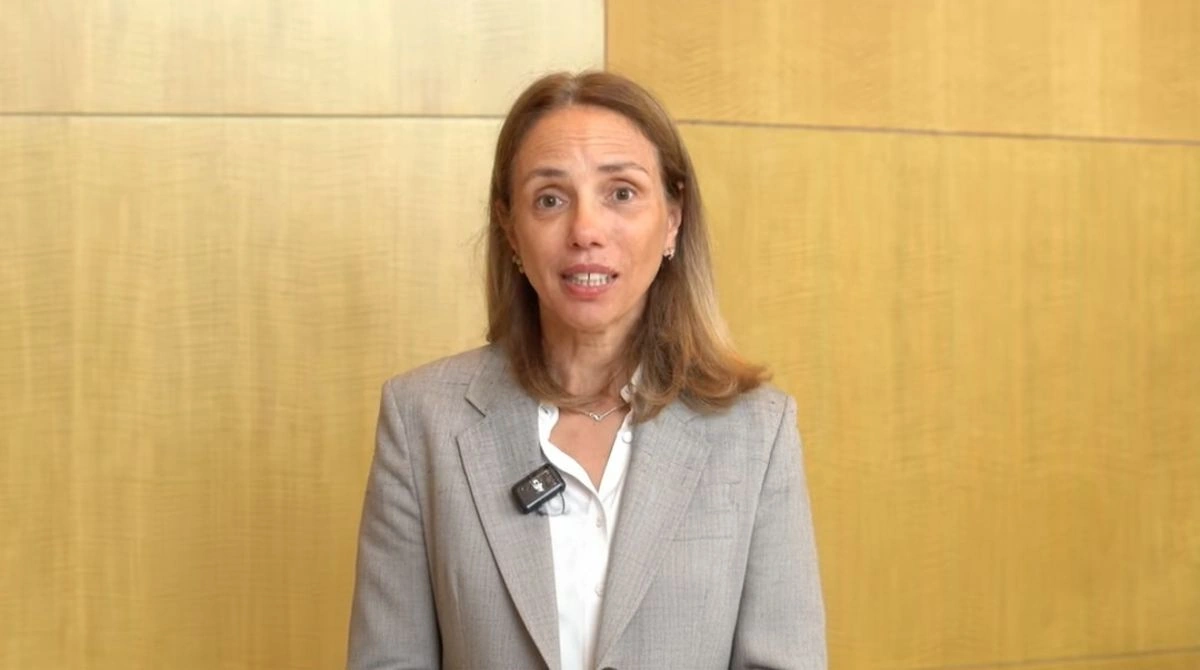
This was stated by Violaine Silvestro von Kameke, the Head of
the Public Sector Unit for the Ukraine Investment Team and
Principal Advisor at the European Investment Bank (EIB) in a video
posted on the social media accounts of the Azerbaijani Ministry of
Energy. She shared her views on the project’s prospects at the
“Green Energy Corridor: From Feasibility Study to Implementation”
forum held in Baku.
“As the European Investment Bank, we are pleased to participate
in this conference, which provides an opportunity to review the
progress made in preparing the project. We actively support this
project. We expect that in the near future, based on the results of
the feasibility study, concrete decisions will be made, after which
the financing phase will begin,” she said.
The EIB representative noted that the bank places particular
importance on projects that promote the development of renewable
energy, strengthen regional integration, and expand the use of
clean energy. According to her, such initiatives can also help
ensure that European Union (EU) countries have access to
electricity at more affordable prices.
At the same time, Violaine Silvestro von Kameke emphasized that
a number of issues need to be clarified in order to assess the
project's funding options.
“We need to obtain more detailed information about all the
countries that will participate in such a large-scale project. At
the same time, it is important to clarify how the costs, expected
benefits, and risks will be distributed among the participants,”
she said.
The EIB representative also noted an interest in receiving
additional information on the progress of the project’s technical
design and the technical details of its implementation.
Investment Prospects for the Project
At the forum held in Baku, the results of the feasibility study
for the “Caspian–Black Sea–Europe Green Energy Corridor” project
were presented to international investors, financial institutions,
and business partners. The event featured discussions on the
project’s investment appeal, its business model, financing options,
the establishment of new partnerships, and preparations for the
final investment decision (FID).
According to the feasibility study, the power transmission
infrastructure requires an investment of 14.3 billion euros. The
document was finalized in July 2026 and approved by the governments
of Azerbaijan, Georgia, Romania, and Hungary. The project is
currently in the development stage.
According to the study, the corridor’s total transmission
capacity will be 3.9 gigawatts (GW). The plan calls for the
construction of three power transmission lines, each with a
capacity of 1.3 GW. The project’s internal rate of return (IRR) is
reportedly estimated at 11.7%.
According to forecasts, starting in 2032, the corridor will be
able to supply 8 terawatt-hours (TWh) of renewable electricity per
year to the EU. This figure is expected to reach 20 TWh by
2040.
The feasibility study projects that revenues from managing
transmission constraints in the power grid will exceed 315 million
euros per year starting in 2032. It also notes that the project
will reduce carbon dioxide emissions to 3.6 million metric tons per
year by 2040.
Furthermore, the annual economic benefit of the project is
expected to grow as the power transmission lines are commissioned
in phases. It is projected that after the first line is
commissioned in 2032, this figure will reach 860 million euros, and
after the second line is launched in 2036, it will reach 1.8
billion euros. With the commissioning of the third line in 2040,
the annual economic benefit is expected to exceed 3 billion
euros.
Speaking at the forum, Azerbaijan’s Minister of Energy Parviz
Shahbazov emphasized the strategic importance of the project in
terms of strengthening regional energy security, diversifying
energy supplies, and advancing the green transition.
The minister stated that this project holds a special place in
Azerbaijan’s strategy to become a regional hub for the production,
transmission, and export of green energy. According to him, during
the recent visit of European Commission President Ursula von der
Leyen to Baku, political support for this initiative was once again
expressed. It was noted that efforts to include the project in the
Ten-Year Network Development Plan (TYNDP) of the European Network
of Transmission System Operators and to obtain Project of Mutual
Interest (PMI) status also strengthen its investment prospects.
The phased commissioning of the corridor, which is approximately
3,000 kilometers long, is scheduled to begin in 2032. The project
is expected to create conditions for the development of at least 8
GW of renewable energy generation capacity in the region, the
transmission of approximately 20 billion kilowatt-hours of
electricity to Europe annually starting in 2040, and a reduction in
carbon emissions of up to 3.6 million metric tons.
Laying subsea power cables in the Black Sea at depths of up to
2,200 meters is one of the project’s main technical challenges. For
this reason, the use of cutting-edge technological solutions is
planned to carry out the work in challenging marine conditions.
To ensure the project’s commercial viability, a hybrid business
model combining regulated and commercial components is being
considered. The model is expected to be based on long-term power
purchase agreements, private capital investment, and the
development of cross-border electricity trade.
Parviz Shahbazov noted that the participation of international
financial institutions and private investors, a reliable business
model, and long-term commercial agreements are key conditions for
preparing to make a final investment decision.
“Our goal is to transform the ‘Green Energy Corridor’ into a
regional infrastructure project with a clear business model, a
sustainable financial structure, and attractive conditions for
investors. Azerbaijan’s strategic location, extensive experience in
implementing international energy projects, and strong
relationships with partner countries provide a solid foundation for
achieving this goal,” the minister emphasized.
At the conclusion of the forum, participants agreed to develop a
roadmap for the partnership and identified the next steps in
preparation for making a final investment decision on the
project.
Project Participants
The “Caspian Sea–Black Sea–Europe Green Energy Corridor” is a
cross-border electricity transmission project involving Azerbaijan,
Georgia, Romania, and Hungary. The initiative was established under
the Strategic Partnership Agreement signed on December 17, 2022, in
Bucharest with the participation of the European Commission.
The project is being implemented by Green Energy Corridor Power
Company (GECO), a joint venture registered in Bucharest. The
company is owned by the national power grid operators of the four
countries. Azerbaijan is represented by Azerenerji, Georgia by
Georgian State Electrosystem, Romania by Transelectrica, and
Hungary by MVM. Each participant holds a 25% stake in the
company.
The project is included in the European Network of Transmission
System Operators for Electricity (ENTSO-E) Ten-Year Network
Development Plan for 2026 under numbers 1248 and 1244.
The next phase of the project involves preparing an
implementation plan, clarifying financing options, and continuing
preparations for a final investment decision in 2029.