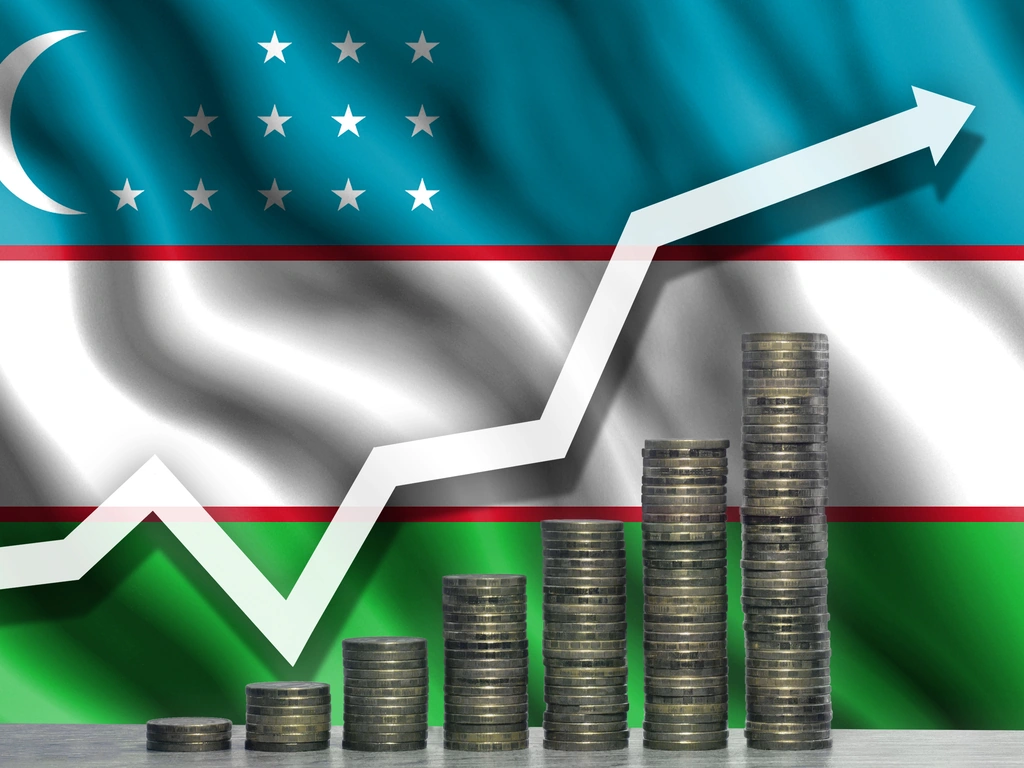
BAKU, Azerbaijan, August 17. Uzbekistan
invested 338.9 trillion soums (about $28.3 billion) in fixed
capital during the first half of 2026, marking a 17.5% year-on-year
increase as investment remained concentrated in manufacturing,
infrastructure and other productive sectors.
This was reflected in the statement by the National Statistics
Committee of Uzbekistan.
Manufacturing attracted the largest volume of investment at
100.5 trillion soums (around $8.4 billion), followed by
agriculture, forestry and fisheries with 32.9 trillion soums
(approx. $2.7 billion) and construction with 32.5 trillion soums
(about $2.7 billion).
Electricity, gas, steam and air-conditioning supply accounted
for 29.9 trillion soums (around $2.5 billion), while residential
construction received 27.3 trillion soums (approx. $2.3 billion).
Mining and quarrying attracted 21.8 trillion soums (about $1.9
billion), followed by transportation and storage at 16.3 trillion
soums (around $1.4 billion).
Wholesale and retail trade, including vehicle and motorcycle
repairs, accounted for 13.7 trillion soums (approx. $1.1 billion).
Water supply, sewerage and waste management received 7.4 trillion
soums (about $620 million), while education and information and
communications attracted 7.2 trillion soums (around $603.2 million)
and 5.8 trillion soums (approx. $486 million), respectively.
Accommodation and food services accounted for 5.6 trillion soums
(about $469,1 million), while professional, scientific and
technical activities received 4.6 trillion soums (around $385,4
million). Healthcare and social services also attracted 4.6
trillion soums (approx. $385,4 million).
Financial and insurance activities accounted for 2.4 trillion
soums (approx. $201 million), followed by arts, entertainment and
recreation at 2 trillion soums (about $167.5 million). Other
activities collectively received 24.4 trillion soums (around $2
billion).
Trend's analysis
shows that Uzbekistan's investment activity remains strongly
oriented toward sectors that expand production capacity and basic
infrastructure. Manufacturing alone absorbed nearly 30% of total
fixed-capital investment, making it the largest recipient and
highlighting the continued role of industrial expansion in the
country's growth strategy.
Trend's calculations show that manufacturing investment was more
than three times higher than investment in agriculture, forestry
and fisheries, the second-largest recipient. Manufacturing,
construction and energy-related activities together attracted
approximately 162.9 trillion soums (about $13.6 billion), or about
48% of total investment during the period.
The distribution also points to continued investment in the
country's energy and transport infrastructure. Electricity and gas
supply attracted 29.9 trillion soums (around $2.5 billion), while
transportation and storage received 16.3 trillion soums (about $1.4
billion), supporting the infrastructure needed to accommodate
expanding industrial and commercial activity.
In Trend's
assessment, the 17.5% increase in fixed-capital investment
indicates that Uzbekistan's economic expansion continues to be
supported by significant capital formation. The concentration of
investment in manufacturing, construction, energy and transport
could strengthen productive capacity and improve connectivity,
while the comparatively smaller allocations to services such as
finance, healthcare and information and communications suggest that
there remains room for greater diversification of investment toward
higher-value service industries.