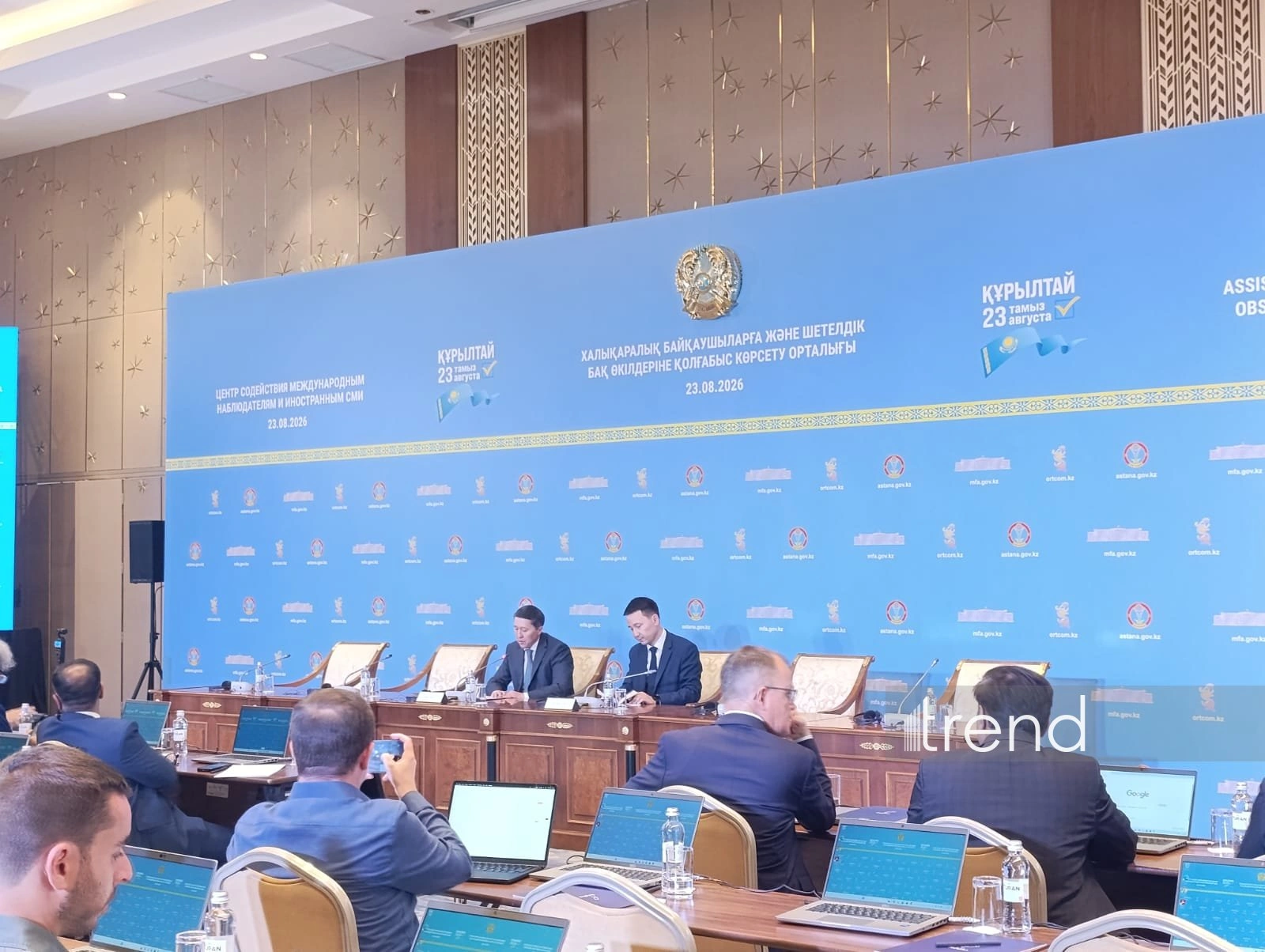
ASTANA, Kazakhstan, August 22. The upcoming
elections to Kazakhstan’s Kurultai mark the transition from
constitutional decisions to the practical functioning of the
country’s new political system, Deputy Foreign Minister Arman
Issetov said at a briefing for journalists ahead of the Kurultai
elections, Trend’s
special correspondent reports.
“Kazakhstan’s GDP grew by 6.5% in 2025. Industry, construction,
transport, investment activity and other sectors made a significant
contribution to this growth,” he said.
Issetov noted that Kazakhstan is steadily expanding the economic
foundations of its development. Industrial production,
infrastructure, transport and logistics, roads and the digital
economy are developing, while investment is being attracted and new
opportunities for businesses are being created. “However, economic
development also presents the state with new challenges. The more
complex the economy becomes, the more effective state institutions
need to be. The greater the scale of private entrepreneurship and
investment, the higher the requirements for the quality of
legislation and public administration,” he said.
The deputy minister noted that as society becomes more diverse,
it becomes increasingly important to have mechanisms that allow
different public interests to be taken into account. “This is one
of the main reasons behind the current constitutional reform. It is
not aimed at change for the sake of change. Its purpose is to bring
political institutions in line with modern Kazakhstan and prepare
them for the country’s next stage of development. The upcoming
Kurultai elections are an important part of this process. They mark
the transition from constitutional decisions to the practical
functioning of the new political system,” Issetov said.
On July 1, 2026, Kazakhstan’s President Kassym-Jomart Tokayev
signed a decree setting August 23, 2026, as the date for elections
to the Kurultai, Kazakhstan’s unicameral parliament.
Previously, legislative power in Kazakhstan was exercised by a
bicameral Parliament consisting of the Senate, the upper house, and
the Mazhilis, the lower house. Under the new Constitution, which
entered into force on July 1, 2026, Kazakhstan’s parliamentary
system now provides for a unicameral Kurultai.
The Kurultai will comprise 145 deputies elected for five-year
terms from party lists in a single nationwide electoral district
through universal, equal and direct suffrage by secret ballot.
Seven political parties are participating in the elections:
Adilet, the Nationwide Social Democratic Party, the Baitak Green
Party of Kazakhstan, the People’s Party of Kazakhstan, Auyl, the Ak
Zhol Democratic Party of Kazakhstan and Respublica.