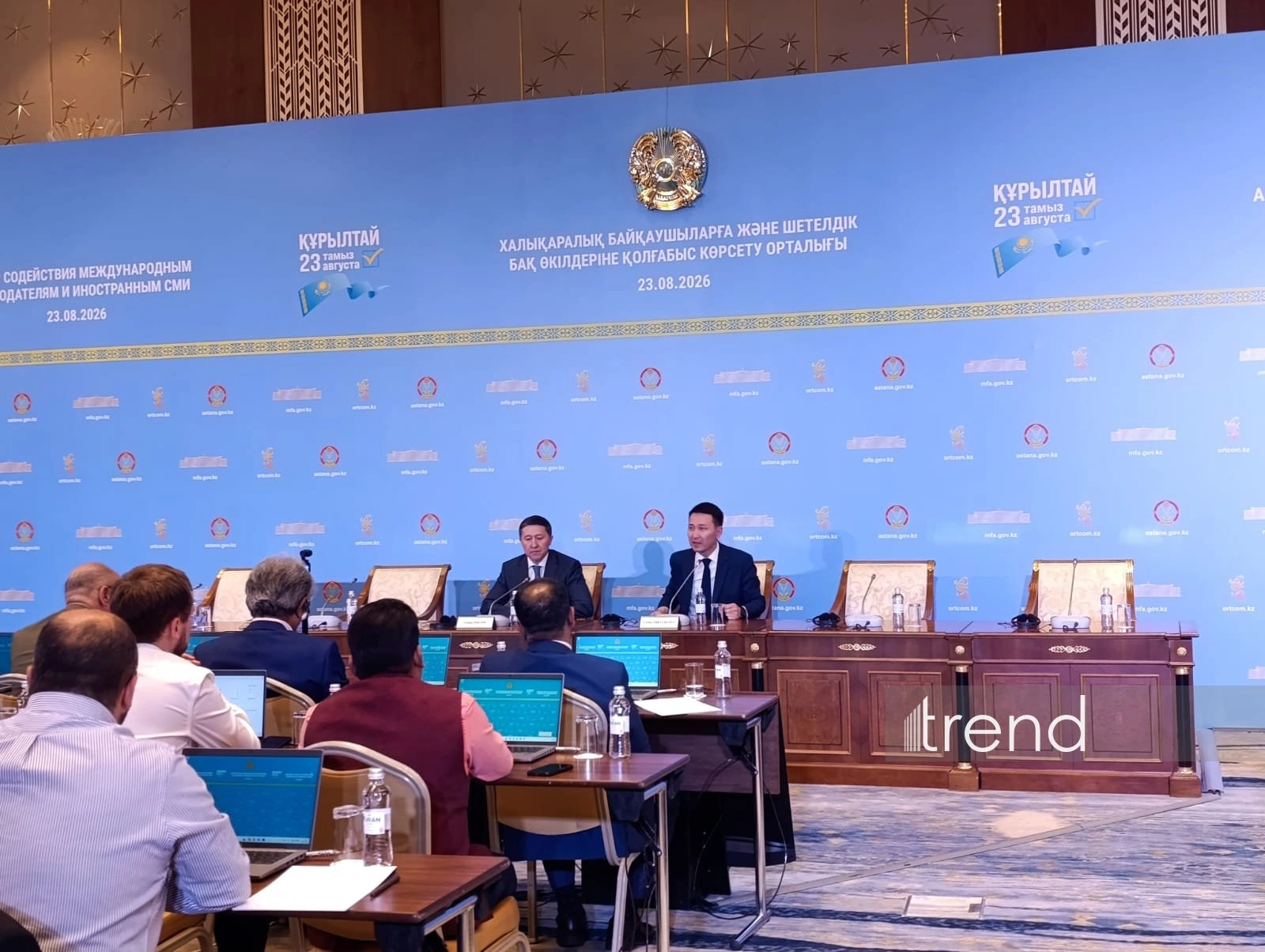
ASTANA, Kazakhstan, August 22. The formation of
a new political architecture should be viewed as a means of
strengthening stability in Kazakhstan, Deputy Foreign Minister
Arman Isetov said at a briefing for journalists ahead of the
Kurultai elections, Trend’s special correspondent reports.
According to Isetov, reforms in Kazakhstan should be viewed in
the context of changes taking place both within the country and
across the wider region. “Today, the international system is
becoming increasingly complex and less predictable. Geopolitical
tensions are rising, trade and economic ties are changing, and
competition for investment, technology and transport routes is
intensifying. Under these circumstances, stability remains one of
Kazakhstan’s key priorities,” Isetov said.
He emphasized that stability does not mean an absence of change.
“In today’s world, stability requires the state to adapt to new
circumstances in a timely manner. That is why the constitutional
reform and the formation of a new political architecture should be
viewed as a means of strengthening Kazakhstan’s stability,” he
said.
On July 1, 2026, Kazakhstan’s President Kassym-Jomart Tokayev
signed a decree setting August 23, 2026, as the date for elections
to the Kurultai, Kazakhstan’s unicameral parliament.
Previously, legislative power in Kazakhstan was exercised by a
bicameral Parliament consisting of the Senate, the upper house, and
the Mazhilis, the lower house. Under the new Constitution, which
entered into force on July 1, 2026, Kazakhstan’s parliamentary
system now provides for a unicameral Kurultai.
The Kurultai will comprise 145 members elected for five-year
terms from party lists in a single nationwide electoral district
through universal, equal and direct suffrage by secret ballot.
Seven political parties are participating in the elections:
Adilet, the Nationwide Social Democratic Party, the Baitak Green
Party of Kazakhstan, the People’s Party of Kazakhstan, Auyl, the Ak
Zhol Democratic Party of Kazakhstan and Respublica.