BAKU, Azerbaijan, October 21. The Middle
Corridor’s importance as a regional transit route is rapidly
increasing, reads the “Trade Study Report – Trade Sector
Development in Azerbaijan: Policies, Constraints and
Opportunities”, issued by the EU.
The report reveals that the total volume of cargo transported
along the Middle Corridor increased from 586,000 tons in 2021 to
1.867 million tons in 2025.
“This is an increase of approximately 3.2 times in four years
and indicates that the importance of the Middle Corridor as a
regional transit route is rapidly increasing,” reads the
report.
The authors of the report point out that the volume of container
transportation has also shown an overall upward trend. Although the
container turnover, which was 25,200 TEU in 2021, increased to
33,600 TEU in 2022, it decreased to 20,500 TEU in 2023. However, a
sharp increase was recorded in subsequent years. The volume was
56,500 TEU in 2024 and 76,900 TEU in 2025. Thus, the volume of
container transportation in 2025 increased by almost 3 times
compared to 2021.
“Overall, the cargo and especially container transportation
along the Middle Corridor has been rapidly expanding in recent
years. This dynamic is one of the key indicators that demonstrate
the strengthening of Azerbaijan's role as a transit and logistics
center, as well as the increasing demand for multimodal transport
and container transportation in the region,” reads the report.
The authors noted that the rapid growth of cargo and container
traffic along the Middle Corridor in 2021–2025 is also explained by
global geopolitical processes.
“In particular, the Russia-Ukraine conflict has significantly
increased the demand for alternative routes between Europe and Asia
bypassing Russian territory. As a result, the strategic importance
of the Middle Corridor has increased. At the same time, security
problems in the Red Sea and disruptions in international shipping
routes have prompted logistics companies and shippers to diversify
their routes, which has increased interest in land and multimodal
transport corridors connecting Asia and Europe, particularly the
Middle Corridor. Given that Iran is one of the main participants in
the International North–South Corridor, it can be assumed that the
security situation in the Persian Gulf in 2026 may stimulate
additional growth in cargo traffic along the Middle Corridor. In
general, the results show that the total volume of freight
transportation in Azerbaijan increased significantly during the
observed period. Particularly, road and sea transport were the main
driving forces of this growth. At the same time, a moderate
increase was observed in rail transport, while air transport was
the only mode of transport to record a decrease,” the report
says.
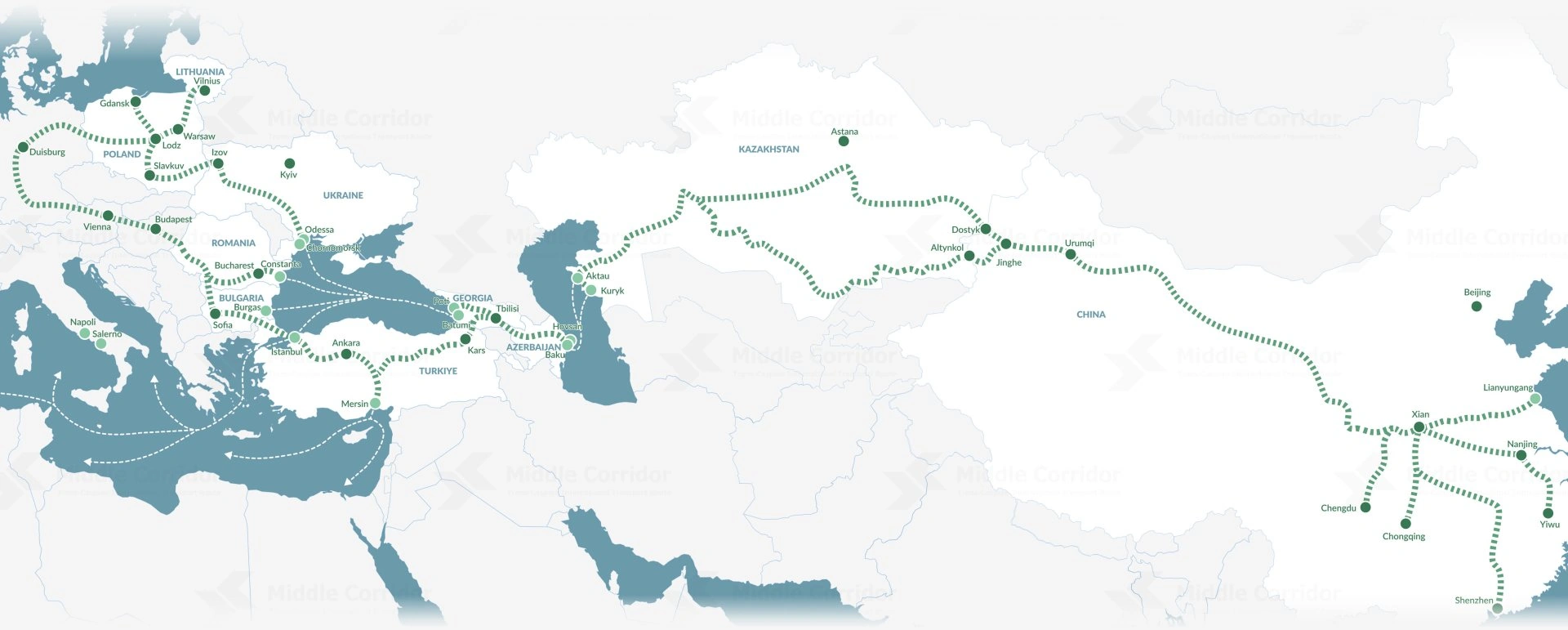
The Middle Corridor is a multimodal trade and transport route
connecting Asia and Europe through Central Asia, the Caspian Sea,
Azerbaijan, Georgia and Türkiye. The route begins in China and runs
through Central Asia before crossing the Caspian Sea and continuing
through Azerbaijan, Georgia and Türkiye to European markets.
The Middle Corridor is being developed as an alternative to
traditional northern and southern transport routes, providing
connectivity between Asian markets, including China, and Europe.
The World Bank says targeted investments and reforms along the
corridor could significantly increase trade volumes and reduce
travel times by 2040.