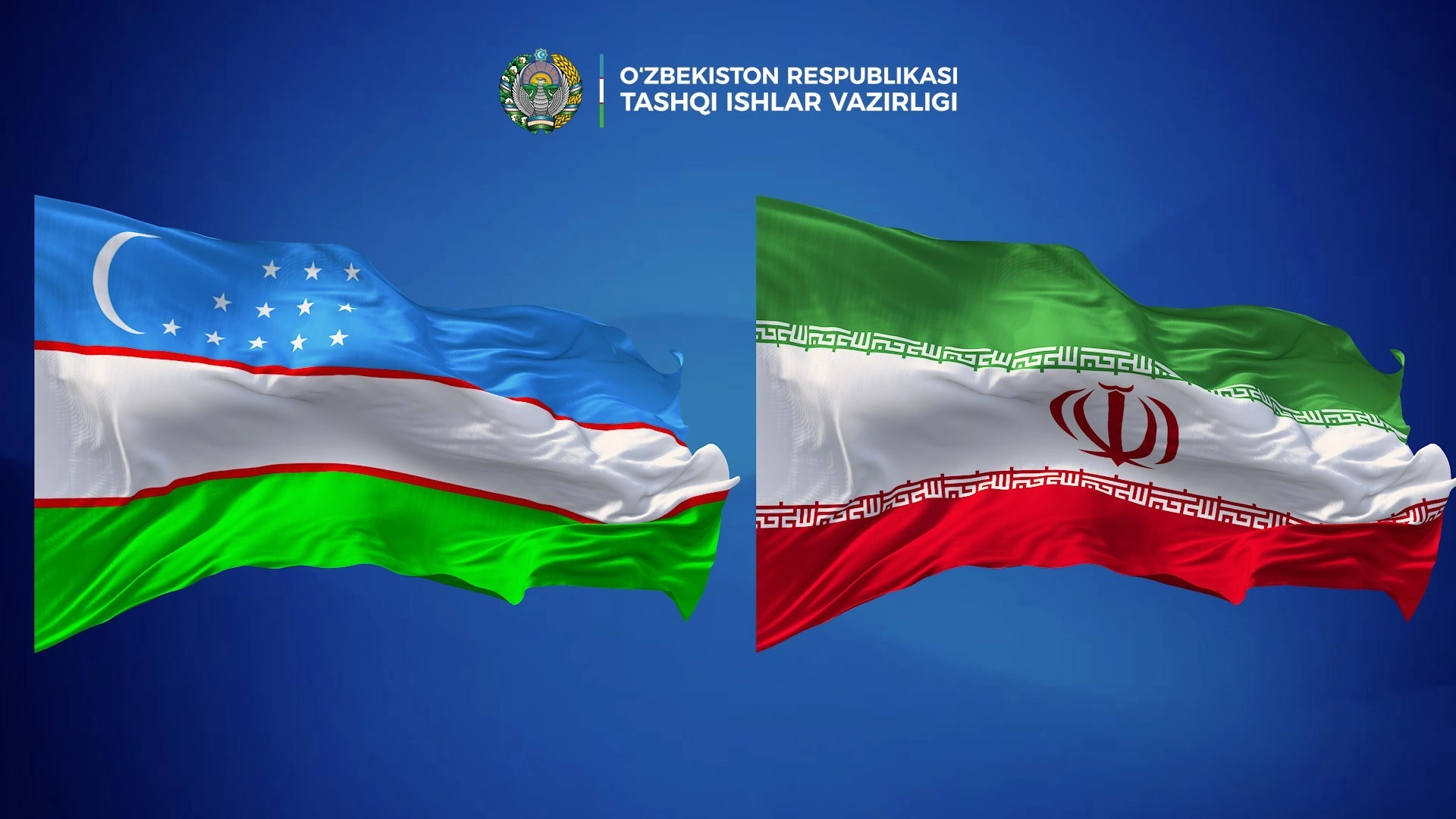
BAKU, Azerbaijan, September 1. Uzbekistan and
Iran are deepening economic ties through expanding bilateral trade,
a pipeline of joint investment projects and growing
business-to-business cooperation, while Iran's role as a transit
corridor gives the relationship broader significance for
Uzbekistan's international trade.
According to data in Uzbekistan's Fiscal Strategy 2027–2029,
Uzbekistan's trade turnover with Iran reached approximately $578
million in 2025. Uzbekistan exported $156.5 million worth of goods
and services to Iran, while imports from Iran amounted to $421.5
million, leaving Uzbekistan with a trade deficit of about $265
million.
The bilateral relationship has gained further momentum in 2026.
Trade between Uzbekistan and Iran reached $305 million in
January-June 2026, up 37.5% from the same period of 2025, according
to Uzbekistan's Ministry of Investment, Industry and Trade.
Trend's
calculations show that the first-half 2026 figure already
represents about 53% of the total bilateral trade recorded in 2025.
If trade were to continue at the same average monthly pace during
the second half of the year, annual turnover could reach roughly
$610 million, although this is a simple extrapolation rather than
an official forecast.
Investment cooperation is also becoming a more prominent part of
the relationship. Uzbekistan and Iran are currently promoting 29
joint projects, with the two sides seeking to expand investment and
industrial cooperation across areas of mutual interest.
The focus on business-level cooperation was further demonstrated
by a memorandum signed in August between the Jizzakh regional
Chamber of Commerce and Industry and Iran's Arak Chamber of
Commerce, Industries, Mines and Agriculture. The agreement provides
for business delegation exchanges, direct contacts between
entrepreneurs, joint investment projects and participation in trade
exhibitions and business events in both countries.
The two countries are also preparing for the 17th meeting of the
Uzbekistan-Iran Joint Intergovernmental Commission and the
Uzbekistan-Iran Business Forum, scheduled for November 26-27 in
Tashkent. The events are expected to focus on expanding bilateral
trade, advancing investment projects and identifying new areas for
business cooperation.
However, Iran's importance to Uzbekistan extends considerably
beyond direct bilateral trade. In 2025, about $1.4 billion of Uzbek
exports were transported through Iranian territory, equivalent to
roughly 10% of Uzbekistan's non-gold exports. At the same time,
around $3.9 billion of imports were transited through Iran,
accounting for approximately 9% of Uzbekistan's total imports.
Trend's calculations show that the value of Uzbek exports
transiting Iran was nearly nine times larger than Uzbekistan's
direct exports to Iran in 2025. Similarly, imports transiting
through Iran were more than nine times larger than direct imports
from Iran. This demonstrates that Iran's economic significance for
Uzbekistan is driven not only by bilateral commerce but also by its
role as a logistics and connectivity gateway.
In Trend's assessment, this dual role makes Iran particularly
important to Uzbekistan's efforts to diversify trade routes and
strengthen connections with markets beyond Central Asia. The scale
of transit flows suggests that improvements in logistics
infrastructure and the reliability of transport corridors through
Iran could have a considerably larger impact on Uzbekistan's trade
than growth in bilateral commerce alone.
At the same time, the structure of bilateral trade presents an
opportunity for Uzbekistan to increase exports to the Iranian
market. Uzbekistan's $265 million trade deficit with Iran in 2025
shows that bilateral trade remains heavily weighted toward imports.
Expanding Uzbek exports while developing joint production projects
could help address this imbalance. The emerging regional business
partnerships could support that objective. Cooperation between
Jizzakh and Arak, alongside the 29 joint projects being promoted at the national
level, creates channels for companies to move from conventional
trade toward joint manufacturing, investment and technology
cooperation.
Trend's analysis shows that the rapid growth in 2026 trade,
combined with the investment pipeline and upcoming business forum,
suggests that Uzbekistan-Iran economic relations are entering a
more practical phase. Rather than relying solely on
government-to-government agreements, the two countries are
increasingly seeking to connect companies directly and develop
projects with longer-term commercial value.
Overall, Uzbekistan-Iran economic ties are becoming broader than
their bilateral trade figures indicate. With trade rising 37.5% in
the first half of 2026, 29 joint projects in the pipeline and
billions of dollars in annual trade moving through Iranian
territory, Iran is emerging simultaneously as a market, investment
partner and critical transit route for Uzbekistan.